Cauvery Water Dispute and Inter-State Federalism
Source:Indian Express ↗
Why It Matters
The Cauvery water dispute is a classic case study of inter-state river water conflicts in India. It tests the efficacy of statutory and constitutional dispute resolution mechanisms (like tribunals and authorities under the Inter-State River Water Disputes Act), the impact of climate-induced water stress on federal relations, and highlights the geopolitical challenges of resource sharing between riparian states.
Summary
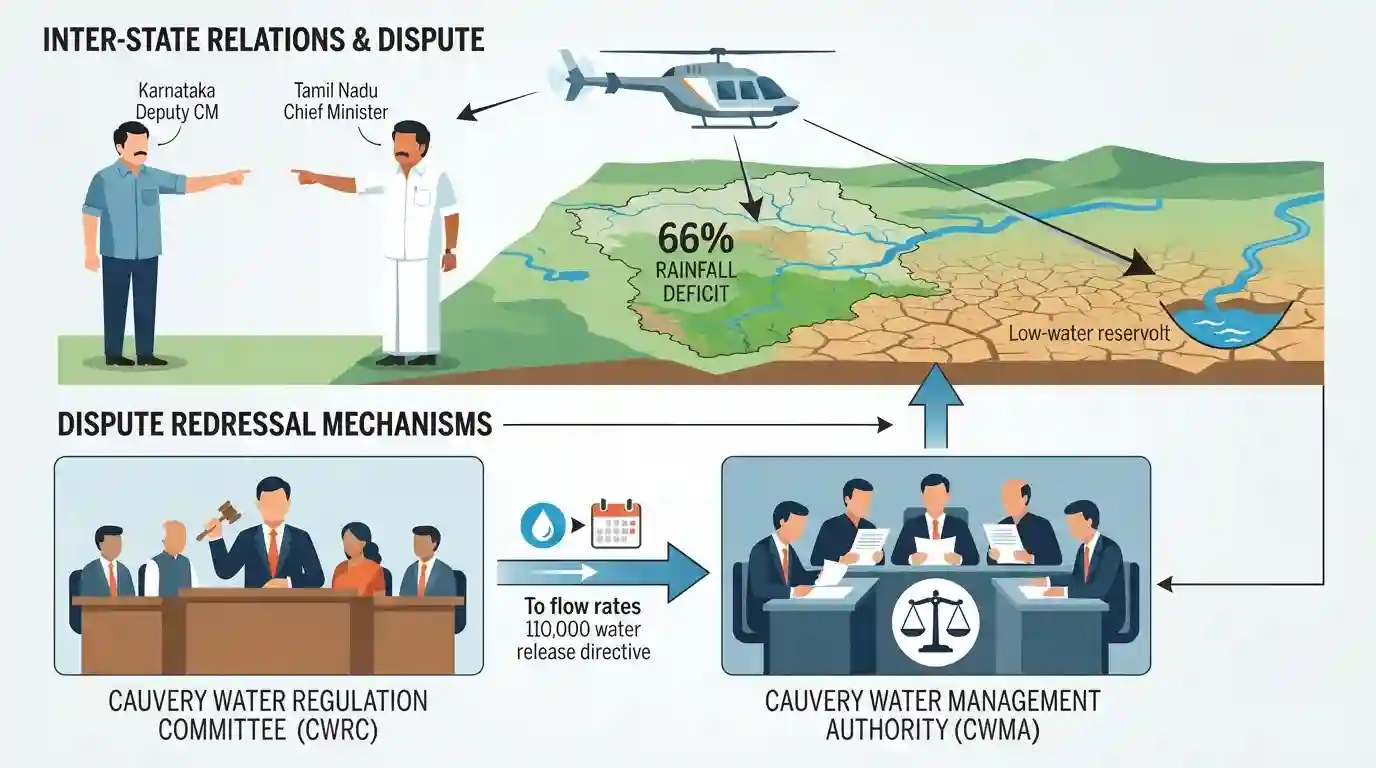
Amid escalating tensions over the sharing of Cauvery river water, Karnataka Deputy CM D K Shivakumar has invited Tamil Nadu Chief Minister Joseph Vijay to take a helicopter tour of the Cauvery basin. The gesture aims to demonstrate the severe ground reality of a 66% rainfall deficit in Karnataka's catchment areas. The invitation follows the Cauvery Water Regulation Committee's (CWRC) order requiring Karnataka to release 3,500 cusecs of water daily to Tamil Nadu for 15 days—a directive Karnataka intends to challenge before the Cauvery Water Management Authority (CWMA).
Key Points
- The Cauvery Water Regulation Committee (CWRC) has directed Karnataka to release 3,500 cusecs of Cauvery water daily to Tamil Nadu for a 15-day period.
- Karnataka authorities plan to appeal this directive to the Cauvery Water Management Authority (CWMA), asserting a 66% deficit in rainfall within the river's catchment areas.
- Karnataka Deputy CM D K Shivakumar has invited Tamil Nadu CM Joseph Vijay for a helicopter tour of the reservoirs to witness the severe water distress firsthand.
- The ongoing issue underscores the persistent challenges in inter-state water dispute resolution in India, particularly during years of monsoon failure or erratic climate patterns.
Important Terms
Cauvery Water Management Authority (CWMA)

A statutory body under the Ministry of Jal Shakti, constituted to monitor and implement the Supreme Court's 2018 judgment on Cauvery water-sharing among basin states.
UPSC context
GS Paper II (Inter-State Relations); tests understanding of statutory mechanisms resolving resource disputes in a federal structure.
Cauvery Water Regulation Committee (CWRC)
A technical committee operating under the CWMA that monitors reservoir levels, rainfall, and inflows to recommend daily or monthly water releases in the Cauvery basin.
UPSC context
GS Paper II (Administrative Bodies); tests role of expert sub-committees in facilitating cooperative federalism and resource monitoring.
Article 262 of the Indian Constitution
A constitutional provision empowering Parliament to legislate on the adjudication of inter-state river disputes, while enabling the exclusion of courts from such jurisdiction.
UPSC context
GS Paper II (Indian Constitution); tests knowledge of dispute resolution mechanisms and constitutional limits on judicial review.
Inter-State River Water Disputes Act, 1956
A parliamentary act enacted under Article 262 to set up tribunals for adjudicating conflicts over the use, distribution, and control of inter-state river waters.
UPSC context
GS Paper II (Statutory Acts); tests legislative schemes designed to resolve federal water-sharing conflicts in India.
Entry 56 of the Union List
A Seventh Schedule entry empowering the Union to regulate and develop inter-state rivers and river valleys when declared by Parliament to be in public interest.
UPSC context
GS Paper II (Seventh Schedule); tests federal distribution of legislative powers over water resources.
Prelims Trap
The Supreme Court has no constitutional authority to hear any appeals or petitions concerning inter-state water disputes once a Tribunal is formed.
While Article 262 permits Parliament to exclude Supreme Court jurisdiction, the Court can still hear appeals against Tribunal awards under Article 136 (Special Leave Petition).
Static Concepts Connected
What are the constitutional and statutory frameworks governing inter-state water disputes in India?
- Article 262: Empowers Parliament to legislate on the adjudication of disputes relating to waters of inter-state rivers or river valleys, excluding Supreme Court jurisdiction.
- ISWD Act, 1956: Enacted under Article 262; enables the Central Government to establish ad-hoc tribunals for water disputes when bilateral negotiations fail.
- CWMA and CWRC: Statutory bodies constituted under the Act to execute and monitor the Supreme Court’s final 2018 Cauvery judgment.
What geographical factors explain the Cauvery River's unique perennial flow?
- Dual monsoon regime: Upper basin is fed by the South-West monsoon, while the lower basin is fed by the retreating North-East monsoon.
- Left-bank tributaries: Hemavati, Shimsha, and Arkavati provide steady drainage from Karnataka's wet catchment areas.
- Right-bank tributaries: Kabini, Bhavani, and Amaravati contribute significant discharges, balancing seasonal volume drops in the lower basin.
Cross-Topic Patterns
Water federalism + Climate volatility
Erratic monsoons are shifting water disputes from legalistic allocations to ecological crises, testing federal cooperative institutions under severe climate distress.
Inter-state disputes + Article 136
The judiciary balances Article 262's exclusionary clauses with Article 136's extraordinary jurisdiction, defining the separation of powers in resource federalism.

UPSC may test the constitutional limits of SC jurisdiction under Article 262 alongside the statutory enforcement powers of the CWMA.
Linked PYQs · 5
Linked PYQs · 5
- 2019MainsGS1
What is water stress? How and why does it differ regionally in India?
- 2024MainsGS2
What changes has the Union Government recently introduced in the domain of Centre-State relations ? Suggest measures to be adopted to build the trust between the Centre and the States and for strengthening federalism.
- 2020MainsGS1
The interlinking of rivers can provide viable solutions to the multi-dimensional inter-related problems of droughts, floods and interrupted navigation. Critically examine.
- 2016PrelimsGS1
Recently, linking of which of the following rivers was undertaken?
- 2022PrelimsGS1
Gandikota canyon of South India was created by which one of the following rivers ?
