Kolkata Divya Kala Mela and Disability Rights Framework
Source:organiser ↗
Why It Matters
The article highlights key national initiatives (Divya Kala Mela and NAMASTE Scheme) aimed at the economic and social empowerment of marginalized communities, reflecting the constitutional ideal of a Welfare State and transitioning from welfare to rights-based approaches.
Summary
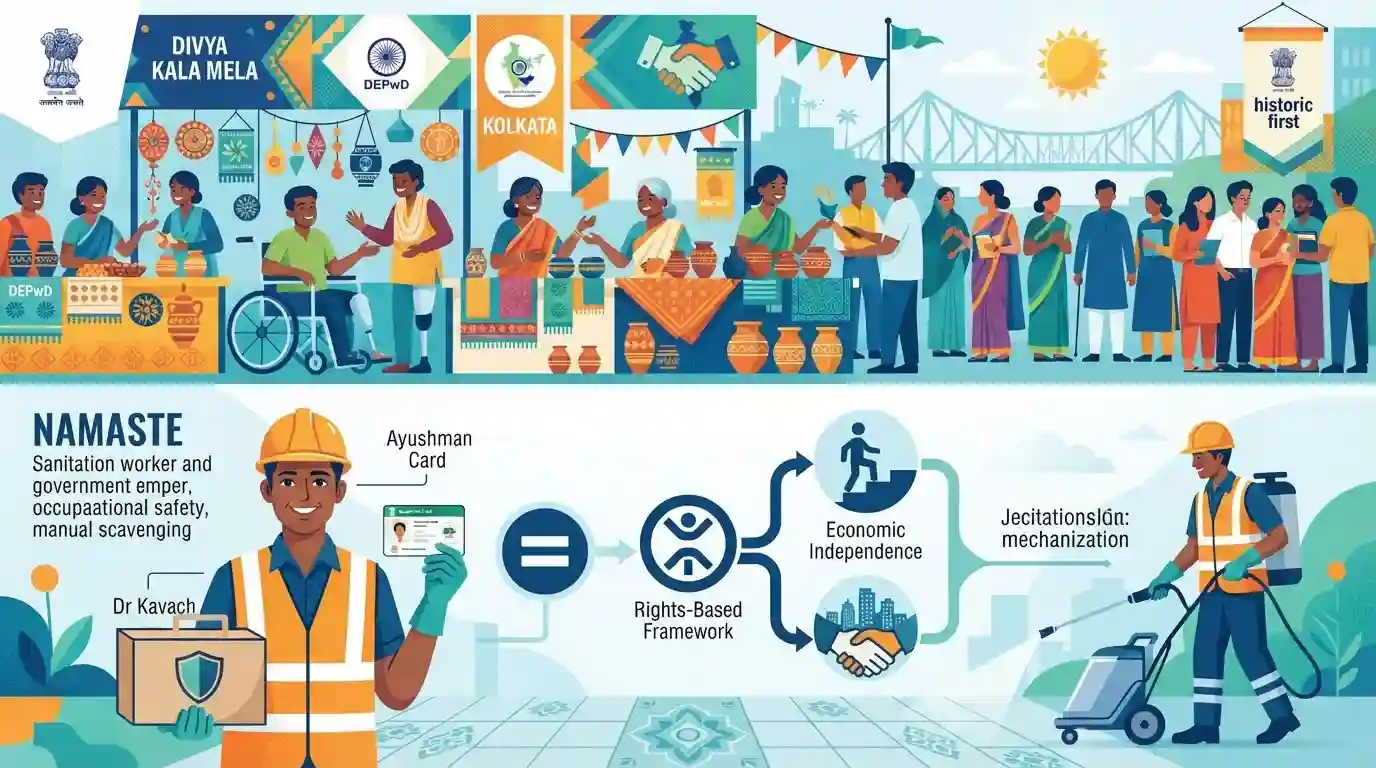
The 31st edition of the Divya Kala Mela, inaugurated in Kolkata, marks a historic first joint initiative between the Centre and the West Bengal government to empower persons with disabilities (Divyangjan). Organized by the Department of Empowerment of Persons with Disabilities (DEPwD), the eight-day event provides a platform for Divyang artisans and entrepreneurs to achieve economic independence and self-reliance. Emphasizing a shift from a welfare model to a rights-based framework, the government aims to ensure equal opportunities for all. Additionally, the event showcased the NAMASTE scheme, underscoring a commitment to the safety and dignity of sanitation workers through the distribution of protective equipment like 'Dr Kavach' kits and Ayushman Cards.
Key Points
- The 31st Divya Kala Mela in Kolkata is the first joint initiative by the Centre and the West Bengal government aimed at empowering Divyangjan.
- Organized by the DEPwD, the event provides artisans with disabilities a platform to showcase their products, promoting entrepreneurship and self-reliance.
- Union Minister Dr. Virendra Kumar highlighted a policy shift from welfare-oriented assistance to a rights-based framework for persons with disabilities.
- The NAMASTE scheme was also highlighted, focusing on the safety, dignity, and social security of sanitation workers through mechanized cleaning and protective gear.
- Sanitation workers received PPE kits, Ayushman Cards, and 'Dr Kavach' safety kits as part of efforts to improve occupational health and eliminate hazardous manual cleaning.
Important Terms
Divya Kala Mela

A nationwide exhibition organized by the DEPwD to showcase and market products made by Divyang (disabled) artisans and entrepreneurs, promoting their economic independence and self-reliance.
UPSC context
GS Paper 2 (Social Justice). Tests awareness of government initiatives empowering vulnerable sections and persons with disabilities.
NAMASTE Scheme
The National Action for Mechanised Sanitation Ecosystem scheme ensures the safety, dignity, and socio-economic security of sanitation workers through mechanized cleaning, PPE distribution, and health insurance.
UPSC context
GS Paper 2 (Social Justice). Highly relevant for issues concerning occupational hazard eradication and sanitation worker welfare.
National Overseas Scholarship Scheme for persons with disabilities
A Central Sector Scheme that annually selects 20 students with disabilities to pursue higher education at reputed universities abroad, promoting academic excellence and international exposure.
UPSC context
GS Paper 2 (Education/Welfare Schemes). Important for understanding targeted educational empowerment initiatives for Divyangjan.
Department of Empowerment of Persons with Disabilities (DEPwD)
A specialized department under the Ministry of Social Justice and Empowerment tasked with facilitating the empowerment, inclusion, and welfare of persons with disabilities in India.
UPSC context
GS Paper 2 (Governance/Institutions). Crucial for knowing the nodal agencies executing disability-related policies and rights-based frameworks.
Ministry of Social Justice and Empowerment
The Union government ministry responsible for the welfare, social justice, and empowerment of disadvantaged and marginalized groups, including scheduled castes, backward classes, and Divyangjan.
UPSC context
GS Paper 2 (Polity/Governance). Core knowledge for identifying which ministry governs key schemes like NAMASTE and Divya Kala Mela.
Prelims Trap
The NAMASTE scheme is solely implemented by the Ministry of Social Justice and Empowerment.
It is a joint initiative between the Ministry of Social Justice & Empowerment (MoSJE) and the Ministry of Housing & Urban Affairs (MoHUA).
Static Concepts Connected
How does the RPwD Act 2016 establish a rights-based framework for disabilities?
- Expanded Definition: Increased recognized disabilities from 7 to 21, adding conditions like acid attack victims, Parkinson's disease, and specific learning disabilities.
- Job Reservation: Increased reservation in government establishments for persons with benchmark disabilities from 3% to 4%.
- UNCRPD Alignment: Shifts from a charity-based welfare model to an empowerment approach, fulfilling India's obligations under the UN Convention (UNCRPD).
What are the core pillars of the NAMASTE Central Sector Scheme?
- Zero Fatalities: Aims to completely eradicate hazardous manual cleaning of sewers and septic tanks, targeting zero fatalities in sanitation work.
- Dual Ministry: Jointly implemented by the Ministry of Social Justice & Empowerment and the Ministry of Housing & Urban Affairs.
- Holistic Security: Profiles Safai Mitras for occupational safety training, capital subsidies for machinery, PPE distribution, and Ayushman Bharat health insurance integration.
Cross-Topic Patterns
Cooperative Federalism in Welfare
The rare Centre-West Bengal collaboration on Divya Kala Mela illustrates cooperative federalism overriding regional political differences for vulnerable sector empowerment.
Sanitation and Formalization
Providing PPE and Ayushman cards to sewer workers reflects the broader UPSC theme of formalizing the informal economy through targeted social security nets and occupational safety regulations.

Integration of NAMASTE with Ayushman Bharat and its dual-ministry nodal structure makes it a prime target for multi-statement Prelims.
Linked PYQs · 2
Linked PYQs · 2
- 2019WBCS_PRELIMSGS1
The Constitution Bill (123rd Amendment), 2017 deals with
- 2019WBCS_PRELIMSGS1
The ideal of 'Welfare State' in the Indian Constitution in enshrined in its
