Political Polarization and Democratic Challenges in the United States
Source:The Hindu ↗
Why It Matters
The political polarization and shift towards protectionism in the US, a global superpower, have direct implications for global supply chains, international trade, and India's strategic interests. Furthermore, the US serves as a core case study for comparative constitutional politics (e.g., the Second Amendment vs. Indian fundamental rights) and the functioning of large democracies.
Summary
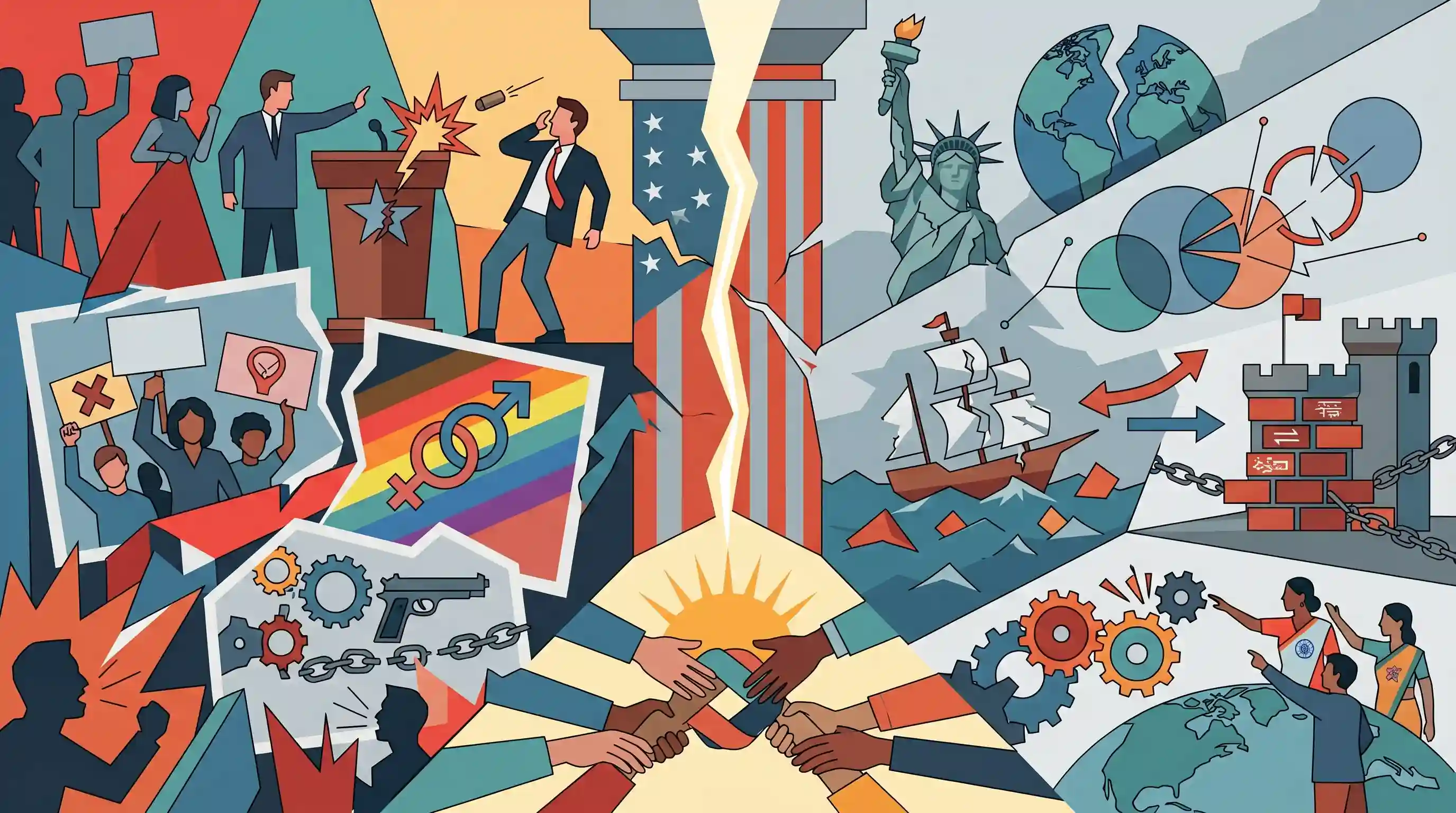
The editorial examines the profound political and social polarization in the United States, underscored by the recent shooting of conservative commentator Charlie Kirk. This incident highlights deep partisan divides over fundamental cultural and constitutional issues, including abortion, LGBTQ rights, and the Second Amendment. Furthermore, the article observes that the US's global standing as a beacon of democracy and champion of a rules-based international order is increasingly challenged by rising domestic nativism, protectionist tariff policies, and the steady erosion of the Washington Consensus. Bridging this fractured polity and repairing its international posture will require enlightened, bipartisan leadership capable of finding a middle ground.
Key Points
- The shooting of conservative commentator Charlie Kirk underscores the intense political polarization and deep-seated "culture war" in the US.
- The US polity is sharply divided across partisan lines on fundamental issues, including abortion rights, LGBTQ rights, and the Second Amendment right to bear arms.
- Despite numerous attempts, such as 17 pushes during the Obama administration, the US has failed to enact "common sense" gun control reform, allowing a toxic gun culture to persist.
- The US's global image as a beacon of democracy and a proponent of the rules-based international order is eroding due to a shift towards nativism and protectionist tariff policies that challenge the Washington Consensus.
Important Terms
Second Amendment (U.S. Constitution)

A provision of the U.S. Bill of Rights (1791) that protects the right of individuals to keep and bear arms for self-defense and militia service.
UPSC context
GS Paper 2: Comparative Constitutions. Tested for contrasting U.S. individual rights with India’s reasonable restrictions and absence of a constitutional right to bear arms.
Washington Consensus
A set of neoliberal economic policy prescriptions (e.g., privatization, trade liberalization, fiscal discipline) advocated by the IMF and World Bank for developing countries since 1989.
UPSC context
GS Paper 2 & 3: International Institutions and Economic Liberalization. Relates to India’s 1991 reforms and the shift toward state-led development models.
Rules-based International Order
A system of global governance based on established laws, norms, and multilateral institutions (UN, WTO) designed to ensure predictable relations and peaceful dispute resolution between nations.
UPSC context
GS Paper 2: International Relations. Crucial for discussing global stability, the crisis of multilateralism, and India’s role as a "responsible stakeholder."
Protectionism
An economic policy of restricting imports through tariffs, quotas, or subsidies to shield domestic industries from foreign competition.
UPSC context
GS Paper 3: Effects of Liberalization. Important for analyzing global trade wars, Deglobalization, and their impact on India’s export-led growth.
Nativism
A political policy or ideology prioritizing the interests of native-born citizens over those of immigrants, often manifesting as opposition to immigration and multiculturalism.
UPSC context
GS Paper 1 & 2: Social Issues and Political Theory. Relevant for understanding the "sons of the soil" doctrine and global shifts toward identity politics.
Prelims Trap
The right to bear arms is an implied fundamental right under Article 21 of the Indian Constitution for self-defense.
Unlike the US Second Amendment, bearing arms in India is strictly a statutory privilege regulated by the Arms Act, 1959, not a constitutional or fundamental right.
Static Concepts Connected
How do US and Indian constitutional frameworks differ on individual rights?
- Gun Rights: The US Second Amendment makes bearing arms a constitutional right. In India, it is merely a statutory privilege regulated under the Arms Act, 1959.
- Due Process: The US Constitution explicitly uses 'Due Process'. India relies on 'Procedure Established by Law', though the Supreme Court has expanded it to include due process elements.
- Reproductive Rights: US abortion laws vary drastically by state post-Roe v. Wade, while India offers uniform federal protection through the Medical Termination of Pregnancy Act.
What is the Washington Consensus and why is it eroding?
- Core Philosophy: Coined in 1989, it advocates for neoliberal, free-market policies like deregulation, privatization, and free trade, traditionally backed by the IMF and World Bank.
- Current Erosion: It is unravelling as Western nations, particularly the US, increasingly reject free-trade orthodoxy in favor of protectionist tariffs, industrial subsidies, and economic nationalism.
Cross-Topic Patterns
Washington Consensus + WTO Appellate Crisis
The US shift towards economic nationalism and tariffs actively undermines the WTO's dispute resolution mechanism, a key pillar of the rules-based international order India heavily relies upon.
Judicial Interpretation + LGBTQ Rights
Polarization over the US 14th Amendment contrasts with the progressive evolution of India's Article 14, where the Supreme Court has actively expanded protections for minority and LGBTQ communities.

The erosion of the Washington Consensus and the rise of Western protectionism is a prime candidate for a GS3 Mains question in 2026.
Linked PYQs · 5
Linked PYQs · 5
- 2018MainsGS2
India and USA are two large democracies. Examine the basic tenets on which the two political systems are based.
- 2024MainsGS2
Discuss India as a secular state and compare with the secular principles of the US constitution.
- 2025MainsGS3
What are the challenges before the Indian economy when the world is moving away from free trade and multilateralism to protectionism and bilateralism? How can these challenges be met?
- 2018MainsGS3
How would the recent phenomena of protectionism and currency manipulations in world trade affect macroeconomic stability of India?
- 2016MainsGS2
The broader aims and objectives of WTO are to manage and promote international trade in the era of globalization. But the Doha round of negotiations seem doomed due to differences between the developed and the developing countries." Discuss in the Indian perspective.
