India Merchandise Export Diversification and Services Sector Growth
Source:The Hindu ↗
Why It Matters
Provides crucial, data-backed insights into India's current account dynamics, specifically highlighting the balance between merchandise and services exports. It links geopolitical events (West Asia) and domestic consumption trends (gold imports) to broader macroeconomic stability, which is vital for GS3 Economy answers.
Summary
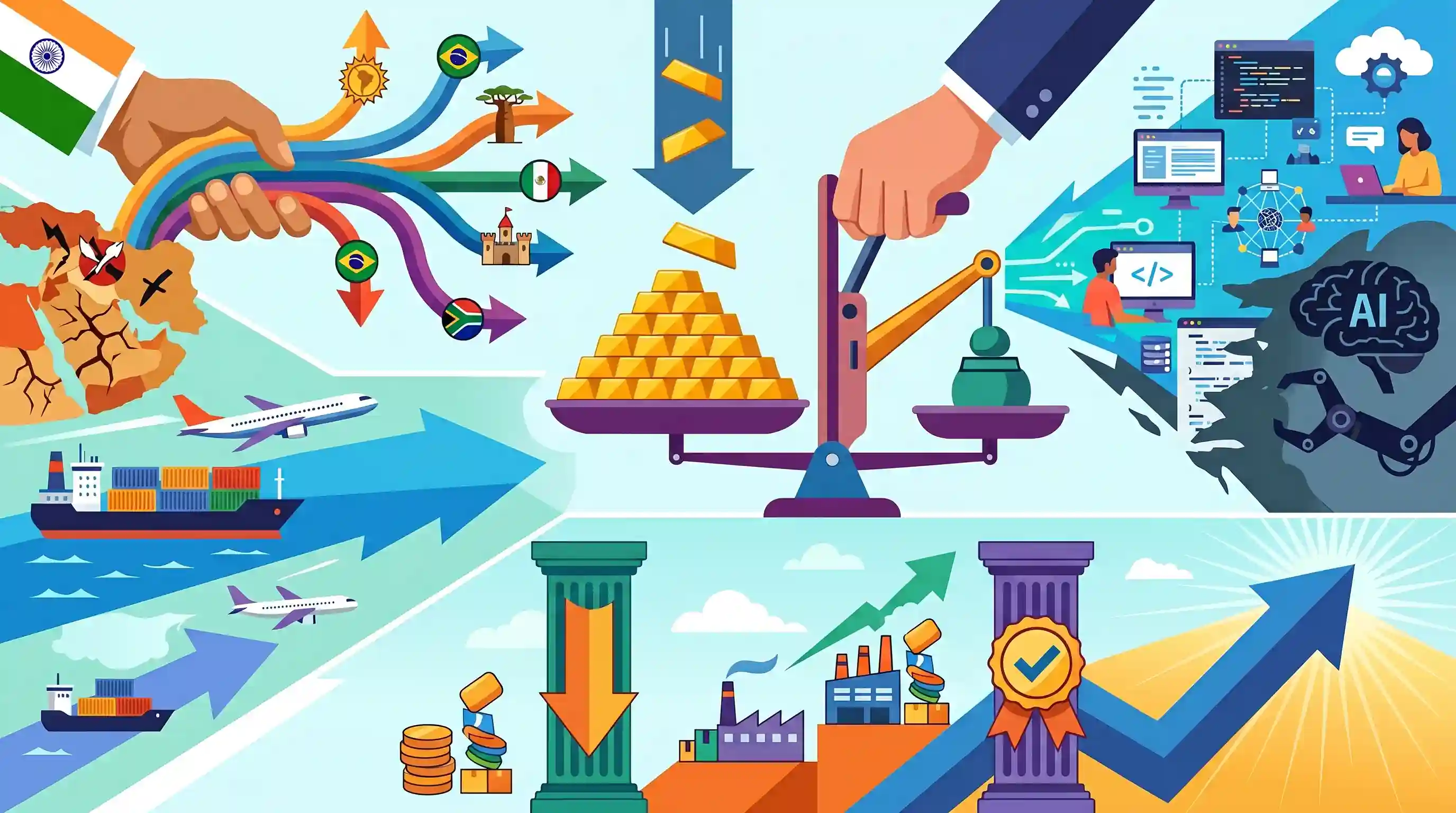
An analysis of India's recent export performance reveals significant gains from merchandise trade diversification across new global markets, mitigating the negative impacts of the West Asia crisis. While merchandise export growth outpaced overall imports, a concerning surge in gold imports required government intervention to stabilize the macroeconomic situation. The article also highlights the growing dominance of services in India's export basket, warning that AI-driven disruptions could threaten IT services. To ensure long-term resilience, India must move beyond diversification and aggressively improve the underlying cost, scale, and quality competitiveness of its manufacturing and export sectors.
Key Points
- India's merchandise exports saw strong growth in April 2026, driven by both price realization and successful geographic diversification into new markets.
- Merchandise export growth outpaced import growth, though an 82% spike in gold imports prompted government intervention via import duty hikes.
- Trade with West Asia contracted sharply due to ongoing geopolitical crises, underscoring the risks of regional instability to India's trade.
- The services sector now accounts for nearly half of India's total exports, though the rise of Artificial Intelligence poses a potential threat to traditional IT services.
- Despite gains from diversification and FTAs, India must improve its manufacturing competitiveness in cost, scale, and quality to sustain export growth.
Important Terms
Balance of Payments (BoP)

A comprehensive record of all economic transactions between a country's residents and the rest of the world, encompassing trade in goods, services, and capital flows.
UPSC context
GS Paper 3 (Economy); vital for analyzing macroeconomic stability, foreign exchange reserves, and trade deficits.
World Trade Organization (WTO)
The only global international organization dealing with the rules of trade between nations, ensuring trade flows smoothly, predictably, and freely through negotiated agreements.
UPSC context
GS Paper 3 (Economy); tests knowledge of multilateral trade rules, dispute settlement, and India’s trade interests.
Free Trade Agreements (FTAs)
Treaties between two or more countries to reduce or eliminate trade barriers like tariffs and quotas, facilitating easier cross-border movement of goods and services.
UPSC context
GS Paper 3 (Economy) & GS 2 (IR); central to India's export strategy and bilateral economic diplomacy.
Services Exports
The export of 'invisible' items like software, consultancy, and business processes. India typically maintains a surplus here, which helps offset its merchandise trade deficit.
UPSC context
GS Paper 3 (Economy); critical as services contribute over 50% to India's GDP and dominate the export basket.
Merchandise Exports
The export of tangible physical goods (e.g., machinery, gems, or fuel). India aims to increase its global share here to boost manufacturing and employment.
UPSC context
GS Paper 3 (Economy); essential for understanding trade diversification, 'Make in India,' and the current account deficit.
Information Technology (IT) Sector
A dominant segment of India's services sector, focused on software development and outsourcing, currently facing shifts due to automation and artificial intelligence.
UPSC context
GS Paper 3 (Economy/S&T); tests impact of technology on services-led growth and global export competitiveness.
Prelims Trap
India currently enjoys an overall trade surplus driven by recent merchandise export diversification.
India runs a persistent merchandise trade deficit. While the services sector generates a massive surplus, the combined overall trade balance often remains in a deficit.
Static Concepts Connected
What are the key components of India's Current Account in the BoP?
- Merchandise Trade: Visible trade encompassing export and import of physical goods. India consistently runs a deficit here due to high oil and gold import bills.
- Services Trade: Invisible trade including software, consulting, and travel. India maintains a robust surplus in this category, heavily driven by IT exports.
- Transfer Payments: Unilateral transfers like remittances, gifts, and grants. India is the global top recipient of remittances, aiding the current account.
- Income Balance: Primary income encompassing profits, interest, and dividends. This is typically a deficit category due to outward remittance of corporate profits.
How do FTAs and CECA/CEPAs differ in international trade diplomacy?
- FTAs: Free Trade Agreements primarily focus on reducing or eliminating tariffs on a defined list of merchandise goods between partner nations.
- CECA/CEPA: Comprehensive Economic Cooperation/Partnership Agreements are wider in scope, covering trade in goods, services, investments, intellectual property, and competition.
Cross-Topic Patterns
Gold imports + Macroeconomic stability
Surging gold imports widen the CAD, which depreciates the Rupee and forces the RBI to intervene via forex sales, directly linking trade dynamics to domestic monetary stability.
AI disruption + IT Services exports
The transition from traditional BPO/IT services to AI-automated workflows threatens India's 'invisible' earnings, requiring an urgent policy pivot toward deep-tech and hardware manufacturing.

Expect a 2026 prelims question merging India's shifting export basket (services parity) with the CAD impact of gold and oil imports.
Linked PYQs · 4
Linked PYQs · 4
- 2015MainsGS3
Craze for gold in Indians has led to a surge in import of gold in recent years and put pressure on balance of payments and external value of rupee. In view of this, examine the merits of the Gold Monetization Scheme.
- 2020PrelimsGS1
With reference to the international trade of India at present, which of the following statements is/are correct? 1. India's merchandise exports are less than its merchandise imports. 2. India's imports of iron and steel, chemicals, fertilisers and machinery have decreased in recent years. 3. India's exports of services are more than its imports of services. 4. India suffers from an overall trade/current account deficit. Select the correct answer using the code given below:
- 2017MainsGS3
Account for the failure of manufacturing sector in achieving the goal of labour-intensive exports. Suggest measures for more labour-intensive rather than capital-intensive exports.
- 2023PrelimsGS1
Consider the following statements: Statement-I: India accounts for 3.2% of global export of goods. Statement-II: Many local companies and some foreign companies operating in India have taken advantage of India's 'Production-linked Incentive' scheme. Which one of the following is correct in respect of the above statements?
