Illegal rat hole mining persists despite environmental bans
Source:The Hindu ↗
Why It Matters
Provides a critical case study of the challenges in enforcing environmental laws against deeply entrenched informal economies and illegal mining operations, relevant for environment, geography, and governance segments in Mains.
Summary
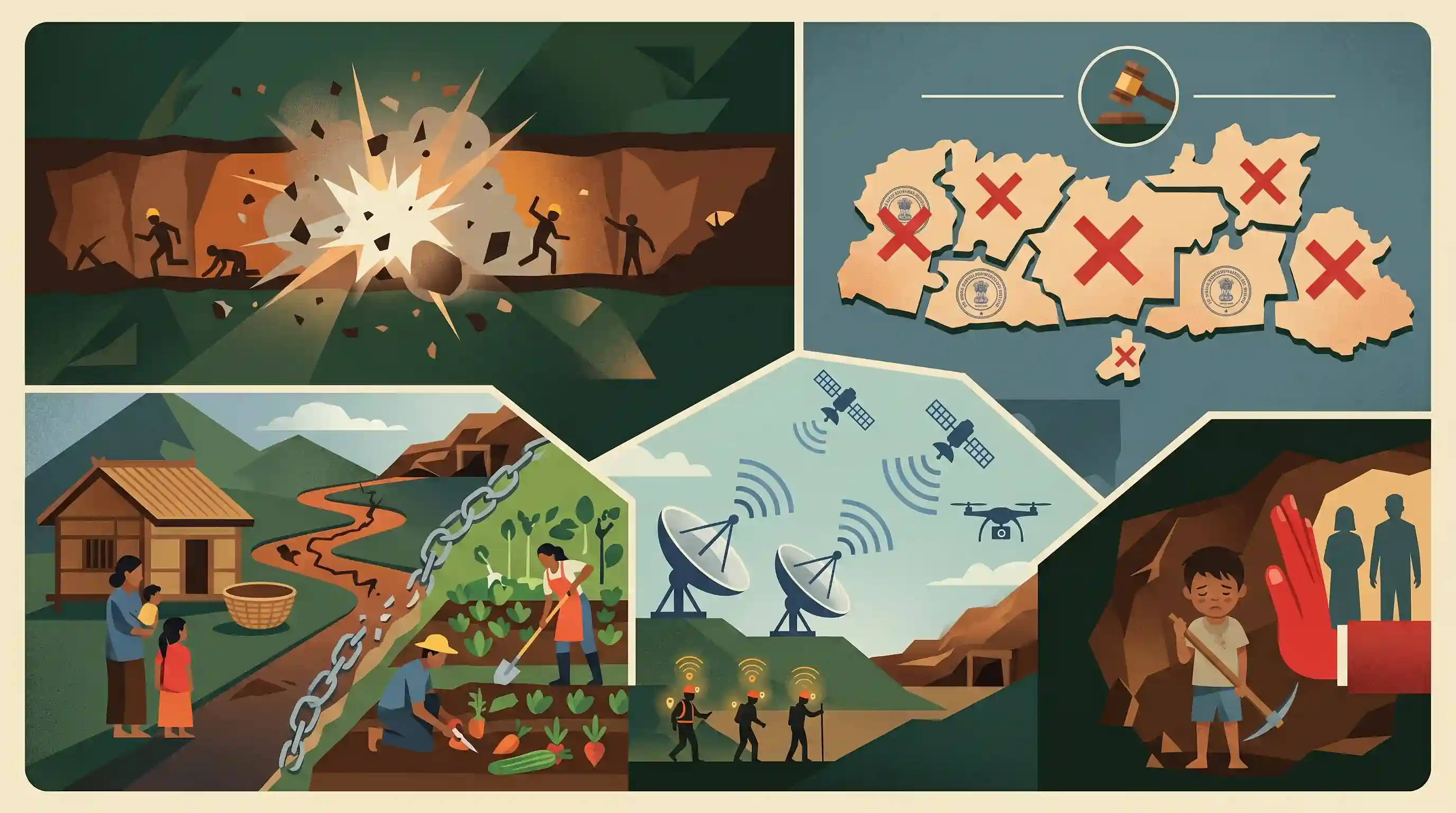
The editorial explores the persistent issue of illegal rat-hole coal mining in Meghalaya, highlighted by a recent explosion that killed 18 workers. Despite a 2014 National Green Tribunal ban and regulations under the MMDR Act, the practice continues due to complex socio-economic dependence, fragmented land ownership, and weak enforcement. The article proposes technological solutions like GPS tracking, integrating satellite data, addressing child labour, and building alternative livelihoods to break the cycle of illegal mining.
Key Points
- An explosion at an illegal coal mine in East Jaintia Hills killed 18 workers, emphasizing the recurring tragedy of rat-hole mining in Meghalaya.
- Despite the National Green Tribunal's 2014 ban, illegal mining persists due to the region's unique geography (thin coal seams) and fragmented private/community ownership.
- Operators maintain an opaque supply chain, often avoiding safety records and sometimes employing child labour to navigate the narrow mining shafts.
- Enforcement of the Mines and Minerals (Development and Regulation) (MMDR) Act remains weak due to a deep socio-economic dependence on mining income and limited local alternatives.
- The article suggests robust technological interventions, such as GPS tracking for carriers and drone mapping, alongside creating alternative livelihoods in horticulture and eco-tourism.
Important Terms
Rat-hole Mining

A primitive, unscientific coal extraction method involving narrow tunnels manually dug into hills. It is extremely hazardous for miners and leads to severe environmental degradation.
UPSC context
GS-III (Environment/Disaster Management); tests awareness of informal mining hazards and the challenges of enforcing environmental bans.
National Green Tribunal (NGT)
A specialized statutory body established in 2010 to expedite cases related to environmental protection, forest conservation, and compensation for damages caused by environmental violations.
UPSC context
GS-II (Statutory Bodies) & GS-III (Environment); tests understanding of environmental jurisprudence and judicial oversight of resource extraction.
MMDR Act
The primary legislation (1957) regulating India's mining sector, detailing processes for obtaining mineral leases and ensuring systematic development and environmental protection during extraction.
UPSC context
GS-II (Governance) & GS-III (Resources); tests knowledge of mineral resource management laws and recent legislative reforms for transparency.
Sixth Schedule
Constitutional provisions (Articles 244(2) and 275(1)) that grant significant autonomy to tribal areas in Assam, Meghalaya, Tripura, and Mizoram to protect their unique culture and land.
UPSC context
GS-II (Polity/Constitution); tests understanding of tribal self-governance, land ownership rights, and special administrative status in Northeast India.
Autonomous District Councils (ADCs)
Elected bodies established under the Sixth Schedule with legislative, executive, and judicial powers over subjects like land, forests, and social customs in tribal districts.
UPSC context
GS-II (Polity/Governance); tests knowledge of decentralized governance and the jurisdictional overlap between local councils and central laws.
District Mineral Foundation (DMF)
A statutory non-profit trust established under the MMDR Act to implement welfare projects for communities and areas specifically affected by mining operations.
UPSC context
GS-III (Social Justice/Economy); tests knowledge of welfare mechanisms meant to mitigate the social impact of resource extraction.
Prelims Trap
Due to the Sixth Schedule, tribal communities in Meghalaya are exempt from the MMDR Act for coal mining.
The Supreme Court clarified in 2019 that while tribal landowners own the sub-surface minerals, extraction must still strictly comply with the central MMDR Act and environmental laws.
Static Concepts Connected
What is Acid Mine Drainage (AMD) and how does it affect ecosystems?
- Formation: Sulfide minerals (like pyrite) in coal react with oxygen and water to produce sulfuric acid.
- Water Acidification: It severely lowers the pH of local rivers (e.g., Lukha and Kopili in Meghalaya), making the water highly acidic and toxic.
- Heavy Metal Leaching: The acidic water leaches heavy metals (lead, arsenic) from rocks, devastating aquatic life and rendering groundwater unfit for consumption.
Who owns sub-surface minerals in Sixth Schedule areas like Meghalaya?
- Customary Ownership: Unlike most of India where the state owns minerals, tribal landholders/communities in Meghalaya possess customary ownership over both the land and subterranean minerals.
- Regulatory Supremacy: Ownership does not grant unregulated mining rights. The Supreme Court ruled that all extraction must operate within the statutory framework of the MMDR Act.
Cross-Topic Patterns
NGT bans vs. Sixth Schedule autonomy
The friction between central environmental regulations (NGT bans, MMDR) and Sixth Schedule customary land rights is a recurring Mains GS2/GS3 theme concerning tribal autonomy versus ecological protection.
Coal phase-down and 'Just Transition'
Eliminating illegal mining requires alternative livelihoods, perfectly illustrating the global COP framework of a 'Just Transition' for communities economically dependent on fossil-fuel extraction.

Expect a Prelims question merging Meghalaya's tertiary coal geology (thin seams) with Sixth Schedule mineral rights and MMDR applicability.
Linked PYQs · 3
Linked PYQs · 3
- 2013MainsGS3
What are the consequences of Illegal mining ? Discuss the Ministry of Environment and Forests' concept of GO AND NO GO zones for coal mining sector.
- 2017MainsGS1
In spite of adverse environmental impact, coal mining is still inevitable for development." Discuss.
- 2025MainsGS3
Mineral resources are fundamental to the country's economy and these are exploited by mining. Why is mining considered an environmental hazard? Explain the remedial measures required to reduce the environmental hazard due to mining.
