Meghalaya Rat-Hole Mining Ban Violations and Environmental Safety
Source:The Hindu ↗
Why It Matters
It illustrates the limitations of judicial bans without structural socio-economic solutions, providing a critical case study for questions on environmental degradation, illegal mining consequences, and resource governance in Northeast India.
Summary
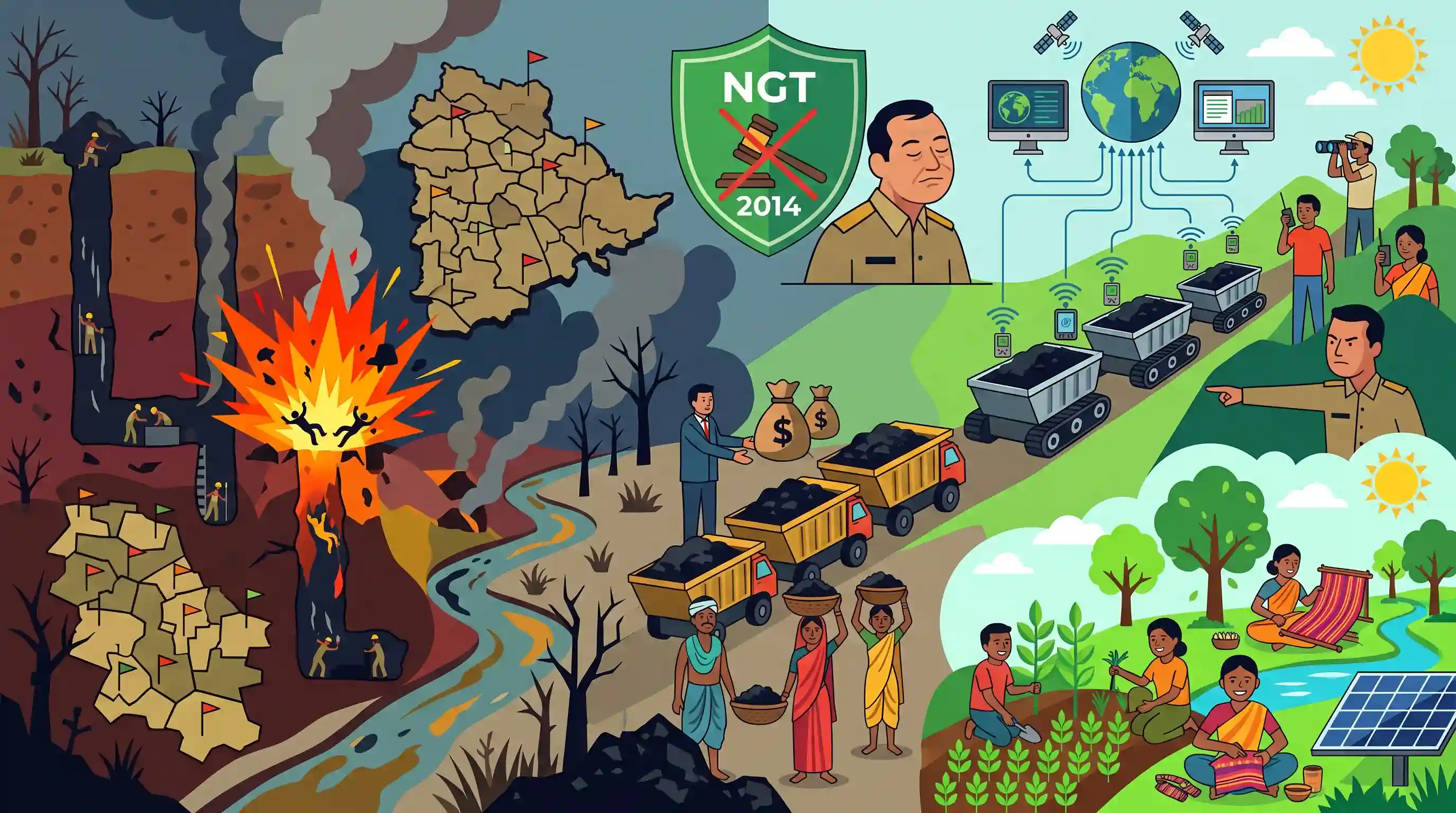
An explosion in a rat-hole coal mine in Meghalaya that killed 18 workers highlights the ongoing crisis of illegal mining, persisting despite a 2014 NGT ban. The article explains how fragmented community landholdings, weak enforcement, and local reliance on coal income enable the practice. It advocates for technological tracking of coal carriers, community-based monitoring, breaking administrative complacency, and creating alternative livelihoods to sustainably end the hazard.
Key Points
- A February 5 explosion in a Meghalaya rat-hole mine killed at least 18 workers, underscoring the persistence of illegal mining despite a 2014 National Green Tribunal ban.
- The region's unique ecosystem of community landholdings, fragmented ownership, and local dependence on coal income severely complicates regulatory enforcement.
- Social and environmental costs are severe, including unreported worker injuries, child labour usage, acid mine drainage, polluted water bodies, and landscape instability.
- Technological interventions such as mandatory GPS tracking for coal carriers and drone patrols are recommended to prevent illegal coal from being laundered into legal supply chains.
- The article emphasizes creating alternative livelihoods in horticulture, manufacturing, and tourism, along with making illegal mining socially expensive through community monitoring.
Important Terms
Rat-hole Mining

A hazardous, manual method of extracting coal by digging narrow horizontal tunnels (3–4 feet high). It is prevalent in Meghalaya due to thin coal seams and persists despite being banned for safety risks.
UPSC context
GS III (Environment & Economy). Tests knowledge of illegal resource extraction, occupational safety, and regional geographical challenges in mining.
National Green Tribunal (NGT)
A specialized statutory body established under the NGT Act (2010) for the effective and expeditious disposal of cases relating to environmental protection and conservation of forests.
UPSC context
GS II (Governance) & III (Environment). Key for environmental jurisprudence and quasi-judicial enforcement.
Mines and Minerals (Development and Regulation) Act (MMDR Act)
The principal central legislation (1957) governing India's mining sector. It regulates mineral concessions, leases, and mandates sustainable development and environmental protection during extraction.
UPSC context
GS II & III. Critical for understanding the legal framework of resource management and federal mining powers.
Sixth Schedule
Constitutional provisions (Articles 244(2) and 275(1)) granting autonomy to tribal areas in Northeast India. It empowers Autonomous District Councils (ADCs) to make laws regarding land and mineral royalties.
UPSC context
GS II (Polity). Important for tribal rights, federalism, and the governance of Fifth/Sixth Schedule areas.
District Mineral Foundation (DMF)
A statutory non-profit trust established in mining-affected districts under the MMDR (Amendment) Act, 2015. It uses a portion of mining royalties for the welfare of local communities.
UPSC context
GS II & III. Tests knowledge of social welfare in resource-rich zones and the PMKKKY scheme.
Prelims Trap
"The State government holds exclusive ownership of all subsurface minerals in Sixth Schedule areas."
In Meghalaya, indigenous communities and individuals have customary rights over land and subsurface minerals, creating a unique regulatory clash with central mining laws.
Static Concepts Connected
How does the Sixth Schedule impact mineral ownership in Meghalaya?
- Customary Rights: Unlike most of India, land and subsurface minerals in Meghalaya are historically owned by individuals or communities.
- Regulatory Clash: This private/community ownership complicates the enforcement of central legislations like the Coal Mines (Nationalisation) Act and the MMDR Act.
- Role of ADCs: Autonomous District Councils (ADCs) regulate local land use, which frequently conflicts with state and central environmental mandates.
What is Acid Mine Drainage (AMD) caused by unscientific coal mining?
- Chemical Formation: It occurs when sulfide minerals in exposed coal veins react with oxygen and water to form highly corrosive sulfuric acid.
- Heavy Metal Leaching: The highly acidic water dissolves and leaches toxic heavy metals (like lead and arsenic) from surrounding rocks into groundwater.
- Ecological Destruction: It drastically lowers the pH of local rivers (e.g., Lukha and Myntdu in Meghalaya), wiping out aquatic life.
Cross-Topic Patterns
Sixth Schedule vs Environmental Governance
The conflict between indigenous land/mineral ownership under the Sixth Schedule and national environmental laws (MMDR Act, EPA) limits the effectiveness of central bans in the Northeast.
Narrow tunnels & child labour exploitation
The physical constraints of rat-hole mines (3-4 feet high) explicitly drive the demand for child labour, deeply linking unregulated environmental exploitation with severe human rights violations.

Expect a multi-statement question combining Sixth Schedule mineral ownership rights with NGT's jurisdiction over customary tribal land.
Linked PYQs · 3
Linked PYQs · 3
- 2025MainsGS3
Mineral resources are fundamental to the country's economy and these are exploited by mining. Why is mining considered an environmental hazard? Explain the remedial measures required to reduce the environmental hazard due to mining.
- 2013MainsGS3
What are the consequences of Illegal mining ? Discuss the Ministry of Environment and Forests' concept of GO AND NO GO zones for coal mining sector.
- 2018MainsGS2
“Policy contradictions among various competing sectors and stakeholders have resulted in inadequate 'protection and prevention of degradation' to environment.” Comment with relevant illustrations.
