Purba Bardhaman funeral disruption and minority rights violations
Source:mattersindia ↗
Why It Matters
The event is highly relevant for WBCS aspirants studying Polity, as it underscores practical challenges related to Article 21 (right to a dignified life/burial) and Article 25 (freedom to practice religion). It also involves local West Bengal geography (Purba Bardhaman).
Summary
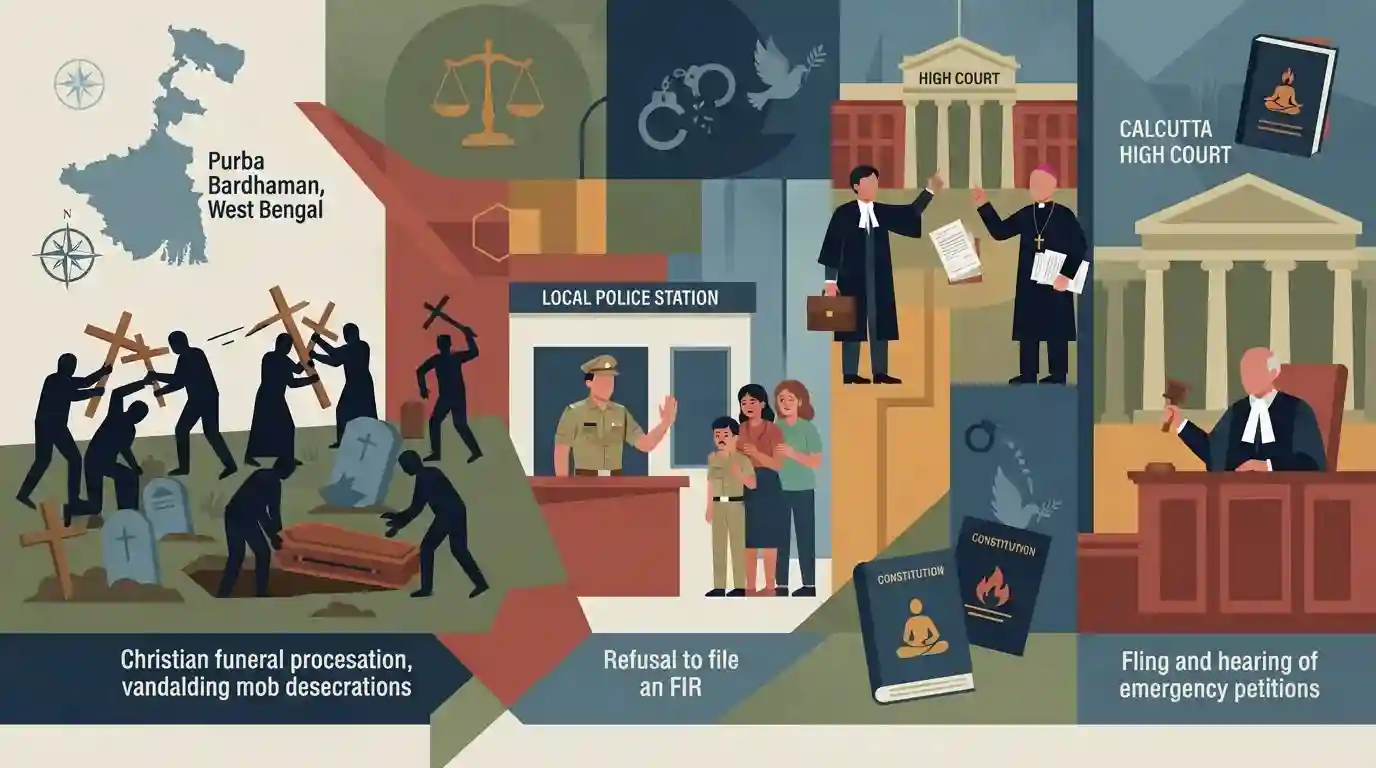
An aggressive mob disrupted a Christian funeral in Sahanagar, Purba Bardhaman district of West Bengal, vandalising the cemetery and illegally exhuming the body. When local police refused to file an FIR, the Bengal Christian Council Legal Cell—acting with the guidance of Calcutta's Archbishop Elias Frank—filed emergency petitions with the High Court. The violent incident and subsequent police inaction highlight significant concerns over minority rights, the fundamental right to religious freedom, and the right to a dignified burial as guaranteed by the Indian Constitution.
Key Points
- A Christian funeral at St. Claret Church cemetery in Sahanagar, Purba Bardhaman, was disrupted by a violent mob that vandalised property and forcibly exhumed the body.
- Local police allegedly refused to register a First Information Report (FIR) against the attackers, leading to accusations of collusion.
- The Bangiya Christiya Pariseba (BCP) Legal Cell, advised by Archbishop Elias Frank of Calcutta, initiated emergency petitions in the High Court seeking judicial oversight.
- The incident raises serious constitutional concerns regarding religious freedom (Article 25) and the right to a dignified burial, a component of the Right to Life and Personal Liberty (Article 21).
Important Terms
Article 21 of the Indian Constitution

Guarantees the right to life and personal liberty. The Supreme Court expansively interprets this to include the right to human dignity, which extends to human remains and ensures the right to a decent burial.
UPSC context
Core Polity topic (Fundamental Rights). WBCS frequently tests its expanded judicial interpretations, including the post-death rights of individuals.
Article 25 of the Indian Constitution
Guarantees freedom of conscience and the right to freely profess, practice, and propagate religion. This fundamental right protects minority religious customs, rituals, and ceremonies, including respectful last rites.
UPSC context
Essential Polity concept. WBCS tests the scope and reasonable restrictions of religious freedoms, secularism, and the protection of minority practices.
Bangiya Christiya Pariseba
An apex united forum of various Christian denominations in West Bengal. It advocates for minority rights, communal harmony, and organizes statewide campaigns against hate speech and targeted violence.
UPSC context
Highly relevant for West Bengal Current Affairs and Social Issues, testing awareness of regional civil society groups defending minority rights.
Bengal Christian Council Legal Cell
The legal advocacy wing of the Bengal Christian Council. It files judicial petitions—such as emergency High Court pleas—to protect minority rights, enforce constitutional liberties, and counter local administrative inaction.
UPSC context
Important for State Current Affairs and Polity, illustrating how regional institutional bodies utilize the judiciary to enforce Fundamental Rights.
St. Claret Church
A local church in Sahanagar, Purba Bardhaman district. Its cemetery became a recent flashpoint for minority rights after an aggressive mob vandalized the grounds and illegally exhumed a body during a funeral.
UPSC context
Useful for West Bengal Geography and State Current Affairs, testing awareness of recent socio-religious incidents and district-level administrative events.
Prelims Trap
"The Right to a dignified burial is explicitly guaranteed under Article 25 (Freedom of Religion)."
The right to a dignified burial is an implied right interpreted by the Supreme Court under Article 21 (Right to Life), not an explicit right.
Static Concepts Connected
How has the Supreme Court expanded Article 21 to cover post-death dignity?
- Dignity in Death: The Supreme Court has repeatedly ruled that the 'right to life' includes living and dying with dignity, extending to a decent burial or cremation.
- State Obligation: The State is constitutionally obligated to ensure that the dead are treated with respect and protected from degrading treatment or illegal exhumation.
What are the legal guidelines for police regarding the registration of an FIR?
- Lalita Kumari Guidelines: A Constitution Bench (Lalita Kumari case) mandated that police must register an FIR immediately if a complaint discloses a cognizable offence.
- Remedies for Refusal: If the local police station refuses, the aggrieved can escalate to the Superintendent of Police or approach a Magistrate under the CrPC/BNSS.
Cross-Topic Patterns
Writs enforcing police duties
When local police refuse to register FIRs, Article 226 empowers High Courts to enforce fundamental rights (Art 21, 25) directly through the writ of Mandamus.
Right to Life expansions
WBCS Mains frequently tests the evolving umbrella of Article 21, linking it with environmental rights, privacy, and posthumous dignity (right to a decent burial).

Expect a Mains question linking Article 21's expanded scope (right to a decent burial) with police duties regarding FIR registration.
Linked PYQs · 2
Linked PYQs · 2
- 2021WBCS_PRELIMSGS1
Article 21 of the Indian Constitution ensues
- 2014WBCS_PRELIMSGS1
The major portion of West Bengal plateau lies in the district of
