Kerala High Court stays disproportionate assets case against ADGP
Source:The Hindu ↗
Why It Matters
Illustrates the procedural and ethical complexities in prosecuting high-ranking civil servants, emphasizing the legal requirement for prosecution sanctions under anti-corruption laws and the administrative principle of hierarchical fairness during investigations.
Summary
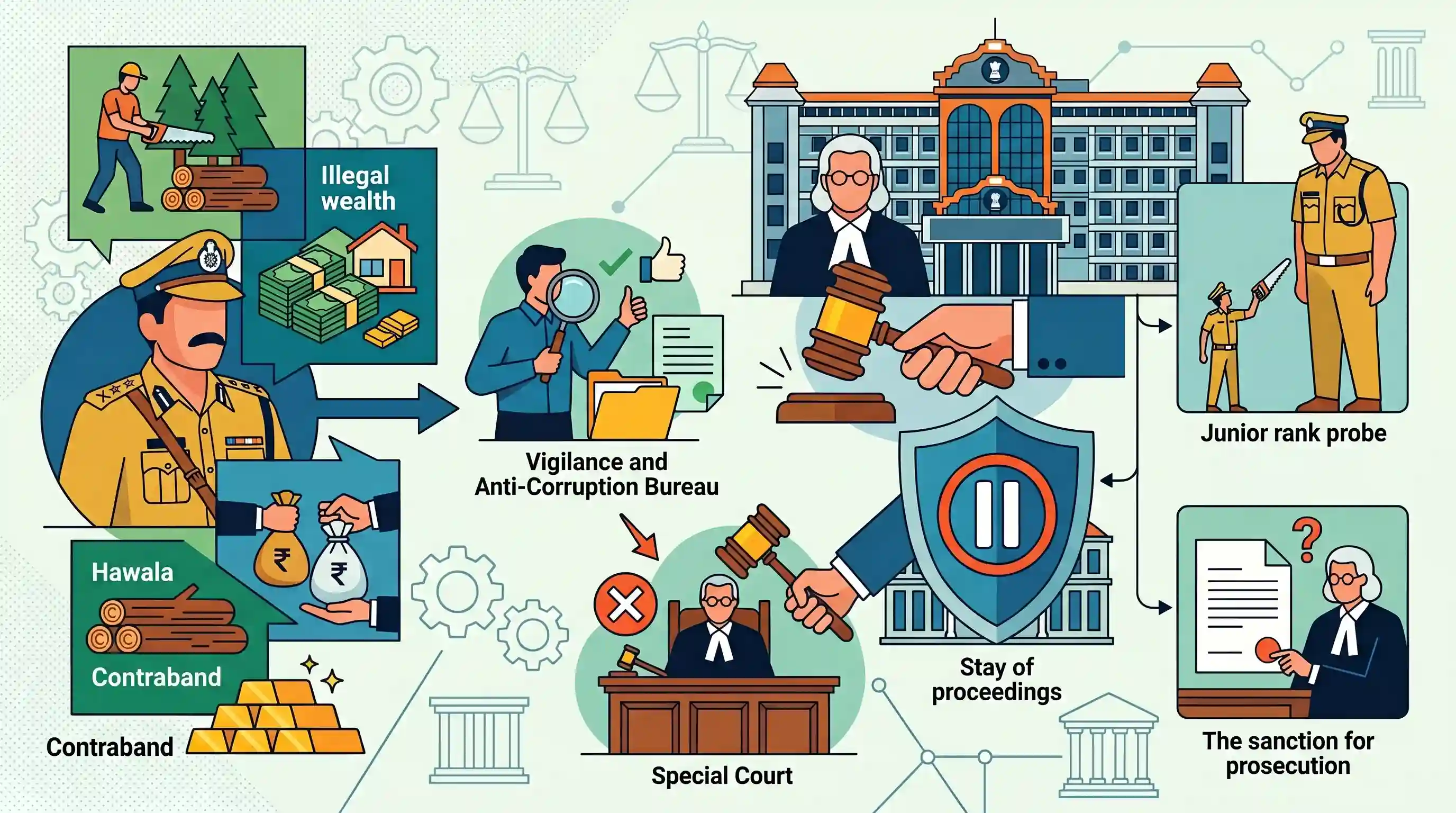
The Kerala High Court has stayed the proceedings against ADGP M.R. Ajith Kumar in a disproportionate assets case before a Special Court. The ADGP faced allegations of illegal wealth accumulation, unlawful timber felling, and profiting from hawala and contraband gold. Although the Vigilance and Anti-Corruption Bureau (VACB) exonerated him in a preliminary inquiry, the Special Court rebuffed this report. The High Court intervened, noting that the probe was unfairly conducted by an officer junior in rank to the ADGP, and additionally inquired if the State had obtained the mandatory legal sanction to prosecute him.
Key Points
- The Kerala High Court stayed Special Court proceedings against ADGP M.R. Ajith Kumar in a disproportionate assets case.
- The Special Court had previously rejected a preliminary inquiry report by the Vigilance and Anti-Corruption Bureau (VACB) that cleared the ADGP of wrongdoing.
- The High Court observed that it is procedurally unfair for a junior officer to conduct an investigation against a senior officer of ADGP rank.
- The Court also questioned whether the State government had secured the mandatory prior sanction required to prosecute the senior police official.
Important Terms
Sanction for Prosecution

Legal requirement under Section 19 of the Prevention of Corruption Act where government permission is mandatory before prosecuting public officials for official acts.
UPSC context
GS2 (Governance/Judiciary). Tests understanding of legal safeguards for public servants and the balance between protection and accountability.
Disproportionate Assets
A criminal offence where a public servant's wealth exceeds their known legal sources of income, often used as evidence of corruption.
UPSC context
GS2 (Governance) & GS4 (Ethics). Key concept for questions on administrative integrity and anti-corruption laws.
Vigilance and Anti-Corruption Bureau (VACB)
The specialized agency in Kerala tasked with investigating bribery, misconduct, and corruption among public servants within the state.
UPSC context
GS2 (Various bodies). Tests knowledge of state-level institutional frameworks for combating corruption and ensuring transparency.
Special Court
A court established under the Prevention of Corruption Act, 1988, to provide speedy trials specifically for corruption-related offences by public officials.
UPSC context
GS2 (Judiciary). Important for understanding specialized judicial mechanisms aimed at improving legal efficiency in corruption cases.
Prevention of Corruption Act (PCA), 1988
The principal Indian law aimed at combating corruption in public offices by criminalizing bribery, criminal misconduct, and illegal enrichment.
UPSC context
GS2 (Polity/Governance). The foundational legislative framework for accountability and anti-corruption measures in India.
Probity in Governance
Strict adherence to a code of ethics, honesty, and transparency in public administration to ensure authority is used for the public good.
UPSC context
GS4 (Ethics). A core syllabus topic testing the understanding of ethical standards and corruption-free administration.
Prelims Trap
"Prior government approval is only required for prosecution, not for initiating a preliminary inquiry against a public servant."
Section 17A (added via 2018 amendment to the PC Act) mandates prior approval even to commence an inquiry or investigation, not just for prosecution.
Static Concepts Connected
What are the statutory shields for public servants against corruption probes?
- Section 197 CrPC: Requires competent government sanction before a court can take cognizance of offenses committed by a public servant during the discharge of official duties.
- Section 19 PC Act: Mandates prior sanction from the government to prosecute corruption charges against serving public servants.
- Section 17A PC Act: Introduced in 2018, it requires prior approval from the competent authority simply to initiate an inquiry or investigation into official decisions.
How is "criminal misconduct" defined for public servants under the PC Act?
- Disproportionate Assets: Possession of pecuniary resources or property that is significantly disproportionate to their known, legal sources of income.
- Misappropriation: Fraudulent misappropriation or conversion of property entrusted to the public servant in their official capacity.
- Burden of Proof: If the prosecution establishes the existence of disproportionate assets, the burden shifts to the accused to account for them satisfactorily.
Cross-Topic Patterns
Police reforms vs. executive control
The requirement of government sanction to prosecute IPS officers frequently intersects with debates on the Prakash Singh directives and insulating police from political executives.
Natural justice in administrative probes
Administrative law dictates that inquiries be conducted by sufficiently senior officers to prevent procedural bias, reflecting the broader 'fair play' doctrines under Article 14.

Expect a 2026 prelims statement testing Section 17A of the Prevention of Corruption Act against Article 311 constitutional safeguards.
Linked PYQs · 3
Linked PYQs · 3
- 2019MainsGS4
What do you understand by probity in governance ? Based on your understanding of the term, suggest measures for ensuring probity in government.
- 2025MainsGS2
Discuss the 'corrupt practices' for the purpose of the Representation of the People Act, 1951. Analyze whether the increase in the assets of the legislators and/or their associates, disproportionate to their known sources of income, would constitute 'undue influence' and consequently a corrupt practice.
- 2024MainsGS4
“The 'Code of Conduct' and 'Code of Ethics' are the sources of guidance in public administration. There is code of conduct already in operation, whereas code of ethics is not yet put in place. Suggest a suitable model for code of ethics to maintain integrity, probity and transparency in governance.”
