Household disposable income projections and economic growth drivers
Source:Indian Express ↗
Why It Matters
Household disposable income directly impacts Private Final Consumption Expenditure (PFCE), which contributes to nearly 60% of India's GDP. Understanding the dynamics of savings, inflation, and tax policies is crucial for grasping macroeconomic stability and growth drivers.
Summary
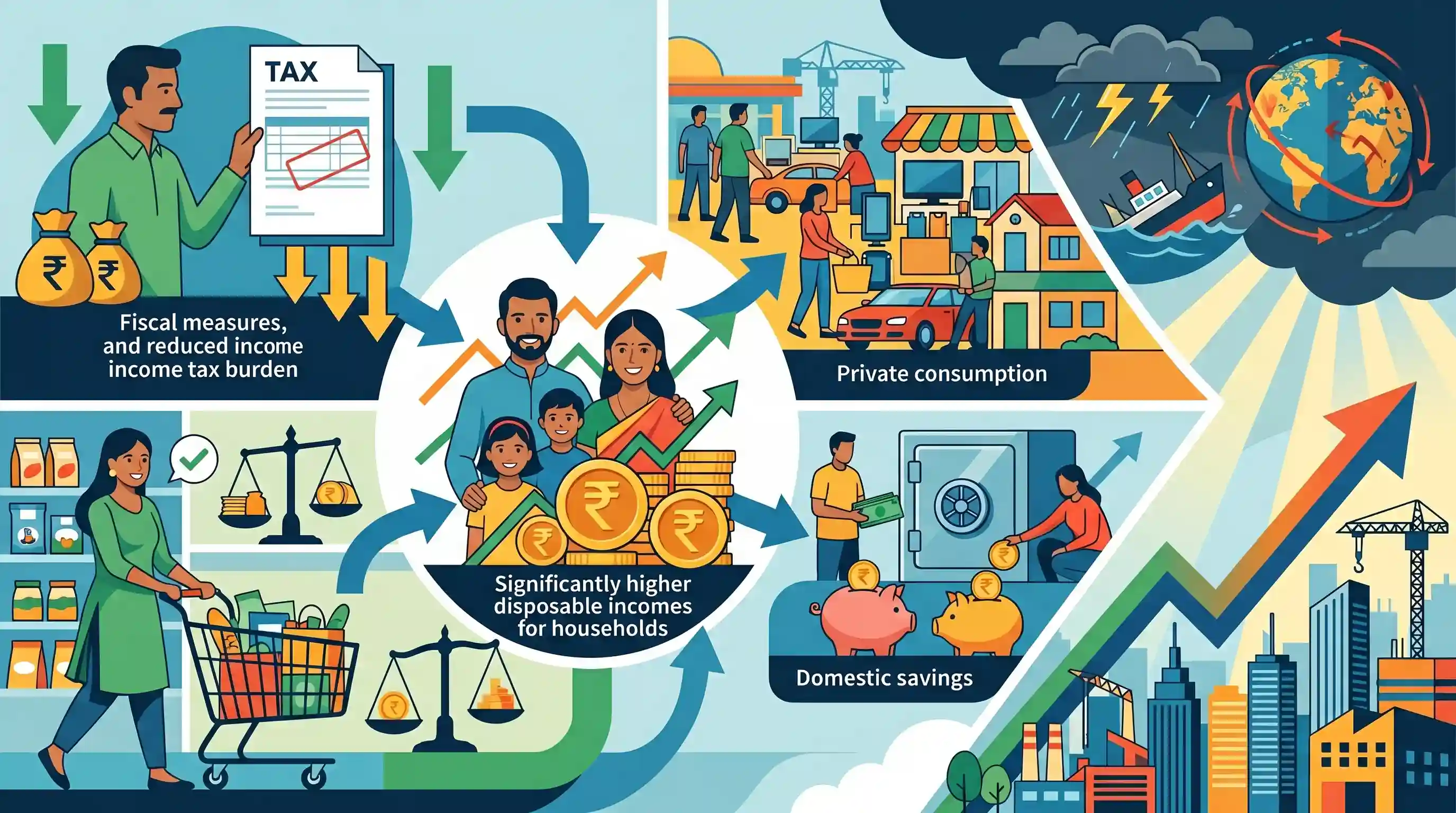
According to the Chief Economic Advisor (CEA), Indian households are projected to experience significantly higher disposable incomes in the current year. This rise is largely driven by fiscal measures, such as tweaks in the new income tax regime reducing the tax burden, alongside a moderation in inflationary pressures which preserves purchasing power. The resulting increase in real household income is expected to stimulate private consumption and improve domestic savings, thereby driving overall economic growth and buffering the Indian economy against global headwinds.
Key Points
- Chief Economic Advisor (CEA) expects household disposable income to increase significantly in the upcoming financial year.
- The increase is attributed to potential tax relief measures (like recent tweaks in the new tax regime) and moderation in inflation levels.
- Higher disposable income is projected to boost private final consumption expenditure (PFCE), a major driver of India's GDP growth.
- Increased real incomes provide a buffer for domestic demand amidst global economic uncertainties and support higher household savings for capital formation.
Important Terms
Disposable Income

The actual amount of money households have available for spending or saving after deducting personal direct taxes (like income tax) from their total income.
UPSC context
GS Paper III (Economy): Crucial for understanding domestic demand, household savings, and the impact of fiscal policy on growth.
New Income Tax Regime
A simplified, default tax structure with lower rates and fewer exemptions/deductions compared to the old system, aimed at reducing the tax burden and simplifying compliance.
UPSC context
GS Paper III (Fiscal Policy): Tests knowledge of tax reforms and government measures to boost consumption.
Chief Economic Advisor (CEA)
A high-ranking official in the Ministry of Finance who advises the government on economic policy and typically authors the annual Economic Survey of India.
UPSC context
GS Paper III (Governance/Economy): Institutional role responsible for economic planning, mobilization of resources, and policy analysis.
Real Income
Income adjusted for inflation to reflect the actual quantity of goods and services it can buy, representing the true purchasing power of an individual or nation.
UPSC context
GS Paper III (Economy): Used to assess standard of living and actual growth beyond nominal price increases.
Private Final Consumption Expenditure (PFCE)
The total spending by resident households and non-profit institutions on final goods and services; it is the largest component of India's GDP.
UPSC context
GS Paper III (Macroeconomics): A primary indicator of domestic demand and the health of the Indian economy.
Prelims Trap
"The private corporate sector is the largest contributor to India's Gross Domestic Savings."
Aspirants often assume corporations save the most, but the Household sector consistently accounts for roughly 60% of Gross Domestic Savings, funding India's capital formation.
Static Concepts Connected
How is Personal Disposable Income (PDI) calculated in National Income Accounting?
- Formula: PDI = Personal Income minus Personal Tax Payments (e.g., income tax) minus Non-tax Payments (e.g., fines, fees).
- Macroeconomic Significance: It represents the actual quantum of money households have available to either spend on consumption or save.
What are the three institutional components of Gross Domestic Savings in India?
- Household Sector: Consistently the largest chunk (~60%); includes both financial savings (bank deposits, shares) and physical savings (real estate, gold).
- Private Corporate Sector: Comprises the retained earnings of private companies. It is the second-largest contributor to domestic savings.
- Public Sector: Savings of the government and public sector enterprises. Often negative or very low due to persistent fiscal deficits.
Cross-Topic Patterns
PFCE vs. Capex Growth Models
India relies heavily on PFCE (~60% of GDP). Higher household disposable income organically drives this consumption, balancing the government's heavy reliance on public Capex-driven growth over the last three budgets.
New Tax Regime & Savings Behavior
Making the New Tax Regime the default removes 80C deductions, subtly shifting households away from forced tax-saving financial instruments toward discretionary consumption or market-linked investments.

Expect a multi-statement Prelims question testing the exact mathematical derivation of Personal Disposable Income and PFCE's share in GDP.
Linked PYQs · 3
Linked PYQs · 3
- 2017MainsGS3
Among several factors for India's potential growth, savings rate is the most effective one. Do you agree? What are the other factors available for growth potential?
- 2018PrelimsGS1
Despite being a high saving economy, capital formation may not result in significant increase in output due to
- 2024MainsGS3
What are the causes of persistent high food inflation in India? Comment on the effectiveness of the monetary policy of the RBI to control this type of inflation.
