Kerala Steps Up Cholera Surveillance After Thiruvananthapuram Death
Source:The Hindu ↗
Why It Matters
This event highlights the crucial intersection of climate change, public health infrastructure, and grassroots healthcare networks. It provides a real-world context for questions related to India's disease surveillance systems (like IDSP), the effectiveness of sanitation and WASH policies, and the frontline role of ASHA workers in managing localized public health emergencies.
Summary
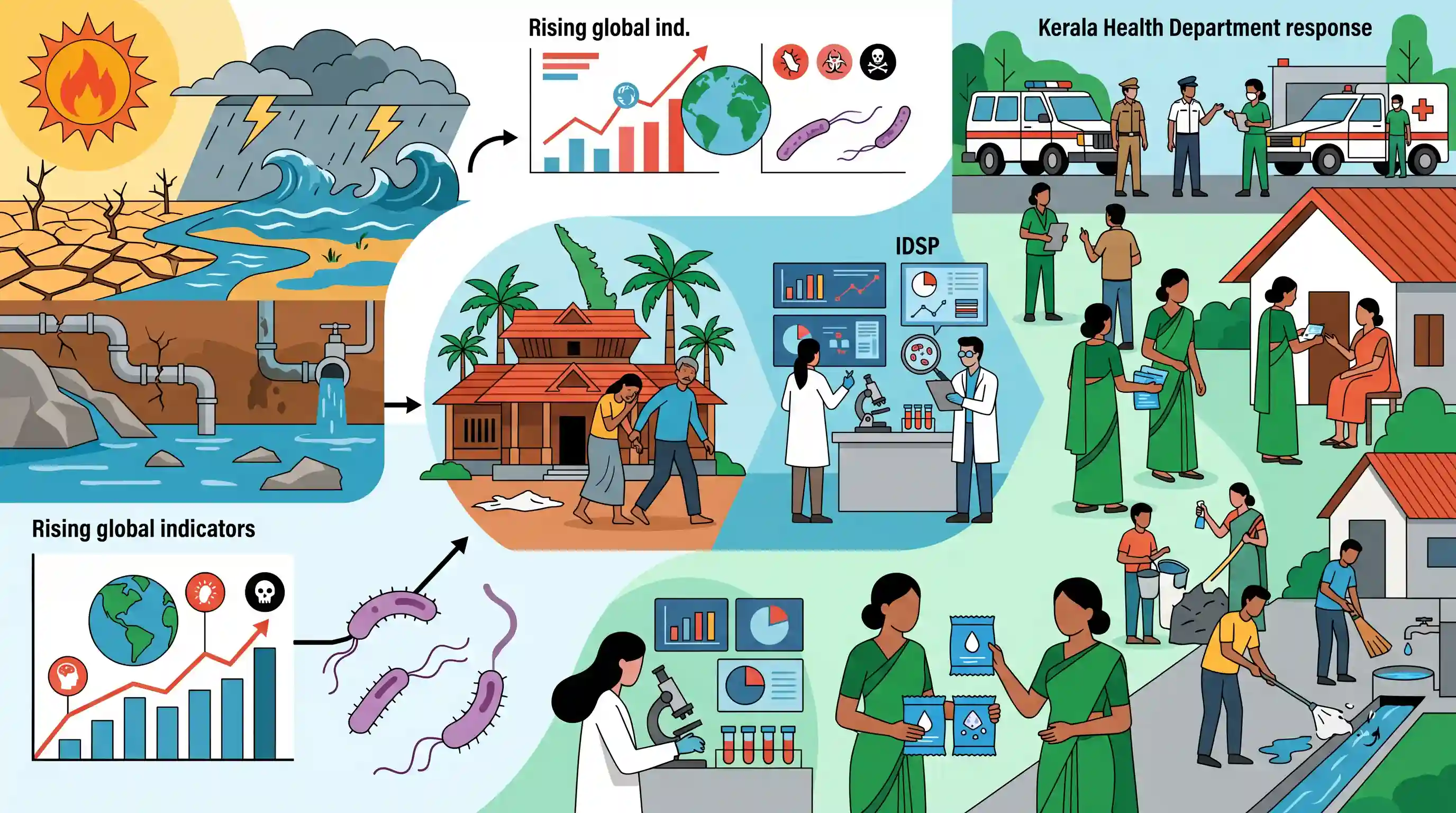
The Kerala Health Department has heightened disease surveillance and initiated comprehensive sanitation efforts in Thiruvananthapuram following a confirmed cholera-related death by the IDSP. To curb potential outbreaks, ASHA workers have been mobilized for active symptom monitoring and the distribution of ORS packets across affected neighborhoods. The incident underscores a broader global challenge highlighted by the WHO, which links the recent rise in cholera cases and mortalities to the compounded effects of climate change and inadequate water, sanitation, and hygiene (WASH) infrastructure.
Key Points
- The Kerala Health Department stepped up surveillance following the confirmation of a cholera death in Thiruvananthapuram by the Integrated Disease Surveillance Project (IDSP).
- Water samples from affected areas were collected, and extensive sanitation operations, including fogging and super-chlorination, have been initiated.
- ASHA workers are conducting house visits in the affected regions to detect unrecorded symptoms and distribute ORS packets.
- A 2024 WHO report highlights a global uptick in cholera cases, attributing it primarily to climate change and inadequate sanitation/WASH facilities.
Important Terms
Integrated Disease Surveillance Programme (IDSP)

A decentralized public health initiative to strengthen surveillance for epidemic-prone diseases. It enables early detection and response via state and district units, currently transitioning to the real-time Integrated Health Information Platform (IHIP).
UPSC context
GS II (Governance/Health); tests knowledge of institutional mechanisms for disease monitoring and epidemic preparedness in India.
WASH
An acronym for Water, Sanitation, and Hygiene; these interrelated sectors are critical for preventing waterborne diseases and are central to achieving Sustainable Development Goal 6 and India’s Jal Jeevan Mission.
UPSC context
GS II & III (Social Justice/Environment); tests understanding of hygiene standards and their impact on public health outcomes.
ASHA (Accredited Social Health Activist)
Trained female community health volunteers under the National Health Mission who act as a link between marginalized populations and the public healthcare system for outreach, monitoring, and primary care.
UPSC context
GS II (Social Justice/Health); tests understanding of community-led healthcare delivery and the role of grassroots volunteers.
Cholera
An acute, potentially fatal diarrheal infection caused by the bacterium Vibrio cholerae. Spread through contaminated water and food, it serves as a key indicator of sanitation and development gaps.
UPSC context
GS III (Science & Tech/Health); tests awareness of infectious disease mechanisms, prevention strategies, and climate change impacts.
World Health Organization (WHO)
A specialized United Nations agency responsible for international public health. It sets global health standards, coordinates responses to health emergencies, and monitors the global burden of infectious diseases.
UPSC context
GS II (International Relations/Governance); tests knowledge of global health governance and the role of international organizations.
Prelims Trap
ASHA workers are permanent salaried employees under the National Health Mission.
ASHA workers are honorary volunteers receiving performance-based incentives, not a fixed monthly salary. UPSC frequently tests their specific employment status.
Static Concepts Connected
What are the eligibility and compensation norms for ASHA workers?
- Selection criteria: Must be a woman resident of the village (preferably married/widowed/divorced) aged 25-45 with formal education up to class 10.
- Remuneration: They are honorary volunteers compensated via performance-based incentives, not fixed salaries, under the National Health Mission.
What is the Integrated Disease Surveillance Programme (IDSP)?
- Core mandate: Maintains a decentralized, state-based surveillance network to detect and respond to epidemic-prone diseases early.
- Action mechanism: Collects weekly disease data and deploys Rapid Response Teams (RRTs) to investigate and control outbreaks.
Cross-Topic Patterns
Climate Change + Epidemic Spread
WHO reports increasingly link global warming and altered rainfall to the geographic expansion of waterborne diseases like Cholera, blending GS3 Environment with GS2 Public Health.
WASH Infrastructure + AMR Mitigation
Inadequate WASH facilities increase disease burden, inadvertently driving up antibiotic usage and accelerating Antimicrobial Resistance (AMR) in affected communities.

Expect a multi-statement question interlinking climate-induced extreme weather, IDSP disease tracking mechanisms, and WASH.
Linked PYQs · 3
Linked PYQs · 3
- 2017MainsGS2
To ensure effective implementation of policies addressing water, sanitation and hygiene needs the identification of the beneficiary segments is to be synchronized with the anticipated outcomes." Examine the statement in the context of the WASH scheme.
- 2016PrelimsGS1
Which of the following statements is/are correct? Viruses can infect 1. bacteria 2. fungi 3. plants Select the correct answer using the code given below.
- 2024PrelimsGS1
Consider the following statements : I. No virus can survive in ocean waters. II. No virus can infect bacteria. III. No virus can change the cellular transcriptional activity in host cells. How many of the statements given above are correct?
