New Moth Genus Discovery in Western Ghats and Biodiversity
Source:The Hindu ↗
Why It Matters
UPSC frequently tests knowledge of biodiversity hotspots (especially the Western Ghats) and newly discovered species in Prelims. For Mains (GS3), it serves as an excellent case study for the hidden biodiversity wealth of India and the pressing anthropogenic threats requiring immediate conservation interventions.
Summary
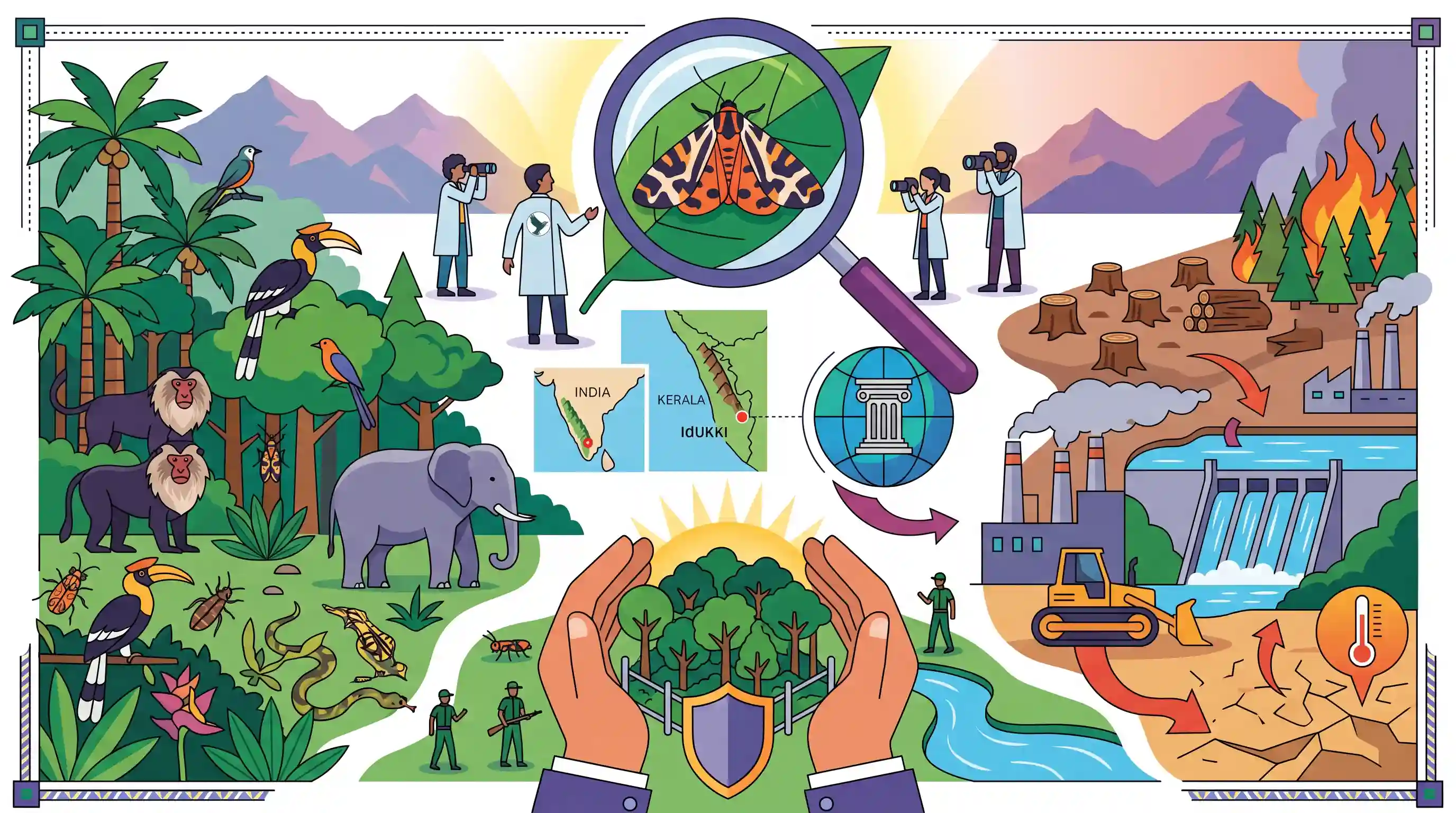
A new genus and species of tiger moth, *Antaram idukki*, has been discovered in Kerala's Idukki district by a collaborative international research team including the Zoological Survey of India. The discovery brings fresh attention to the rich, hidden biodiversity of the Western Ghats, a UNESCO World Heritage site and global biodiversity hotspot. The researchers emphasize that these delicate ecosystems are increasingly threatened by habitat degradation, climate change, and unregulated human activities, underscoring the urgent need for robust conservation strategies.
Key Points
- A new genus and species of tiger moth, named *Antaram idukki*, has been discovered in the Idukki district of Kerala, within the Western Ghats.
- The moth belongs to the subfamily Arctiinae, and its genus name 'Antaram' (Sanskrit for 'difference') denotes its distinct morphological divergence from related genera.
- The discovery was made through a collaborative effort involving the Zoological Survey of India (ZSI), London's Natural History Museum, Paris's National Museum of Natural History, and Bengaluru's NCBS.
- This find highlights the rich, unexplored biological diversity of the Western Ghats, a UNESCO World Heritage site and one of the globe's eight 'hottest hotspots' of biodiversity.
- Researchers warn that the region's unique ecosystems are under severe threat from climate change, habitat degradation, unregulated tourism, and changing land-use patterns, demanding urgent conservation.
Important Terms
Western Ghats

A 1,600km mountain range along India's western coast, older than the Himalayas, and one of the world's eight 'hottest hotspots' of biological diversity.
UPSC context
GS Paper I (Geography) and GS III (Environment). Crucial for monsoon regulation and endemism studies.
Biodiversity Hotspot
A biogeographic region with significant levels of biodiversity that is threatened with destruction; must contain 1,500 endemic vascular plants and lost 70% of primary vegetation.
UPSC context
GS Paper III (Environment). Tests knowledge of global conservation priorities and India's four major hotspots.
Zoological Survey of India (ZSI)
India’s apex organization for animal taxonomy and faunal surveys, established in 1916 under the Ministry of Environment, Forest and Climate Change.
UPSC context
GS Paper III (Biodiversity). Frequently featured in questions regarding species discovery and conservation reports.
UNESCO World Heritage Site
A landmark or area legally protected by an international convention for having 'outstanding universal value' to humanity, designated by UNESCO.
UPSC context
GS Paper I (Culture) and GS III (Environment). Tests criteria for natural and cultural site inscription.
Antaram idukki
A newly discovered genus and species of tiger moth (subfamily Arctiinae) found in Kerala's Idukki district, representing a unique evolutionary lineage.
UPSC context
GS Paper III (Environment: Species in News). Tests awareness of new discoveries and endemism in the Western Ghats.
Arctiinae
A diverse subfamily of moths within the Erebidae family, commonly known as tiger moths, known for their role as pollinators and biological indicators.
UPSC context
GS Paper III (Science/Environment). Relevant for taxonomy and ecosystem service questions.
Prelims Trap
"A region is declared a biodiversity hotspot solely based on having exceptionally high endemic plant and animal species."
UPSC often omits the threat criterion. To qualify as a hotspot, a region MUST have also lost at least 70% of its primary native vegetation.
Static Concepts Connected
What are the two strict criteria for a region to be designated a Biodiversity Hotspot?
- High Endemism: It must contain at least 1,500 species of vascular plants that are endemic (found nowhere else on Earth).
- Severe Threat: It must have lost at least 70% of its original, primary native vegetation, indicating severe habitat degradation.
What is the mandate and structural status of the Zoological Survey of India (ZSI)?
- Apex Status: Established in 1916, it operates as a subordinate organization under the Ministry of Environment, Forest and Climate Change (MoEFCC).
- Key Publications: It conducts faunal surveys, prepares the Fauna of India database, and notably publishes the Red Data Book on Indian Animals.
Cross-Topic Patterns
Moths as ecological bio-indicators
Moths are highly sensitive to micro-climate changes. UPSC often tests bio-indicator species (like lichens or diatoms) to connect local species discoveries with broader climate change impact assessments.
Western Ghats ESA committees
Threats to Idukki's biodiversity constantly revive administrative debates over Ecologically Sensitive Area (ESA) demarcations, linking species discoveries back to the Gadgil and Kasturirangan committee reports.

Expect a multi-statement question mixing Western Ghats endemism (like Antaram idukki) with the strict threat criteria of global hotspots.
Linked PYQs · 2
Linked PYQs · 2
- 2011PrelimsGS1
Three of the following criteria have contributed to the recognition of Western Ghats-Sri Lanka and Indo-Burma regions as hotspots of biodiversity: 1. Species richness 2. Vegetation density 3. Endemism 4. Ethno-botanical importance 5. Threat perception 6. Adaptation of flora and fauna to warm and humid conditions Which three of the above are correct criteria in this context?
- 2010PrelimsGS1
Consider the following statements: 1. Biodiversity hotspots are located only in tropical regions. 2. India has four biodiversity hotspots i.e., Eastern Himalayas, Western Himalayas, Western Ghats and Andaman and Nicobar Islands. Which of the statements given above is/are correct?
