Discover UP Tourism Conclave and Religious Tourism Growth in State
Source:bureaugram ↗
Why It Matters
UPPSC Prelims regularly tests students on Uttar Pradesh-specific tourism schemes, cultural circuits, and infrastructure projects (such as HRIDAY schemes and the Swami Vivekanand Etihasik Paryatan Yatra Yojna) targeting regions like Varanasi, Mathura, and Ayodhya.
Summary
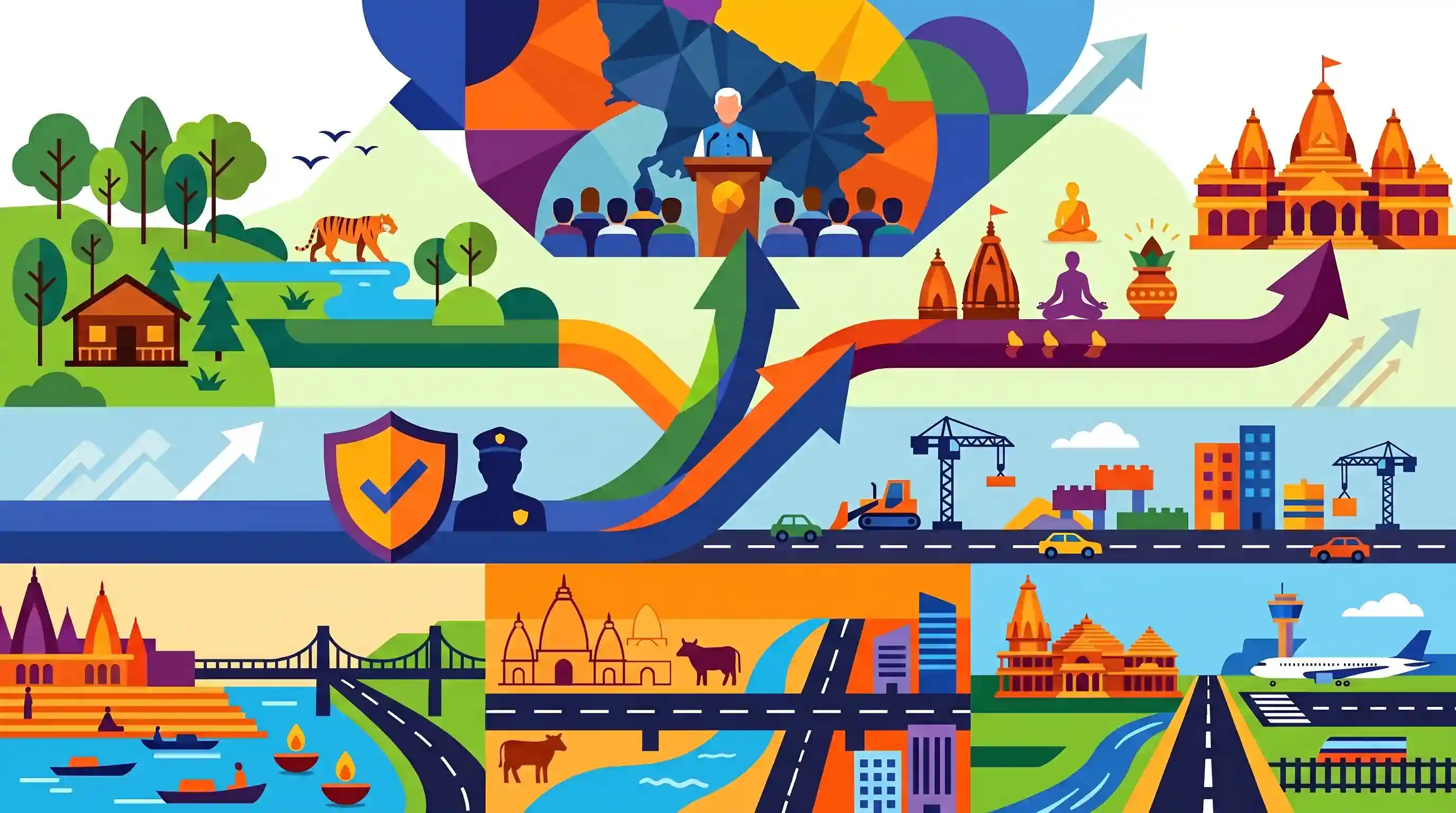
The 'Discover UP – People, Places, Possibilities' Tourism Conclave was hosted in Lucknow, where Uttar Pradesh's Minister for Tourism & Culture, Jaiveer Singh, highlighted the state's rise as a top destination for religious, spiritual, and eco-tourism. He emphasized that enhanced law and order, coupled with infrastructure developments in Varanasi, Mathura, and Ayodhya, have significantly boosted tourism and pilgrimage since 2017.
Key Points
- The 'Discover UP – People, Places, Possibilities' Tourism Conclave was held in Lucknow to highlight the state's tourism growth.
- Jaiveer Singh, the Minister for Tourism & Culture of Uttar Pradesh, emphasized that the state has emerged as a premier hub for religious, spiritual, and eco-tourism.
- Major infrastructure developments, world-class amenities, and enhanced connectivity around Varanasi, Mathura, and Ayodhya have boosted pilgrim and tourist experiences.
- The transformation is attributed to improved law and order, focused tourism initiatives, and development policies implemented since 2017.
Important Terms
UP Tourism Policy 2022

A comprehensive policy framework that grants industrial status to tourism, aims to develop twelve thematic circuits, and leverages private investments to establish Uttar Pradesh as a leading global tourism hub.
UPSC context
GS Paper III (State Policies and Tourism Sector) and GS Paper II (Government Initiatives for development).
Thematic Tourist Circuits
Geographically and culturally linked routes (like Ramayana, Buddhist, and Sufi circuits) designed to structure tourism development, streamline traveler journeys, and enhance regional infrastructure.
UPSC context
GS Paper I (Indian Heritage and Culture) and GS Paper III (Infrastructure and Regional Development).
Spiritual Tourism
Tourism motivated by the pursuit of spiritual growth, pilgrimage, mindfulness, or religious devotion, acting as a powerful driver of the domestic service economy.
UPSC context
GS Paper I (Salient features of Indian Society) and GS Paper III (Service Sector Economics).
Eco-Tourism
Environmentally responsible travel to fragile, pristine, and relatively undisturbed natural areas, intended to support conservation efforts and empower local communities.
UPSC context
GS Paper III (Ecology, Environment, Sustainable Development, and Tourism Economics).
Heritage Tourism
Travel directed toward experiencing, preserving, and understanding the historic, artistic, and cultural heritage of a region, often utilizing historical structures via adaptive reuse.
UPSC context
GS Paper I (Art, Culture, and Heritage Conservation) and GS Paper III (Economic Growth).
Public-Private Partnership (PPP)
A long-term, contractually structured collaboration between public government agencies and private sector companies to jointly fund, develop, and operate infrastructure or public assets.
UPSC context
GS Paper III (Investment Models, Economic Growth, and Infrastructure Development).
One District One Product (ODOP) Scheme
An initiative designed to identify and promote a unique indigenous product from each district, fostering local craftsmanship, enhancing rural livelihoods, and scaling regional art globally.
UPSC context
GS Paper III (Indian Economy, MSMEs, and Rural Development).
Prelims Trap
The PRASHAD scheme is a Centrally Sponsored Scheme jointly funded by Centre and States under the Ministry of Housing and Urban Affairs.
PRASHAD is a 100% centrally funded Central Sector Scheme under the Ministry of Tourism, though it absorbed elements of MoHUA's discontinued HRIDAY scheme.
Static Concepts Connected
What distinguishes the PRASHAD scheme from the Swadesh Darshan scheme?
- Target focus: PRASHAD focuses strictly on single-destination pilgrimage rejuvenation, whereas Swadesh Darshan develops wider, multi-destination theme-based tourism circuits.
- Funding structure: Both are 100% centrally funded Central Sector Schemes, but PRASHAD incorporates community-based livelihood components and heritage integration.
What are the structural benefits of granting 'industry status' to the tourism sector?
- Utility tariffs: Enables hotels to pay for electricity, water, and property taxes at lower industrial rates rather than expensive commercial rates.
- Credit access: Allows hospitality projects to secure long-term, lower-interest institutional financing from banks, easing capital constraints.
Cross-Topic Patterns
Religious tourism and cultural diplomacy
Development of Buddhist and Ramayana circuits directly supports India's neighborhood diplomacy and Act East policy, using heritage corridors as strategic soft-power instruments.
Service-sector formalization and labor shifts
Granting industry status to hospitality accelerates the transition of rural labor from low-productivity agriculture to formalized service-sector employment in tier-2/3 cities.

PRASHAD scheme funding mechanics combined with the federal economics of granting 'industry status' to hospitality is a strong 2026 theme.
Linked PYQs · 2
Linked PYQs · 2
- 2020UPPSC_PRELIMSGS1
Which of the following cities of Uttar Pradesh is/are covered under the 'Heritage City Development and Augmentation Yojana (HRIDAY)' ? 1. Varanasi 2. Mathura 3. Prayagraj 4. Ayodhya Select the correct answer from the codes given below.
- 2021UPPSC_PRELIMSGS1
'Uttar Pradesh Swami Vivekanand Etihasik Paryatan Yatra Yojna 2021' was introduced by the U.P. Government for which of the following people for religious travel ?
