MGNREGA Scheme Modifications and Rural Migration Concerns
Source:The Hindu ↗
Why It Matters
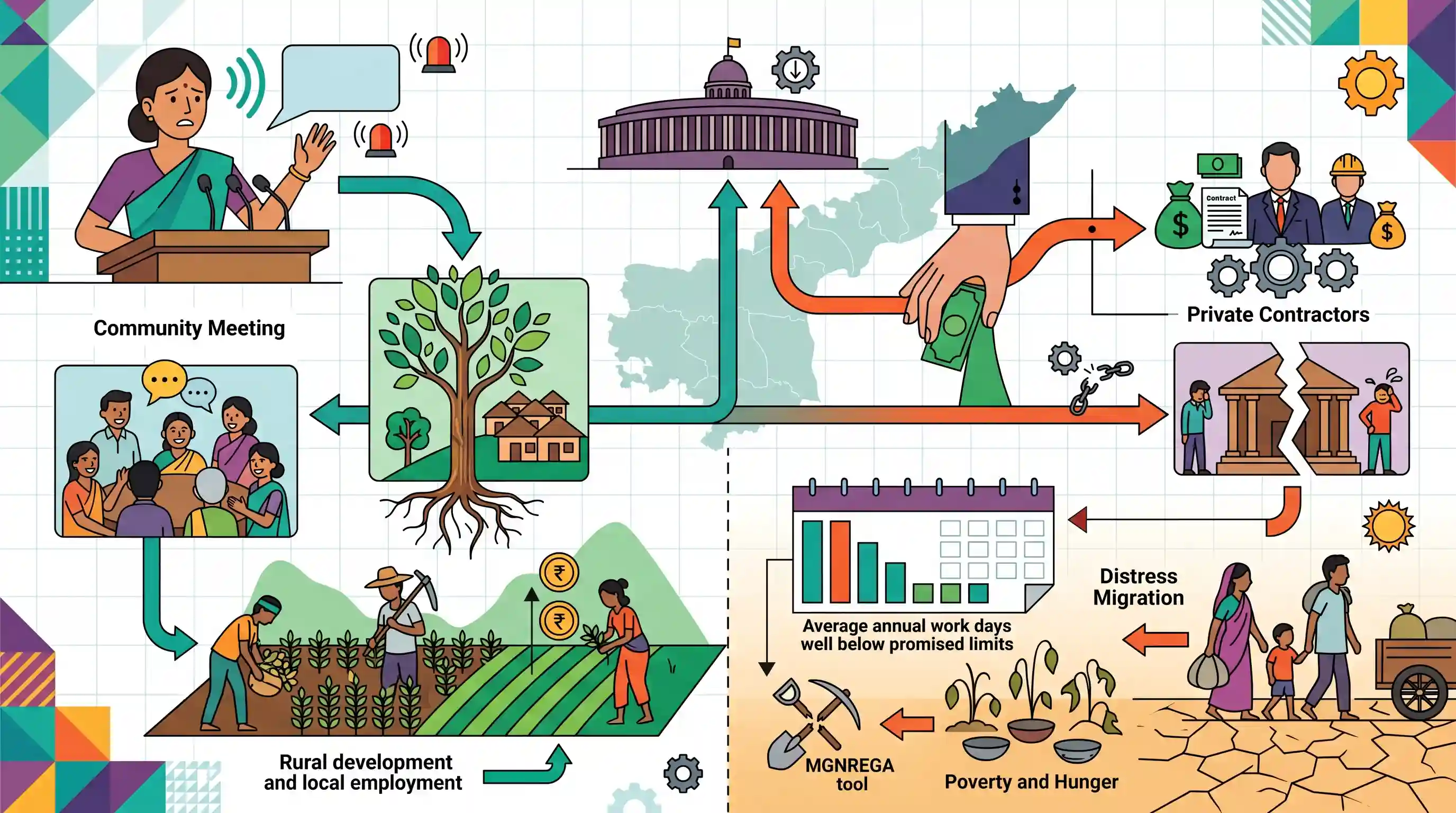
The article underscores the critical role of MGNREGA in curbing rural distress and migration. It raises essential issues about decentralization versus centralization in policy design and highlights the gap between stated objectives (100-125 work days) and actual scheme performance. This is highly relevant for GS Paper 2 topics concerning the design, performance, and local-level implementation of welfare schemes.
Summary
A prominent state political leader has raised concerns over the Union government's alleged modifications to the Mahatma Gandhi National Rural Employment Guarantee Act (MGNREGA). APCC chief Y.S. Sharmila warned that diluting the scheme's original, decentralized framework will precipitate massive distress migration from the backward Rayalaseema region in Andhra Pradesh. She argued that centralizing the decision-making process undermines local village bodies (Gram Sabhas) and instead benefits private contractors. Furthermore, she challenged the Centre's claims regarding employment generation, noting that the average annual work days provided to rural households remain substantially below the promised limits.
Key Points
- APCC chief Y.S. Sharmila highlighted that modifications to the original MGNREGA framework threaten rural livelihoods, potentially triggering large-scale distress migration from the arid Rayalaseema region.
- She criticized the centralization of decision-making under the new scheme format, arguing that it shifts control away from local village bodies and benefits contractors over the rural poor.
- Despite the Union government's claims of providing 125 days of work per year, she alleged that the average work days generated since 2014 have been less than 52 days.
Important Terms
MGNREGA

A rights-based social security law guaranteeing 100 days of unskilled manual work per financial year to every rural household to enhance livelihood security and create durable assets.
UPSC context
GS II (Welfare Schemes) and GS III (Employment/Poverty); tests understanding of demand-driven governance and rural labor rights.
Gram Sabha
The foundational assembly of the Panchayati Raj system consisting of all registered voters in a village, responsible for identifying local needs, prioritizing works, and conducting social audits.
UPSC context
GS II (Polity/Panchayati Raj); tests knowledge of grassroots democracy and the effectiveness of the 73rd Constitutional Amendment.
Distress Migration
Forced movement of rural populations to urban centers due to the absence of local livelihood options, agrarian distress, or recurring environmental shocks like drought.
UPSC context
GS I (Society/Urbanization) and GS III (Agriculture); tests analysis of socio-economic vulnerabilities and regional development gaps.
Rayalaseema
A drought-prone, rain-shadow geographic region in southern Andhra Pradesh (comprising districts like Anantapur and Kurnool) facing historical developmental lag and agrarian challenges.
UPSC context
GS I (Geography/Regionalism); tests awareness of India's physiographic regions and the socio-economic impact of localized climate conditions.
Decentralization
The constitutional devolution of administrative, financial, and decision-making powers from central/state governments to local bodies to enable participatory governance and community-led development.
UPSC context
GS II (Governance/Local Self-Government); tests evaluation of power devolution and its impact on rural administrative efficiency.
National Democratic Alliance (NDA)
A center-right political coalition in India, currently the ruling alliance at the Union level, representing a significant facet of India's multi-party coalition system.
UPSC context
GS II (Polity); tests understanding of the coalition nature of Indian politics and the federal-state party dynamics.
Prelims Trap
MGNREGA guarantees 100 days of employment to every rural individual.
The 100 days of guaranteed wage employment is per *rural household*, not per individual. Additionally, it isn't an absolute cap; 150 days are permitted in drought-notified districts.
Static Concepts Connected
What is the role of Panchayati Raj Institutions (PRIs) in implementing MGNREGA?
- Gram Sabha: Legally mandated to recommend works, prioritize local projects, and conduct mandatory social audits for transparency.
- Panchayat execution: At least 50% of the scheme's works (in terms of cost) must be executed by the Gram Panchayats.
- Contractor ban: The Act strictly bans private contractors and labor-displacing machinery to prevent fund leakages and ensure direct wage transfers.
What are the core statutory guarantees of MGNREGA?
- Demand-driven work: Recognizes the 'right to work'; employment must be provided within 15 days of receiving a demand application from a rural household.
- Unemployment allowance: If the government fails to provide work within 15 days, it is legally obligated to pay an unemployment allowance.
- Drought relief: Provides an additional 50 days (totaling 150 days) of wage employment in districts officially notified as drought or calamity-affected.
Cross-Topic Patterns
Climate shocks + Distress migration
Droughts in arid zones like Rayalaseema push distress migration, making MGNREGA's water conservation mandate a critical tool for climate adaptation and disaster resilience.
Digital centralization vs Local governance
Recent scheme modifications, such as mandatory digital attendance and Aadhaar payments, are increasingly critiqued for shifting control to centralized bureaucracies and bypassing Gram Sabhas.

Expect a 2026 multi-statement question testing MGNREGA exceptions (150 days in droughts) and the exact legal mandate of Gram Sabhas.
Linked PYQs · 3
Linked PYQs · 3
- 2011PrelimsGS1
Among the following who are eligible to benefit from the “Mahatma Gandhi National Rural Employment Guarantee Act”?
- 2025MainsGS2
"In contemporary development models, decision-making and problem-solving responsibilities are not located close to the source of information and execution defeating the objectives of development." Critically evaluate.
- 2022MainsGS2
To what extent, in your opinion, has the decentralisation of power in India changed the governance landscape at the grassroots?
