Hamas Demands Amendments to US Proposed Gaza Peace Plan
Source:Indian Express ↗
Why It Matters
The Israel-Palestine conflict is a core issue in West Asian geopolitics, frequently tested in UPSC Mains (GS2 - IR) and Prelims (Map-based questions like Levant or conflict zones). Understanding peace proposals and the roles of mediators like Qatar, Turkey, and the USA is crucial for analyzing regional stability.
Summary
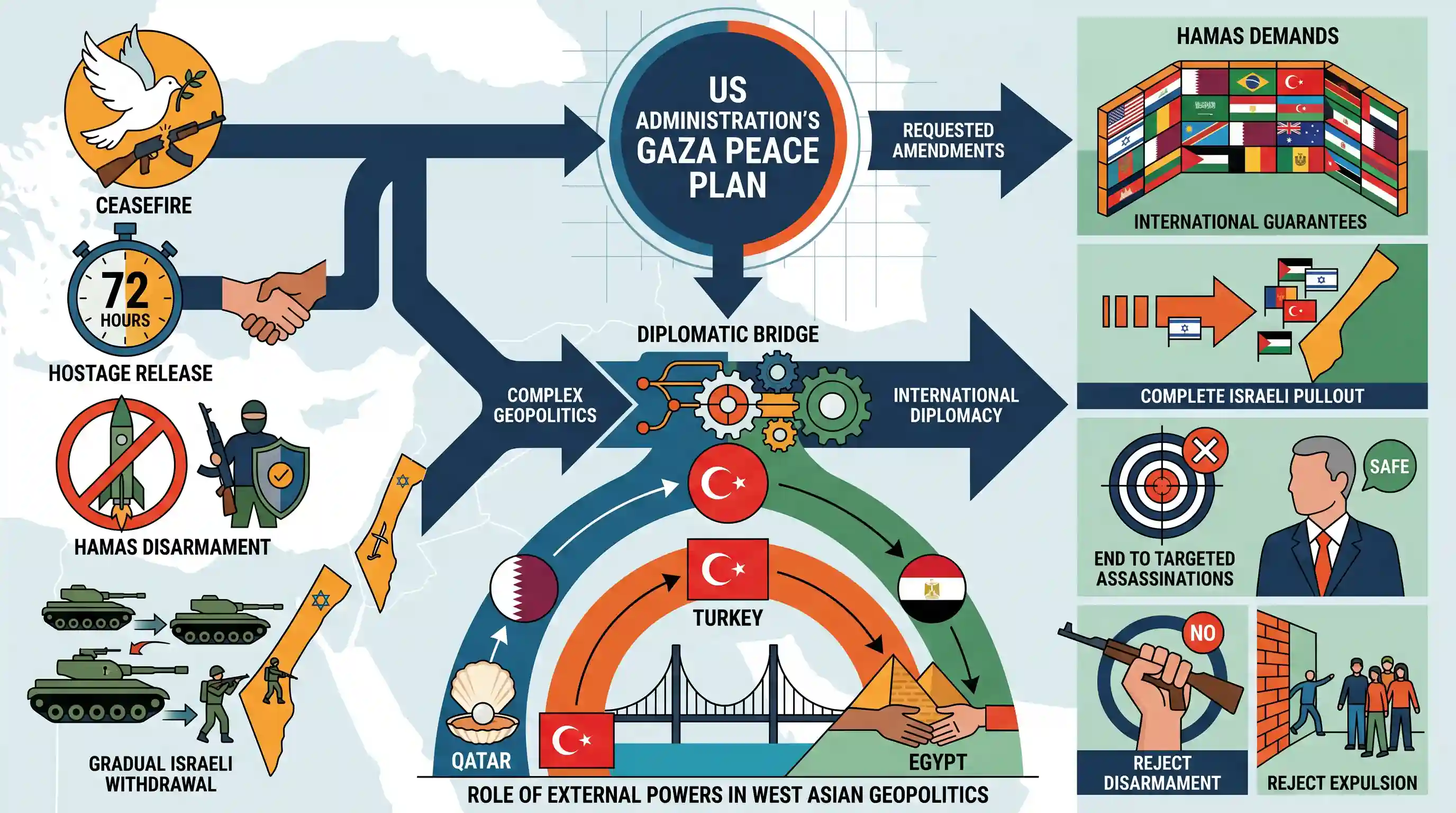
Hamas is seeking major amendments to the Donald Trump administration's Gaza peace plan. While the US proposal outlines a ceasefire, a 72-hour window for hostage release, Hamas disarmament, and a gradual Israeli withdrawal, Hamas is demanding international guarantees for a complete Israeli pullout and an end to targeted assassinations of its leaders. The Palestinian group has firmly rejected terms requiring it to disarm or expel its cadres. The ongoing diplomatic efforts to bridge these gaps are being mediated by Qatar, Turkey, and Egypt, highlighting the complex geopolitics and role of external powers in the West Asian conflict.
Key Points
- Hamas has demanded substantial tweaks to Donald Trump's proposed Gaza peace plan, seeking international guarantees for a full Israeli withdrawal from the Gaza Strip.
- The Palestinian group explicitly rejects the provisions regarding the disarmament of its fighters and the expulsion of Hamas cadres from Gaza.
- Hamas has sought firm assurances that there will be no future assassinations of its leaders by Israel.
- The US-proposed plan, backed by the Trump administration, currently demands a ceasefire, hostage release within 72 hours, and a gradual Israeli withdrawal.
- Qatar, Turkey, and Egypt are actively mediating these high-stakes negotiations amidst US pressure on regional players.
Important Terms
Trump's Gaza Peace Plan

A 20-point US-led framework (2025) proposing a ceasefire, Hamas disarmament, and an International Stabilization Force to end the Gaza war.
UPSC context
GS II: International Relations. Tests understanding of West Asian peace processes and US influence on regional stability.
Hamas
A Palestinian militant and political organization that has governed the Gaza Strip since 2007; currently at the center of peace negotiations.
UPSC context
GS II: Regional geopolitics. Relates to non-state actors and their impact on international security and Indian interests.
International Stabilization Force (ISF)
A proposed temporary multinational body to train Palestinian police and secure Gaza post-conflict, replacing the Israeli Defense Forces (IDF).
UPSC context
GS II: Global governance. Concerns the role of international peacekeeping and transitional administration in conflict zones.
Two-State Solution
A diplomatic framework seeking to establish an independent State of Palestine alongside Israel, a long-standing goal supported by India.
UPSC context
GS II: India’s Foreign Policy. Tests knowledge of India's historical stance on Palestinian sovereignty versus current geopolitical pragmatism.
Board of Peace
An international body, chaired by the US President, tasked with overseeing Gaza’s reconstruction and monitoring compliance with the 2025 peace plan.
UPSC context
GS II: International Relations. Represents a specific mechanism for oversight in multilateral peace treaties.
Abraham Accords
A series of 2020 normalization agreements between Israel and several Arab nations (UAE, Bahrain, Morocco), which the Trump plan seeks to expand.
UPSC context
GS II: West Asia Geopolitics. Crucial for understanding the shift from conflict to economic and diplomatic normalization in the region.
Prelims Trap
Hamas and Fatah jointly govern the Gaza Strip under the internationally recognized Palestinian Authority.
Hamas controls Gaza independently of the Fatah-dominated Palestinian Authority (PA), which governs parts of the West Bank. They are rival factions with distinct diplomatic statuses.
Static Concepts Connected
What are the geographic boundaries and key border crossings of the Gaza Strip?
- Land borders: Bounded by Israel to the north and east, and the Sinai Peninsula of Egypt to the south.
- Maritime boundary: Faces the Mediterranean Sea to the west.
- Border crossings: Rafah crossing controls access to Egypt; Erez and Kerem Shalom control access to Israel.
How do the PLO, Fatah, and Hamas differ within Palestinian politics?
- PLO: Internationally recognized umbrella organization representing Palestinians at the UN; negotiated the Oslo Accords.
- Fatah: Dominant secular faction within the PLO; controls the Palestinian Authority (PA) in the West Bank.
- Hamas: Islamist militant and political group ruling Gaza since 2007; not a member of the PLO.
Cross-Topic Patterns
Abraham Accords limits
The Gaza conflict demonstrates that "outside-in" normalization agreements like the Abraham Accords cannot guarantee regional stability without addressing the core territorial demands of the Palestinians.
Middle Power Mediation
Qatar and Turkey's mediation highlights the rising influence of non-Western "middle powers" acting as crucial bridge-builders in conflicts where Western actors carry heavy partisan baggage.

Map-based matching of West Asian conflict zones (Gaza/Rafah, West Bank, Golan Heights) or a faction-matching IR question is highly probable.
Linked PYQs · 3
Linked PYQs · 3
- 2023PrelimsGS1
Consider the following statements: Statement-I: Israel has established diplomatic relations with some Arab States. Statement-II: The 'Arab Peace Initiative' mediated by Saudi Arabia was signed by Israel and Arab League. Which one of the following is correct in respect of the above statements?
- 2022PrelimsGS1
The term "Levant" often heard in the news roughly corresponds to which of the following regions?
- 2018MainsGS2
“India’s relations with Israel have, of late, acquired a depth and diversity, which cannot be rolled back.” Discuss.
