Anti-Conversion Cells Directive in Uttar Pradesh State Universities
Source:indiatomorrow ↗
Why It Matters
This issue is crucial for UPPSC aspirants as it illustrates the practical application of the state's anti-conversion laws, the constitutional scope of the Governor's authority as Chancellor of state universities, and the intersecting dynamics of fundamental rights (Articles 21 and 25) and executive-led campus surveillance policies.
Summary
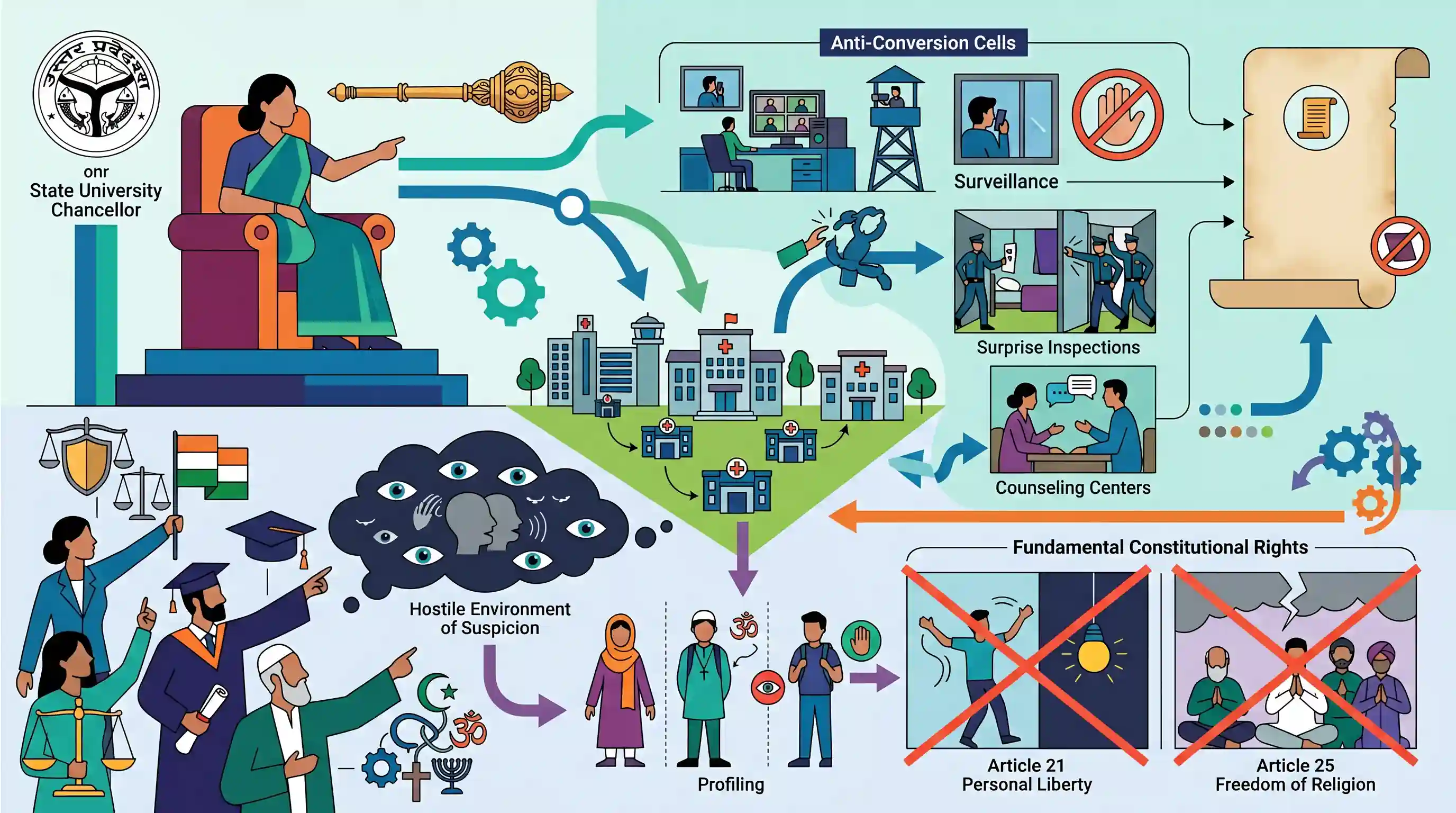
Uttar Pradesh Governor Anandiben Patel has issued a directive to all state-run public universities and higher educational institutions to establish 'Anti-Conversion Cells' (alternatively termed 'Anti-Radicalisation Units' or 'Student Welfare Cells'). Following alleged religious conversion controversies in top medical institutes like KGMU and SGPGI, the administration intends to use these cells to curb forced conversions using stricter hostel surveillance, surprise inspections, and counseling centers, with violations punishable under the state's stringent anti-conversion law. The order has triggered sharp opposition from civil liberties advocates, former academics, and minority organizations, who argue that it fosters a hostile environment of suspicion, risks profiling religious minority students, and threatens fundamental constitutional rights, including freedom of religion under Article 25 and personal liberty under Article 21.
Key Points
- Uttar Pradesh Governor Anandiben Patel, in her capacity as Chancellor of state universities, issued a directive to establish 'Anti-Conversion Cells' or 'Anti-Radicalisation Units' in all state-run higher education institutions.
- The directive, communicated via a letter dated May 29, 2026, holds Vice-Chancellors and Directors responsible for maintaining a safe, religion-neutral environment and curbing forced conversions.
- The policy is linked to recent controversies of alleged forced conversions and exploitation at King George's Medical University (KGMU) and SGPGI in Lucknow.
- Mandated security and administrative measures include confidential counseling centers, periodic surprise inspections in hostels, restricted entry of unauthorized outsiders, and mentor-mentee surveillance sessions.
- Any suspicious activity detected must be immediately reported to the police and local administration to initiate proceedings under the Uttar Pradesh Prohibition of Unlawful Conversion of Religion Act, 2021.
- Opponents, including legal experts, civil society members, and minority leaders, argue that the setting up of such surveillance-heavy cells in educational institutes compromises secularism, targets religious minorities (Muslims and Christians), and infringes upon Fundamental Rights under Articles 21 (Privacy and Personal Liberty) and 25 (Freedom of Religion).
Important Terms
Uttar Pradesh Prohibition of Unlawful Conversion of Religion Act, 2021

A state law enacted to prohibit religious conversions done through misrepresentation, force, undue influence, coercion, allurement, marriage, or fraudulent means, making violations non-bailable with up to 10 years of imprisonment.
UPSC context
GS Paper II: Polity. Tests freedom of religion (Article 25), individual liberty, state-level legislation, and judicial reviews.
All India Shia Personal Law Board
An Indian non-governmental organisation formed in January 2005 to represent and advocate for the rights and personal laws of Shia Muslims, independent of the All India Muslim Personal Law Board.
UPSC context
GS Paper II: Social Justice. Tests personal laws, minority rights, and debates surrounding the Uniform Civil Code.
Samajwadi Party
A prominent socialist political party in India, founded in 1992 by Mulayam Singh Yadav, primarily active in Uttar Pradesh and advocating for secularism and the upliftment of marginalized communities.
UPSC context
GS Paper II: Polity. Relates to political parties, electoral dynamics, regionalism, and the representation of backward classes.
Lucknow University
A prestigious public state university established in 1920 in Lucknow, Uttar Pradesh, evolving from the colonial-era Canning College to become a major institution of higher learning.
UPSC context
GS Paper II: Governance. Relevant for higher education policy, state university administration, and the Governor’s role as Chancellor.
Sanjay Gandhi Postgraduate Institute of Medical Sciences (SGPGI)
A premier tertiary care super-specialty medical institution and university in Lucknow, established in 1983 under a State Legislative Act to provide advanced healthcare, teaching, and research.
UPSC context
GS Paper II: Health & Governance. Tests public health infrastructure, autonomous state institutions, and medical education governance.
Prelims Trap
The Governor of a State, when acting as the ex-officio Chancellor of state universities, is bound by the state cabinet's aid and advice.
Chancellorship is a statutory role created by state university acts, not a constitutional one; thus, the Governor acts in their independent capacity, not bound by Article 163.
Static Concepts Connected
What is the statutory and constitutional status of State Governors acting as University Chancellors?
- Statutory basis: The office of Chancellor is created by state legislature acts, not by the Constitution.
- Aid and advice: While acting as Chancellor, the Governor is generally not bound by the Council of Ministers under Article 163.
- Punchhi Commission: Recommended stripping Governors of Chancellorships to prevent political friction and maintain administrative neutrality.
How has the Supreme Court defined the limits of religious propagation and conversion?
- Stainislaus judgment: In 1977, SC held that the right to 'propagate' does not include a fundamental right to forcibly convert others.
- Burden of proof: Anti-conversion acts often reverse standard criminal law by placing the burden of proving voluntariness on the converter.
- Privacy linkage: In Puttaswamy, freedom of choice in faith and personal relations was declared integral to Article 21.
Cross-Topic Patterns
University Autonomy vs. Executive Overreach
Surveillance mechanisms in state-run universities test the balance between administrative public safety directives and statutory academic freedom.
Federalism and Gubernatorial Chancellorship
Governors bypassing state cabinets to issue administrative university orders mirrors larger federal disputes over higher education control.

Analytical questions on the statutory powers of Governors as Chancellors vs. Article 163 constraints are highly likely in GS-II.
Linked PYQs · 3
Linked PYQs · 3
- 2024UPPSC_PRELIMSGS1
Given below are two statements, one is labelled as Assertion (A) and the other as Reason (R). Assertion (A) : According to the Constitution of India, the same person cannot function as the Governor of two or more States at the same time. Reason (R) : Article 153 of the Indian Constitution states that there shall be a Governor for each State. Select the correct answer from the codes given below :
- 2012UPPSC_PRELIMSGS1
State Governor is appointed by
- 2024UPPSC_PRELIMSGS1
Which of the following freedoms is not guaranteed by the Indian Constitution under Article 19 ?
