Centre Directs NCERT to Review All Textbooks
Source:The Hindu ↗
Why It Matters
This issue sits at the intersection of education policy, curriculum regulation, and the judiciary's role in curbing misrepresentation versus upholding freedom of speech. It highlights the systemic mechanisms behind textbook formulation (NCERT, NSTC) and tests the boundaries of constructive criticism of the judiciary.
Summary
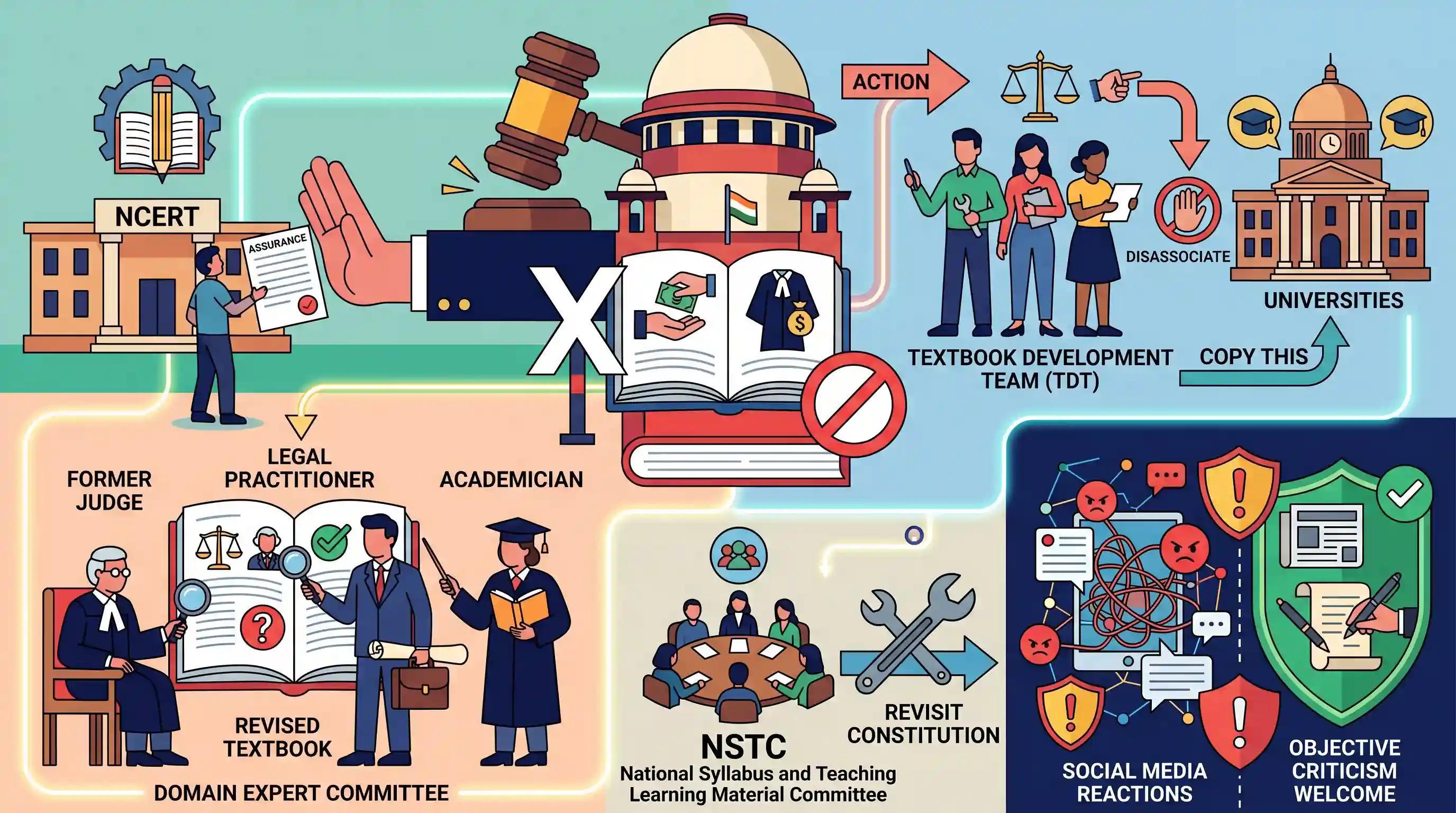
Following a Supreme Court ban on a Class 8 Social Science textbook due to a controversial section on "corruption in judiciary," the Centre has directed the NCERT to review all its textbooks. The Supreme Court expressed dissatisfaction with the NCERT's brief assurance that the chapter was rewritten and mandated that a domain expert committee—including a former judge and a legal practitioner—approve the revised text. The Court took strict action against the Textbook Development Team (TDT) authors, accusing them of deliberate misrepresentation and directing universities to disassociate from them. The ruling also called for revisiting the constitution of the National Syllabus and Teaching Learning Material Committee (NSTC) and warned against irresponsible social media reactions, while clarifying that objective criticism of the judiciary remains welcome.
Key Points
- The Centre informed the Supreme Court that it has directed the NCERT to review textbooks of all classes following controversy over a Class 8 Social Science chapter on 'corruption in judiciary'.
- The Supreme Court mandated that the rewritten chapter must be approved by an expert committee comprising a former senior judge, an eminent academic, and a legal practitioner before publication.
- The SC ordered governments and universities to disassociate from the Textbook Development Team (TDT) members who drafted the controversial text, accusing them of deliberately misrepresenting facts.
- The Court emphasized the need to review the constitution of the National Syllabus and Teaching Learning Material Committee (NSTC).
- While welcoming objective criticism of the judiciary, the Court criticized deliberate misrepresentation and warned social media users against irresponsible reactions to the textbook ban.
Important Terms
NCERT (National Council of Educational Research and Training)

Autonomous body (est. 1961) under Ministry of Education advising Center and States on school education. It develops the National Curriculum Framework (NCF) and prepares standardized textbooks for school-level learning.
UPSC context
GS Paper II: Statutory and Regulatory bodies; critical for topics on education policy and management of social sector services.
Supreme Court of India
The highest judicial forum and final interpreter of the Indian Constitution. It exercises original, appellate, and advisory jurisdictions and has the power of judicial review to maintain constitutional supremacy.
UPSC context
GS Paper II: Structure, organization, and functioning of the Judiciary; essential for Constitutional and Governance-related questions.
National Syllabus and Teaching Learning Material Committee (NSTC)
A high-powered 19-member committee formed by NCERT in 2023 to develop syllabi and teaching-learning materials for Classes 3 to 12, aligning them with the National Curriculum Framework (NCF-SE).
UPSC context
GS Paper II: Issues relating to development and management of Social Sector/Services relating to Education and government policies.
Textbook Development Team (TDT)
Specialized groups of experts appointed by NCERT or its steering committees to draft and review individual textbooks, ensuring academic rigor and adherence to pedagogical guidelines.
UPSC context
GS Paper II: Governance and education; focuses on the mechanisms of policy implementation and institutional accountability.
Separation of Powers
The constitutional principle dividing government functions into three branches—Legislature, Executive, and Judiciary—to ensure checks and balances and prevent arbitrary use of power.
UPSC context
GS Paper II: Constitutional provisions regarding separation of powers and the relationship between different organs of the state.
Prelims Trap
"NCERT is a statutory body established under the Right to Education Act to frame national curriculum."
NCERT is NOT a statutory body. It is an autonomous organization established in 1961 and registered under the Societies Registration Act, 1860.
Static Concepts Connected
What constitutes Contempt of Court and its exceptions?
- Article 129: Under Article 129, the Supreme Court is a 'Court of Record' with the inherent power to punish for contempt of itself.
- Contempt Act 1971: Differentiates between civil (willful disobedience of an order) and criminal (scandalizing or lowering the authority of the court) contempt.
- Section 5 Exception: Expressly protects "fair criticism of judicial act" from being considered contempt, a defense highlighted in this textbook ruling.
How does Judicial Overreach differ from Judicial Activism?
- Judicial Activism: Proactive judicial intervention to protect fundamental rights and promote equitable justice, often via Public Interest Litigations (PILs).
- Judicial Overreach: Occurs when the judiciary crosses its constitutional boundaries, usurping executive or legislative functions, such as dictating academic review committees.
Cross-Topic Patterns
Judiciary + Academic Autonomy
SC mandates for textbook review panels clash with NEP 2020’s vision of autonomous educational frameworks, spotlighting the Separation of Powers.
Article 19(1)(a) vs Contempt
The conflict between the fundamental right to free speech (fair criticism) and protecting institutional dignity (criminal contempt) remains a recurring GS2 theme.

GS2 Mains 2026 will likely test the boundary between judicial activism and judicial overreach using SC directives on academic syllabus.
Linked PYQs · 3
Linked PYQs · 3
- 2020MainsGS2
National Education Policy 2020 is in conformity with the Sustainable Development Goal-4 (2030). It intends to restructure and reorient education system in India. Critically examine the statement.
- 2023MainsGS2
“Constitutionally guaranteed judicial independence is a prerequisite of democracy.” Comment.
- 2020MainsGS2
Judicial Legislation is antithetical to the doctrine of separation of powers as envisaged in the Indian Constitution. In this context justify the filing of large number of public interest petitions praying for issuing guidelines to executive authorities.
