Kolkata Biratnagar rail cargo service launches trade connectivity
Source:nepal-news ↗
কেন এটি গুরুত্বপূর্ণ
Demonstrates practical implementation of neighborhood first policies through improved cross-border connectivity (railways and Integrated Check Posts). Crucial for understanding transit treaties, dry ports, and trade logistics between India and landlocked Nepal.
সারসংক্ষেপ
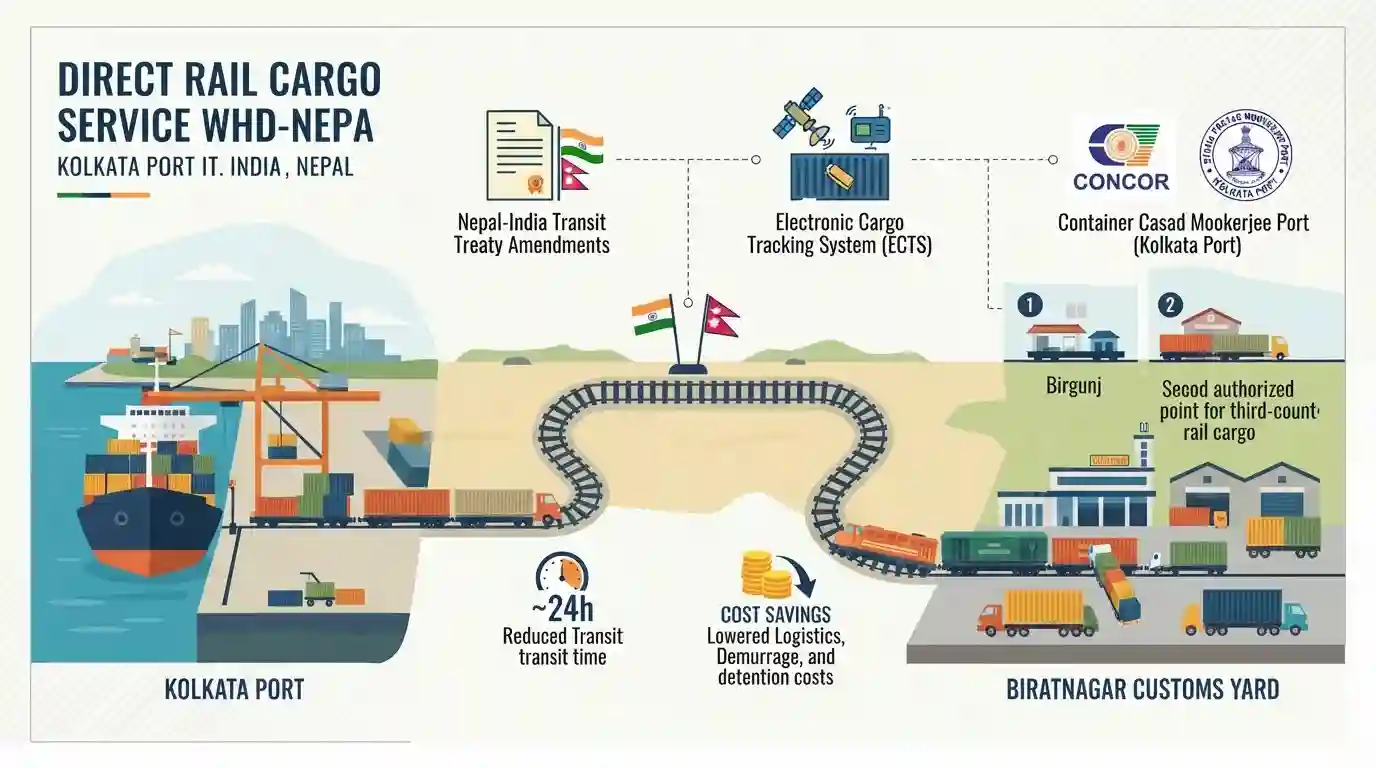
The first direct rail cargo service connecting India's Kolkata Port to Nepal's Biratnagar Customs Yard has been officially launched, marking a significant milestone in cross-border trade logistics. Facilitated by recent amendments to the Nepal-India Transit Treaty and the implementation of the Electronic Cargo Tracking System (ECTS), this service designates Biratnagar as Nepal's second authorized point for receiving third-country rail cargo, after Birgunj. The direct rail link, coordinated by entities including CONCOR and the Syama Prasad Mookerjee Port, runs via Jogbani and reduces the Kolkata-Biratnagar transit time to approximately 24 hours, effectively lowering associated logistics, demurrage, and detention costs.
মূল বিষয়
- A direct rail cargo service has commenced between Kolkata Port (India) and the Biratnagar Customs Yard (Nepal), aiming to boost bilateral trade efficiency.
- Biratnagar is now the second authorized rail transhipment point for third-country cargo entering Nepal from India, breaking the previous monopoly held by Birgunj.
- The operationalization follows recent amendments to the Nepal-India Transit Treaty and utilizes the Electronic Cargo Tracking System (ECTS) to secure cargo movement.
- The cargo transits via the Jogbani land customs station in India before entering the Integrated Check Post (ICP) in Biratnagar.
- Operated with the involvement of CONCOR and Syama Prasad Mookerjee Port, the new route slashes transit time to around 24 hours, significantly reducing demurrage, detention, and overall logistics costs.
গুরুত্বপূর্ণ শব্দ
Nepal-India Transit Treaty

A bilateral agreement that facilitates the transit of landlocked Nepal's third-country trade through designated Indian ports, roads, and railways.
UPSC context
GS Paper II (India & Neighborhood), testing bilateral logistics treaties, cross-border trade facilitation, and strategic regional connectivity.
Electronic Cargo Tracking System (ECTS)
A satellite, GPS, and RFID-based cargo monitoring system that tracks sealed transit containers to prevent smuggling, unauthorized unloading, and custom delays.
UPSC context
GS Paper III (Infrastructure & Technology), testing tech-enabled logistics, border security, customs modernization, and trade efficiency.
Syama Prasad Mookerjee Port
Formerly Kolkata Port, it is India's oldest operating port and only major riverine port, located on the Hooghly River in West Bengal.
UPSC context
GS Paper I (Geography) & GS Paper III (Economy), testing major national infrastructure, maritime geography, and riverine trade routes.
Container Corporation of India (CONCOR)
A Navratna Public Sector Undertaking under the Ministry of Railways that provides multimodal logistics, container transport, and inland port services.
UPSC context
GS Paper III (Economy/Infrastructure), testing state-run transport systems, dry port networks, and logistics cost reduction strategies.
প্রিলিমস ফাঁদ
Birgunj is the sole operational land customs station authorized to receive third-country rail cargo transit into Nepal.
Biratnagar has now been operationalized as the second rail cargo terminal for third-country transit, ending the exclusive operational monopoly of Birgunj.
সংযুক্ত স্থির ধারণা
What are the unique geographical and operational features of the Syama Prasad Mookerjee Port?
- Riverine Status: It is India's only major riverine port, situated on the Hooghly River, requiring constant dredging to maintain navigable draft.
- Hinterland & Transit: Acts as the primary maritime gateway for landlocked countries like Nepal and Bhutan under bilateral transit treaties.
- Historical Legacy: Established in 1870, it is the oldest operating major port in India.
How does international law govern the transit rights of landlocked states?
- UNCLOS Article 125: Grants landlocked states the right of access to and from the sea, and freedom of transit through transit states.
- Bilateral Reliance: Actual implementation of these transit rights depends on bilateral, sub-regional, or regional agreements between the states concerned.
- Sovereignty Clause: Transit states maintain full sovereignty to ensure transit activities do not infringe upon their legitimate security interests.
আন্তঃবিষয় প্যাটার্ন
Neighborhood First + Integrated Check Posts (ICPs)
Upgrading land customs stations to ICPs (like Jogbani, Raxaul) bridges physical connectivity gaps, balancing India's regional security concerns with its neighborhood trade commitments.
ECTS + Trade Facilitation Agreement (TFA)
The use of GPS-based ECTS aligns with the WTO Trade Facilitation Agreement, illustrating how technology-driven customs reform reduces non-tariff barriers in South Asian cross-border corridors.

India-Nepal land connectivity corridors, ICP locations (Jogbani, Birgunj), and ECTS transit mechanisms are highly testable in 2026.
সংযুক্ত PYQ · 2
সংযুক্ত PYQ · 2
- 2018WBCS_PRELIMSGS1
'Dry Port' of West Bengal is located at
- 2023WBCS_PRELIMSGS1
The Diamond Quadrilateral of India will connect
