Tamil Nadu Plea in Supreme Court for Cauvery Water Release
Source:The Hindu ↗
ఇది ఎందుకు ముఖ్యం
It underscores the ongoing friction between riparian states in India over river water sharing, testing the effectiveness of judicial intervention and institutional mechanisms like the Cauvery Water Management Authority under cooperative federalism.
సారాంశం
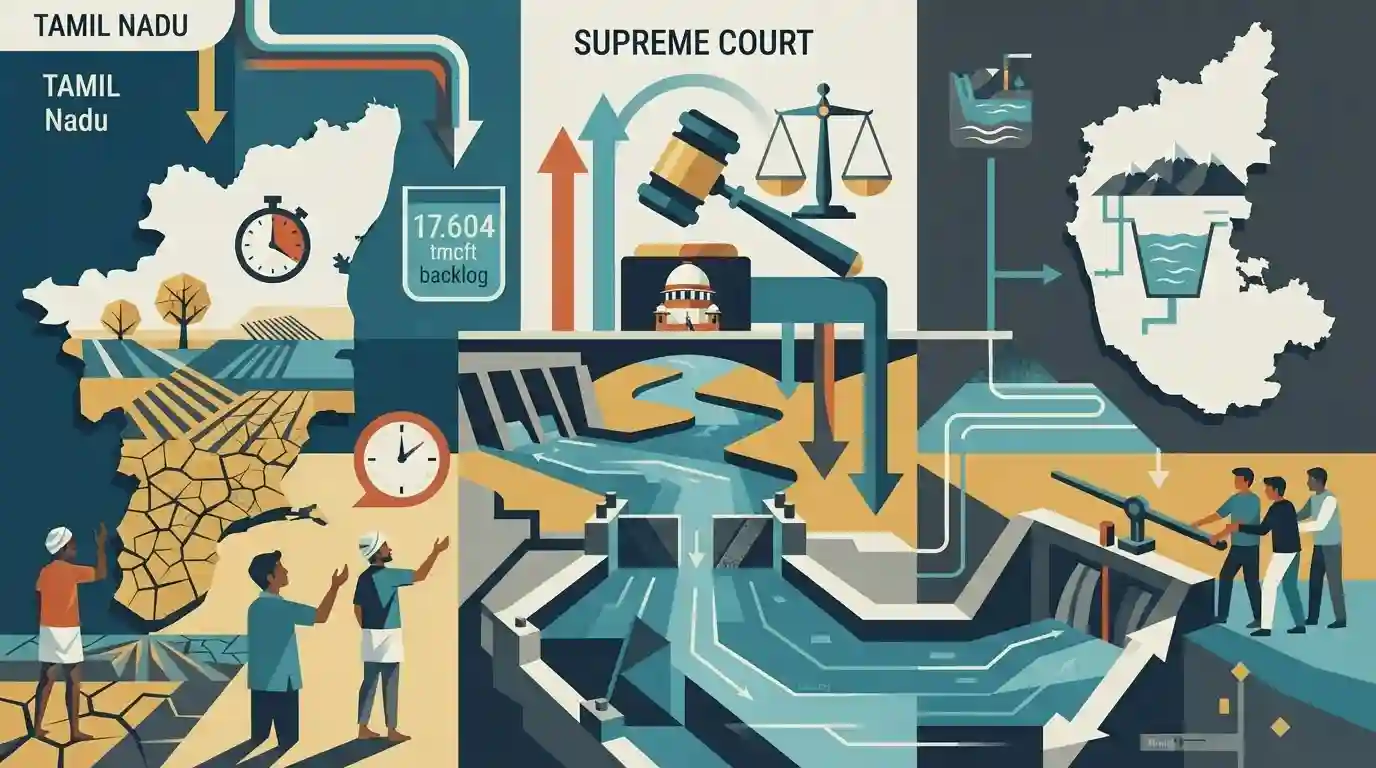
Tamil Nadu has moved the Supreme Court seeking directions to compel Karnataka to release a backlog of 17.604 tmcft of Cauvery water, escalating the long-standing inter-state water dispute over the Cauvery river basin management and compliance with water-sharing orders.
ముఖ్య అంశాలు
- Tamil Nadu approached the Supreme Court seeking directions for Karnataka to release a backlog of 17.604 tmcft of Cauvery water.
- The dispute highlights persistent friction between riparian states over water-sharing arrangements mandated by tribunals and regulatory bodies like the CWMA.
- Inter-state water disputes test the limits of cooperative federalism and judicial enforcement mechanisms in India.
ముఖ్యమైన పదాలు
Inter-State Water Disputes Act

A central legislation enacted under Article 262 of the Constitution that provides for the adjudication of water disputes relating to inter-state rivers and river valleys through specially constituted tribunals.
UPSC context
Important for GS Paper II (Polity and Governance - Federalism, Centre-State relations, statutory bodies, and dispute resolution mechanisms).
Supreme Court
The apex judicial body of India that possesses original jurisdiction under Article 131 and appellate oversight, occasionally intervening in inter-state river water disputes despite statutory bars under specific conditions.
UPSC context
Crucial for GS Paper II (Indian Constitution, Judicial Review, and federal dispute resolution).
Cauvery Water Management Authority (CWMA)
A body established by the Central Government under Section 6A of the Inter-State Water Disputes Act, 1956, pursuant to Supreme Court directions to implement the Cauvery water-sharing awards.
UPSC context
Important for GS Paper II/III (Statutory bodies, water resource management, and cooperative federalism challenges).
ప్రిలిమ్స్ ఉచ్చు
Article 262 ensures that the Supreme Court has exclusive and original jurisdiction over all inter-state river water disputes without exception.
Article 262 empowers Parliament to provide for the adjudication of inter-state water disputes and explicitly allows Parliament to exclude the jurisdiction of all courts, including the Supreme Court.
అనుసంధానమైన స్థిర భావనలు
What constitutional and statutory mechanisms govern inter-state river water disputes in India?
- Article 262: Constitutional Basis: Empowered by Article 262, Parliament enacted the Inter-State Water Disputes Act, 1956.
- Court Bar: Exclusion of Jurisdiction: Parliament may by law exclude the jurisdiction of the Supreme Court and all other courts in such disputes.
- Tribunals & CWMA: Statutory Bodies: Tribunals are constituted ad-hoc for adjudication, while permanent regulatory bodies like the CWMA oversee implementation.
అంతర-అంశ నమూనాలు
Cauvery Dispute & Cooperative Federalism Limits
Inter-state water sharing disputes directly test the strength of cooperative federalism, constitutional enforcement under Article 131, and the efficacy of statutory authorities like the CWMA.
Monsoon Deficits and Basin Management Friction
Climate change induced monsoon deficits frequently exacerbate traditional river basin disputes, linking agricultural water security with disaster and resource management.

Article 262 + exclusions of SC jurisdiction vs Article 131 original jurisdiction in inter-state water disputes is a high-yield prelims trap.
అనుసంధాన PYQలు · 3
అనుసంధాన PYQలు · 3
- 2014PrelimsGS1
The power of the Supreme Court of India to decide disputes between the Centre and the States falls under its
- 2015MainsGS2
The concept of cooperative federalism has been increasingly emphasized in recent years. Highlight the drawbacks in the existing structure and the extent to which cooperative federalism would answer the shortcomings.
- 2019PrelimsGS1
Consider the following pairs: Wildlife Naturally found in 1. Blue-finned Mahseer : Cauvery River 2. Irrawaddy Dolphin : Chambal River 3. Rusty-spotted Cat : Eastern Ghats Which of the pairs given above are correctly matched?
