Cauvery River Water Sharing Dispute and Legal Proceedings
Source:The Hindu ↗
কেন এটি গুরুত্বপূর্ণ
The Cauvery River water dispute is a highly critical and recurring theme in Indian federalism. It exemplifies the constitutional, statutory, and administrative challenges of transboundary water governance under Article 262 and the Inter-State River Water Disputes Act, 1956. It highlights the complexities of devising a functional distress-sharing formula during dry years and balances the overlapping domains of judicial intervention, federal coordination, and regional agricultural survival (Kuruvai and Samba crops).
সারসংক্ষেপ
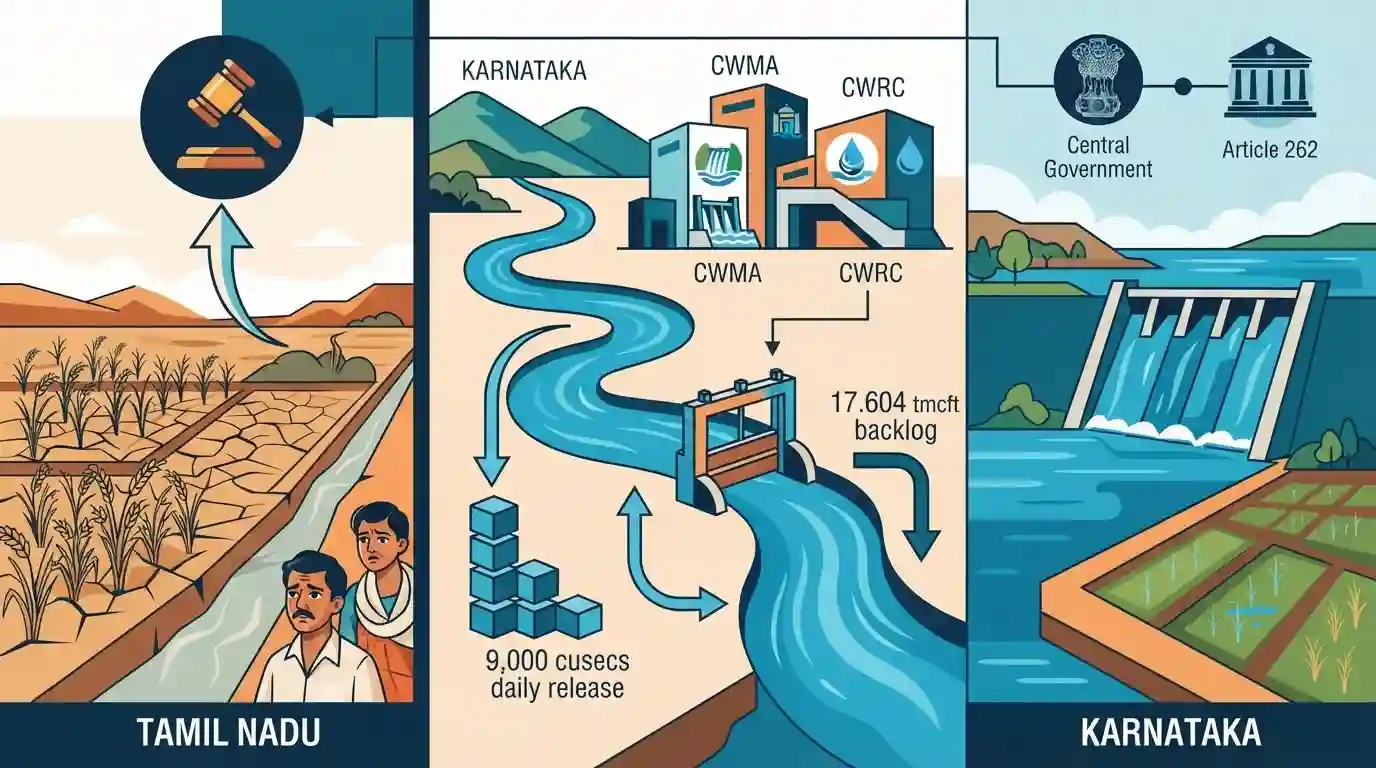
Tamil Nadu has approached the Supreme Court seeking directions to Karnataka for the release of 17.604 tmcft of backlog water, alongside the daily release of 9,000 cusecs as mandated by the Cauvery Water Management Authority (CWMA). Highlighting severe agricultural distress in the Cauvery Delta affecting the Kuruvai and Samba paddy crops, Tamil Nadu argued that the CWMA has failed to properly implement the pro-rata water-sharing mechanism during distress years under Section 6A of the Inter-State River Water Disputes Act, 1956.
মূল বিষয়
- Tamil Nadu has filed a supplementary affidavit in the Supreme Court of India seeking a directive to Karnataka to immediately release a backlog of 17.604 tmcft of Cauvery water.
- Tamil Nadu also urged the apex court to mandate Karnataka to release 9,000 cusecs of water daily, in line with the directions issued by the Cauvery Water Management Authority (CWMA).
- The state argued that the CWMA failed to consider a substantial backlog of 17.415 tmcft (as of August 23) when it fixed the daily release of 9,000 cusecs.
- The petition highlights the failure to implement the Cauvery Water Management Scheme framed under Section 6A of the Inter-State River Water Disputes Act, 1956, specifically regarding 'pro-rata' (proportionate) water sharing during distress years.
- The agricultural sector in Tamil Nadu's Cauvery Delta is severely impacted: the Kuruvai paddy season is virtually over, the Mettur reservoir has insufficient storage to open for irrigation, and the upcoming Samba crop cultivation is in jeopardy.
গুরুত্বপূর্ণ শব্দ
Inter-State River Water Disputes Act, 1956

An Act enacted under Article 262 of the Constitution that establishes a statutory framework and ad-hoc tribunals for the binding adjudication of water-sharing disputes over inter-state rivers and river valleys.
UPSC context
GS Paper II (Polity/Dispute Redressal); tests constitutional provisions on inter-state water conflicts and federalism.
Cauvery Water Management Scheme, 2018
A central scheme framed in June 2018 under the Supreme Court's mandate, establishing a permanent institutional mechanism (CWMA and CWRC) to implement the modified water-sharing award of the Cauvery Water Disputes Tribunal.
UPSC context
GS Paper II (Governance) / Paper III (Resources); tests execution of judicial mandates and federal mechanisms.
Cauvery Water Management Authority (CWMA)
A statutory, quasi-judicial body notified under Section 6A of the Inter-State River Water Disputes Act, 1956, responsible for regulating, apportioning, and supervising water release and distress-sharing in the Cauvery basin.
UPSC context
GS Paper II (Statutory Bodies); tests structure, power, and role of river basin authorities in federalism.
Cauvery Water Regulation Committee (CWRC)
A subordinate monitoring body under the CWMA that collects daily meteorological and hydrological data—such as reservoir storage, rainfall, inflows, and outflows—to assist and recommend weekly/monthly water releases.
UPSC context
GS Paper II (Governance) / Paper III (Water Resources); tests technical data-driven monitoring mechanisms in dispute resolution.
প্রিলিমস ফাঁদ
The Supreme Court is constitutionally barred from entertaining any petition or appeal on inter-state water disputes due to Article 262.
While Article 262 and ISRWD Act Section 11 bar normal jurisdiction, the SC retains jurisdiction under Article 136 (SLP) to review final tribunal awards and monitor their enforcement.
সংযুক্ত স্থির ধারণা
What is the constitutional framework governing inter-state water disputes in India?
- Legislative competence: Water is primarily a State subject (Entry 17), but subject to Union regulation of inter-state rivers in public interest (Entry 56).
- Article 262: Empowers Parliament to adjudicate disputes relating to inter-state rivers and exclude the jurisdiction of all courts, including the Supreme Court.
- Judicial review: Despite statutory bars, the Supreme Court can entertain Special Leave Petitions (Article 136) to hear appeals against final tribunal awards.
What are the core geographical features and tributaries of the Cauvery river?
- Origin and course: Originates at Talakaveri in the Brahmagiri Range (Karnataka) and flows southeast through Tamil Nadu and Puducherry to the Bay of Bengal.
- Left-bank tributaries: Key tributaries include the Harangi, Hemavati, Shimsha, and Arkavati, which feed the river system primarily from the north.
- Right-bank tributaries: Key tributaries include the Kabini, Bhavani, Noyyal, Amaravati, and Lakshmantirtha, contributing major inflows from the south.
আন্তঃবিষয় প্যাটার্ন
Water federalism + Agrarian crop cycles
Delayed inter-state water releases directly disrupt localized agrarian cycles like Kuruvai and Samba in downstream states, elevating a legal dispute into an acute food security and economic crisis.
Climate change + Pro-rata sharing
Erratic monsoons and rainfall deficits strain the pro-rata water-sharing formulas of statutory bodies, converting ecological crises into frequent constitutional battles over federal resource allocation.

UPSC likely to test the intersection of Article 262, Entry 56 (List I), and Supreme Court's Article 136 power over tribunal awards.
সংযুক্ত PYQ · 2
সংযুক্ত PYQ · 2
- 2015MainsGS2
The concept of cooperative federalism has been increasingly emphasized in recent years. Highlight the drawbacks in the existing structure and the extent to which cooperative federalism would answer the shortcomings.
- 2020MainsGS3
Suggest measures to improve water storage and irrigation system to make its judicious use under depleting scenario.
