US Tariff Hikes Impact on Indian Exports and Economy
Source:The Hindu ↗
Why It Matters
Understanding the impact of global trade protectionism on the Indian economy is crucial for GS-3. This article highlights the vulnerability of specific export sectors to U.S. tariff hikes while underscoring India's overall resilience due to export diversification. It also touches upon ongoing developments in the banking and insurance sectors, including IPOs and bancassurance regulations, which are relevant for financial sector topics.
Summary
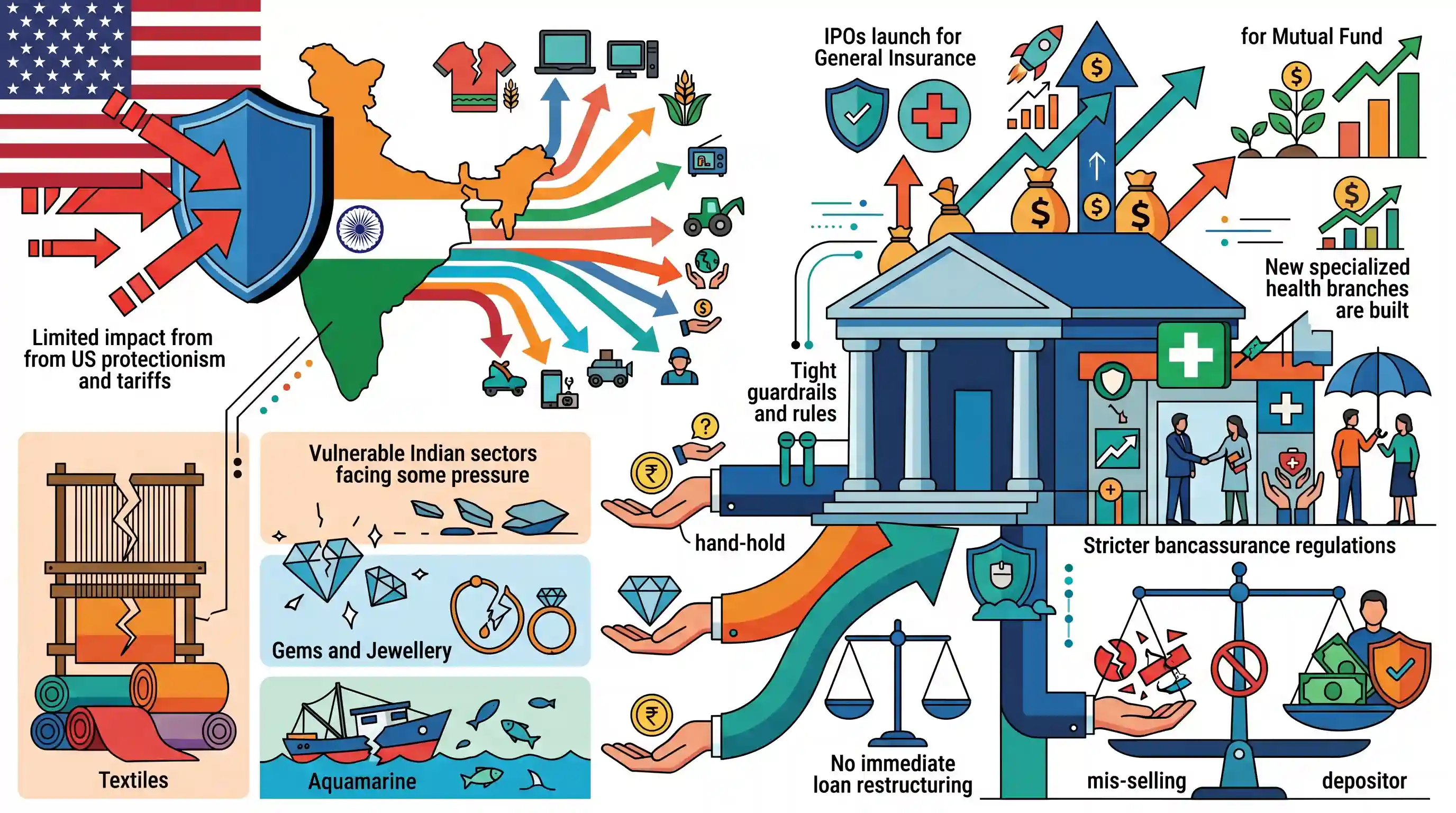
According to SBI Chairman C.S. Setty, a higher tariff regime in the U.S. is expected to have a limited direct impact on the Indian economy, thanks to India's diversified export destinations and broad product basket. However, specific sectors heavily dependent on U.S. exports, such as textiles, gems and jewellery, and aquamarine, could face pressure and may require targeted support or "hand-holding" from banks. Immediate loan restructuring for these sectors is not yet being considered. In addition to trade concerns, SBI is exploring IPOs for its general insurance and mutual fund subsidiaries. The bank is also focusing on increasing insurance penetration by launching specialized health branches and advocated for stricter bancassurance regulations to prevent mis-selling and safeguard depositors.
Key Points
- SBI Chairman C.S. Setty stated that increased U.S. tariffs will have a limited direct impact on India owing to its diversified export basket and geographical spread.
- Sectors predominantly exporting to the U.S., such as textiles, gems and jewellery, and aquamarine, may face challenges and require banking support.
- While some industries might need 'hand-holding', immediate loan restructuring is not currently under consideration by the bank.
- SBI is evaluating Initial Public Offerings (IPOs) for its subsidiaries, SBI General Insurance and SBI Mutual Fund, in the near future.
- To deepen insurance penetration, SBI General Insurance has launched 30 specialized health insurance branches.
- The bank emphasized the need for tweaking bancassurance norms to prevent mis-selling and protect the interests of depositors.
Important Terms
Protectionism

Economic policy of restricting trade between countries through methods such as high tariffs on imports or restrictive quotas to protect domestic industries from foreign competition.
UPSC context
GS Paper 3: International Trade. Tests understanding of trade barriers, their impact on Indian exports, and global trade dynamics.
Domestic Systemically Important Banks (D-SIBs)
A classification by the RBI for banks "too big to fail" due to their size, complexity, and interconnectedness. Currently includes SBI, ICICI, and HDFC, requiring them to hold higher capital buffers.
UPSC context
GS Paper 3: Banking Sector. Tests knowledge of financial stability frameworks and regulatory requirements for major financial institutions.
Insurance Penetration
The ratio of total insurance premiums collected in a year to the country’s Gross Domestic Product (GDP). It serves as a macro-indicator of a nation\'s insurance sector development.
UPSC context
GS Paper 3: Indian Economy. Key metric for financial inclusion and the depth of the financial services sector in India.
Bancassurance
A partnership between banks and insurance companies where the bank acts as a distribution channel to sell insurance products to its customers, often scrutinized for "mis-selling" or forced bundling.
UPSC context
GS Paper 3: Banking/Insurance. Relevant to financial consumer protection, ethical banking practices, and RBI/IRDAI regulatory reforms.
Loan Restructuring
A mechanism where a lender modifies the terms of a loan—such as extending the repayment period or reducing interest rates—to help stressed borrowers avoid default and prevent NPA classification.
UPSC context
GS Paper 3: Banking Sector. Essential for understanding NPA management and relief measures for export-oriented or stressed sectors.
Initial Public Offering (IPO)
The process by which a private company offers shares to the public for the first time to raise capital from institutional and retail investors, transitioning to a publicly traded entity.
UPSC context
GS Paper 3: Capital Markets. Tests understanding of resource mobilization and the role of the stock market in the economy.
Prelims Trap
Bancassurance in India is regulated exclusively by the Insurance Regulatory and Development Authority of India (IRDAI).
Bancassurance involves banks selling insurance; thus, it operates under the dual regulatory oversight of both the RBI (for the banking side) and IRDAI (for the insurance side).
Static Concepts Connected
What is Bancassurance and how is it regulated in India?
- Definition: An arrangement between a bank and an insurance company allowing the insurer to sell its products to the bank's client base.
- Dual Regulation: It is jointly regulated by the RBI (which oversees banking operations) and IRDAI (which oversees insurance products and sales guidelines).
- Mis-selling Risks: A major governance concern where bank staff push unsuitable insurance products to depositors to meet targets, prompting regulators to tighten norms.
What are the macroeconomic characteristics of India's Gems & Jewellery sector?
- Significance: A highly labour-intensive sector contributing roughly 7% to India's GDP and accounting for over 10% of total merchandise exports.
- Import Dependence: It heavily relies on the import of raw materials (like rough diamonds and gold) which are cut, polished, and then exported.
- Major Markets: The United States and UAE remain the dominant export destinations, making the sector highly vulnerable to external tariff shocks.
Cross-Topic Patterns
US Tariffs & Labour-Intensive Exports
Protectionist US tariffs directly threaten employment in India's textile and gems sectors, linking international trade policies to domestic urban and semi-urban unemployment issues.
Financial Inclusion via Bancassurance
The push for 'Insurance for All by 2047' leverages vast banking networks to penetrate rural areas, linking financial inclusion targets with ethical banking governance (preventing mis-selling).

Expect a 2026 prelims statement testing the dual regulatory nature (RBI + IRDAI) of Bancassurance alongside recent mis-selling norms.
Linked PYQs · 3
Linked PYQs · 3
- 2018MainsGS3
How would the recent phenomena of protectionism and currency manipulations in world trade affect macroeconomic stability of India?
- 2025MainsGS3
What are the challenges before the Indian economy when the world is moving away from free trade and multilateralism to protectionism and bilateralism? How can these challenges be met?
- 2020PrelimsGS1
With reference to the international trade of India at present, which of the following statements is/are correct? 1. India's merchandise exports are less than its merchandise imports. 2. India's imports of iron and steel, chemicals, fertilisers and machinery have decreased in recent years. 3. India's exports of services are more than its imports of services. 4. India suffers from an overall trade/current account deficit. Select the correct answer using the code given below:
