Legal Vacuum and Smuggling Risks for Indian Fossil Heritage
Source:The Hindu ↗
Why It Matters
UPSC frequently focuses on the conservation of Indian heritage. The article highlights an ignored aspect of heritage—geological and paleontological relics. Recognizing the legislative gap between art heritage (protected by the Antiquities Act) and natural/geo-heritage is critical for GS1 (Heritage) and GS3 (Conservation) discussions.
Summary
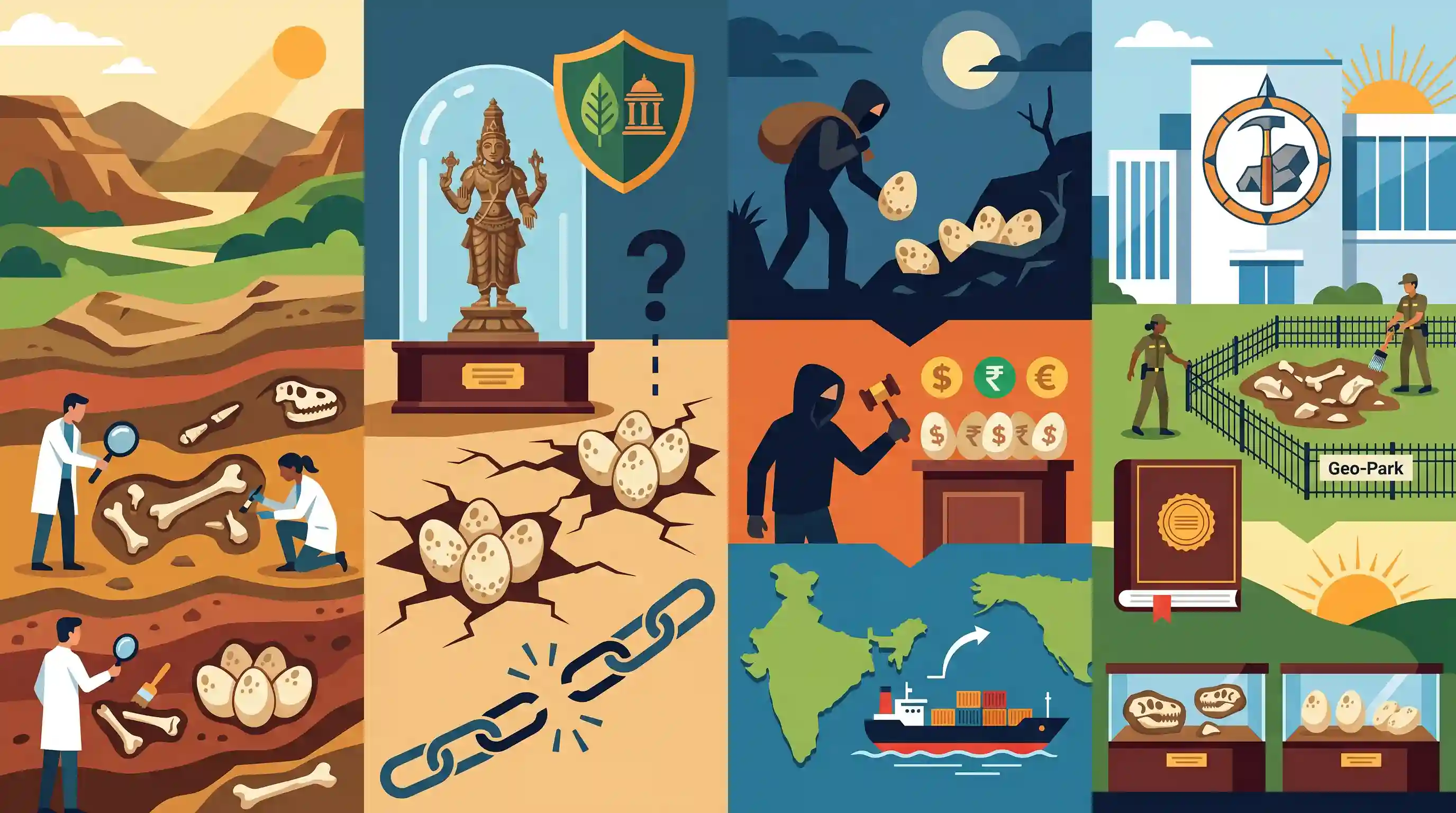
The article emphasizes the alarming vulnerability of India's paleontological wealth, specifically the rich deposits of dinosaur egg fossils found in regions like the Narmada Valley. It draws a stark contrast between historical antiquities, such as bronze idols that are protected under the Antiquities and Art Treasures Act, 1972, and natural geological fossils, which suffer from a severe legal vacuum. Despite the drafting of the Geo-heritage Sites and Geo-relics (Preservation and Maintenance) Bill in 2022, the lack of swift legislative action and on-ground enforcement allows smugglers to loot and auction these rare geo-relics abroad. The piece calls for immediate legal reforms and stronger institutional oversight by bodies like the Geological Survey of India to prevent the irreversible loss of the nation's deep-time scientific heritage.
Key Points
- India possesses significant paleontological wealth, particularly in the Narmada Valley, which hosts some of the world's largest known dinosaur nesting sites and egg clutches.
- Unlike historical artifacts such as bronze idols—which are strictly protected under the Antiquities and Art Treasures Act of 1972—fossils currently lack robust legal safeguards against theft, smuggling, and unauthorized commercial sale.
- The proposed Geo-heritage Sites and Geo-relics (Preservation and Maintenance) Bill, 2022, was drafted to protect geological relics, but delays in its enactment leave these treasures vulnerable to international smuggling rings and private auctions.
- There is an urgent need to empower institutions like the Geological Survey of India (GSI) and foster local awareness to preserve India's irreplaceable deep-time geological heritage for scientific research.
Important Terms
Antiquities and Art Treasures Act, 1972

A 1972 law regulating the export and internal trade of antiquities (items 100+ years old) and art treasures to prevent smuggling and preserve India's cultural heritage.
UPSC context
GS Paper I (Art and Culture); tests knowledge of legal frameworks for cultural preservation and heritage protection.
Geo-heritage Sites and Geo-relics (Preservation and Maintenance) Bill, 2022
Proposed legislation aimed at declaring, protecting, and maintaining sites and movable geological materials (fossils, meteorites) of national importance under the Geological Survey of India.
UPSC context
GS Paper III (Environment/Conservation) and Paper II (Governance); highlights legislative gaps in natural heritage protection.
Geological Survey of India (GSI)
An attached office of the Ministry of Mines, founded in 1851, responsible for geoscientific mapping, mineral resource assessment, and designating National Geological Monuments.
UPSC context
GS Paper I (Physical Geography) and GS Paper III (Resources); critical for institutional roles in resource management and geo-conservation.
Geo-relics
Movable geological materials such as sediments, rocks, minerals, meteorites, or fossils that possess significant scientific or historical interest.
UPSC context
GS Paper I (Geography); tests terminology related to natural history and scientific heritage conservation.
Geo-heritage Sites
Specific geographical locations containing unique geological features, rock formations, or fossils that provide scientific insights into Earth's evolutionary history.
UPSC context
GS Paper I (Geography) and Paper III (Environment); relates to biodiversity and natural resource conservation.
Lameta Formation
A sedimentary rock formation in the Narmada Valley (Late Cretaceous) famous for containing one of the world's largest collections of dinosaur egg clutches.
UPSC context
GS Paper I (Geography); specific site-based knowledge relevant to India’s paleontological significance and natural heritage.
Prelims Trap
Natural fossils discovered in India are protected as antiquities by the Archaeological Survey of India under the Antiquities and Art Treasures Act, 1972.
Fossils are geological relics, not man-made historical artifacts. They are excluded from the 1972 Antiquities Act. The nodal agency is the GSI, not ASI.
Static Concepts Connected
What are the key geological features of the Lameta Formation?
- Location: Primarily found in the Narmada Valley spanning states like Madhya Pradesh, Gujarat, and Maharashtra.
- Geological era: Consists of sedimentary rock layers dating back to the Late Cretaceous period.
- Paleontological significance: Known globally for exceptional preservation of Titanosaur dinosaur eggs and bones, shielded from erosion by subsequent Deccan volcanic flows.
How does the mandate of GSI differ from ASI?
- GSI: Under the Ministry of Mines. Deals with geological mapping, mineral resources, and identifying Geo-heritage Sites and natural geo-relics (fossils, meteorites).
- ASI: Under the Ministry of Culture. Responsible for archaeological research and the protection of historical, man-made cultural monuments and antiquities.
Cross-Topic Patterns
Volcanism + Sedimentary preservation
The Deccan Trap volcanic eruptions (Physical Geography) acted as a protective cap over the sedimentary Lameta formation, saving fragile dinosaur clutches from weathering over millions of years.
Antiquities Act + Legal loopholes
UPSC frequently tests legal definitions. Just as the Wildlife Protection Act specifies 'vermin', the 1972 Antiquities Act explicitly defines artifacts to exclude naturally occurring geological objects like fossils.

Expect a Prelims question contrasting ASI's mandate over antiquities (1972 Act) with GSI's jurisdiction over geo-relics and fossils.
Linked PYQs · 2
Linked PYQs · 2
- 2018MainsGS1
Safeguarding the Indian art heritage is the need of the moment. Discuss.
- 2019PrelimsGS1
The word 'Denisovan' is sometimes mentioned in media in reference to
