India-Canada Bilateral Ties Resume With New High Commissioners
Source:The Hindu ↗
Why It Matters
The restoration of India-Canada ties underscores the impact of domestic political transitions on foreign policy. It highlights India's evolving approach to managing bilateral spats with Western nations over diaspora issues (such as Khalistan extremism) and the critical role of diplomatic channels in protecting long-term economic and geopolitical interests.
Summary
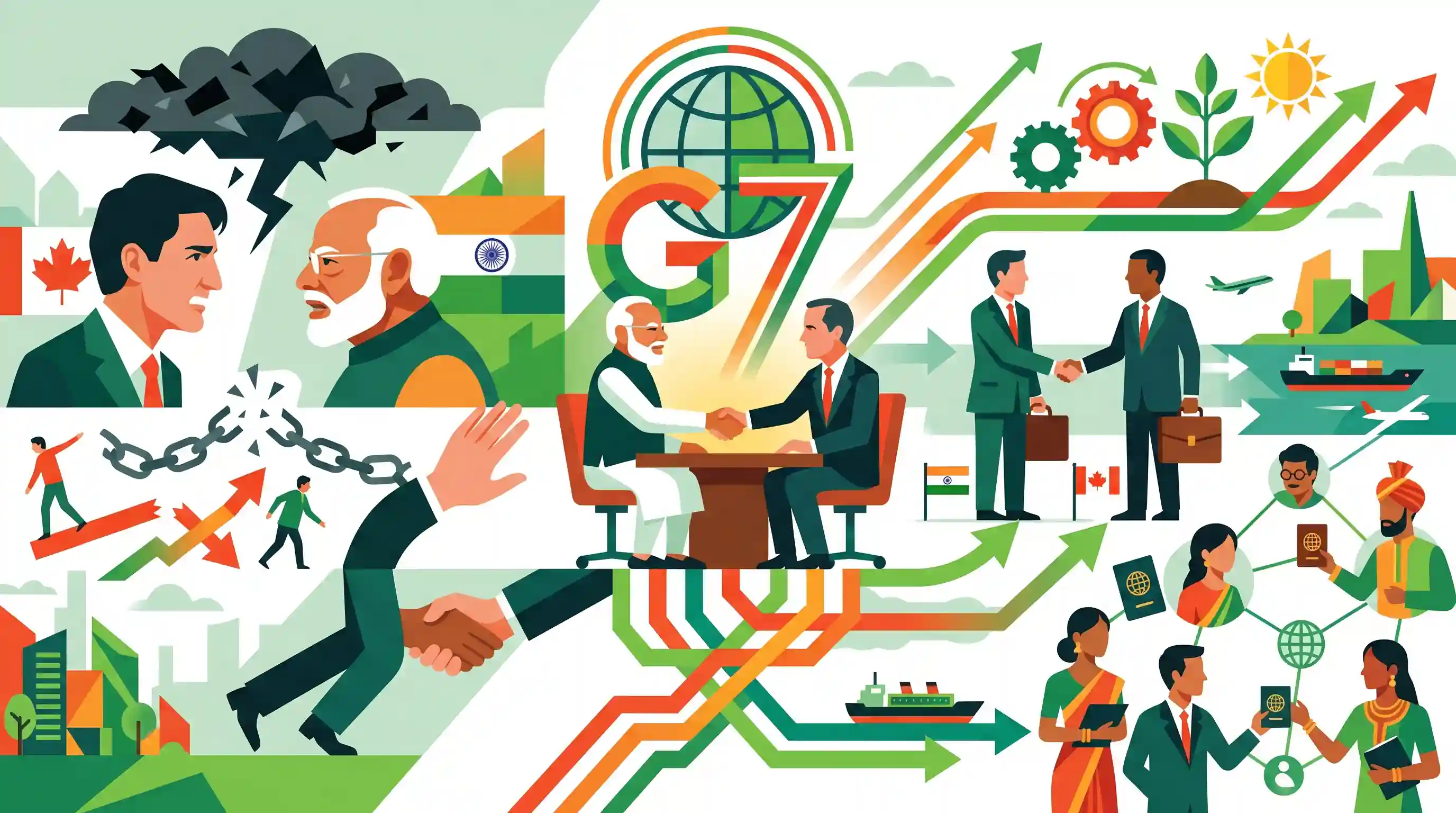
India and Canada have announced the appointment of new envoys, signaling an end to the severe diplomatic rift triggered by the 2023 assassination of pro-Khalistan activist Hardeep Singh Nijjar. Following former Canadian PM Justin Trudeau's resignation and the election victory of his successor Mark Carney, both nations have taken concrete steps toward normalization. The reinstatement of High Commissioners comes after a meeting between PM Narendra Modi and PM Mark Carney at the G7 summit, highlighting a pragmatic reset in bilateral relations that prioritizes mutual cooperation and diaspora services over historical grievances.
Key Points
- India and Canada have appointed new High Commissioners (Dinesh K. Patnaik and Christopher Cooter, respectively), marking the formal normalization of bilateral ties.
- The diplomatic relationship had severely deteriorated following former PM Justin Trudeau's allegations of Indian involvement in the 2023 assassination of pro-Khalistan activist Hardeep Singh Nijjar, leading to tit-for-tat diplomat expulsions.
- The shift towards rapprochement follows a leadership change in Canada, where Trudeau resigned in January 2025 and was succeeded by Mark Carney, who won the April 2025 elections.
- Prime Minister Narendra Modi and Mark Carney recently agreed to upgrade ties during their bilateral meeting on the sidelines of the G7 summit in Kananaskis.
Important Terms
Ministry of External Affairs (MEA)

The Indian government ministry responsible for formulating and executing foreign policy, representing the nation in international forums and bilateral negotiations.
UPSC context
GS Paper II: International Relations; crucial for understanding the institutional mechanics of India's diplomatic engagements.
G7 (Group of Seven)
An informal forum of seven of the world's most advanced economies, meeting annually to discuss global economic, security, and environmental issues.
UPSC context
GS Paper II: Important International institutions; tests India’s strategic autonomy while engaging with Western blocs.
High Commissioner
The diplomatic equivalent of an Ambassador, used specifically for the head of a diplomatic mission between member nations of the Commonwealth.
UPSC context
GS Paper II: International Relations; tests knowledge of diplomatic protocols and Commonwealth-specific terminology.
Khalistan Movement
A separatist movement aiming to establish a sovereign Sikh state (Khalistan) in Punjab, often posing significant diplomatic challenges in India-Canada relations.
UPSC context
GS Paper III: Internal Security; tests the impact of cross-border extremism on bilateral ties and sovereignty.
Comprehensive Economic Partnership Agreement (CEPA)
A comprehensive free trade agreement that reduces tariffs and facilitates trade in goods, services, and investment between two countries.
UPSC context
GS Paper III: Indian Economy; relevant for trade policy, export diversification, and economic diplomacy.
Indo-Pacific
A geopolitical construct emphasizing the interconnectedness of the Indian and Pacific Oceans as a single strategic maritime space.
UPSC context
GS Paper II: Regional Groupings; tests India's 'Act East' policy and strategic maritime security.
Prelims Trap
India violated international law by unilaterally forcing Canada to withdraw 41 diplomats during the 2023 diplomatic row.
India legally invoked Article 11.1 of the 1961 Vienna Convention on Diplomatic Relations, which permits a host state to limit the size of a diplomatic mission to ensure parity.
Static Concepts Connected
Which key features of the Indian Constitution were borrowed from the Canadian Constitution?
- Strong Centre: India adopted a federal system with a strong central government, rejecting the model of a weak centre.
- Residuary Powers: Unlike the US where residuary powers belong to states, Article 248 vests residuary powers in the Union Parliament.
- Governor Appointments: State Governors are appointed by the Centre and act as agents of the Union, a feature taken from Canada.
- Advisory Jurisdiction: The Supreme Court's advisory jurisdiction (Article 143), where the President can seek its opinion, is a Canadian borrowing.
How does the Vienna Convention regulate the size of foreign diplomatic missions?
- Article 11.1: Under Article 11.1, if there is no specific agreement, the receiving state can dictate the size of a foreign mission.
- Reasonable Limits: The size must be kept within limits considered "reasonable and normal" by the host state, based on needs and circumstances.
- Parity Principle: India invoked this to demand parity, forcing Canada to match India's smaller diplomatic presence in Ottawa.
Cross-Topic Patterns
CEPA revival and India's FTA strategy
Normalizing ties could restart the stalled Comprehensive Economic Partnership Agreement (CEPA). UPSC often compares stalled FTAs like Canada and the EU with finalized ones like UAE (CEPA) and Australia (ECTA).
Diaspora extremism & internal security
The diplomatic spat underscores how political dynamics within the diaspora can harbor transnational extremism, linking India’s bilateral diplomacy directly to its internal security and sovereignty challenges.

Expect a mixed-statement Prelims question linking Vienna Convention rules (Article 11) to constitutional borrowings from Canada in 2026.
Linked PYQs · 2
Linked PYQs · 2
- 2023MainsGS2
Indian diaspora has scaled new heights in the West. Describe its economic and political benefits for India.
- 2020MainsGS2
Indian diaspora has a decisive role to play in the politics and economy of America and European Countries'. Comment with examples.
