Congress Criticises Modi Address to Israeli Parliament
Source:The Hindu ↗
Why It Matters
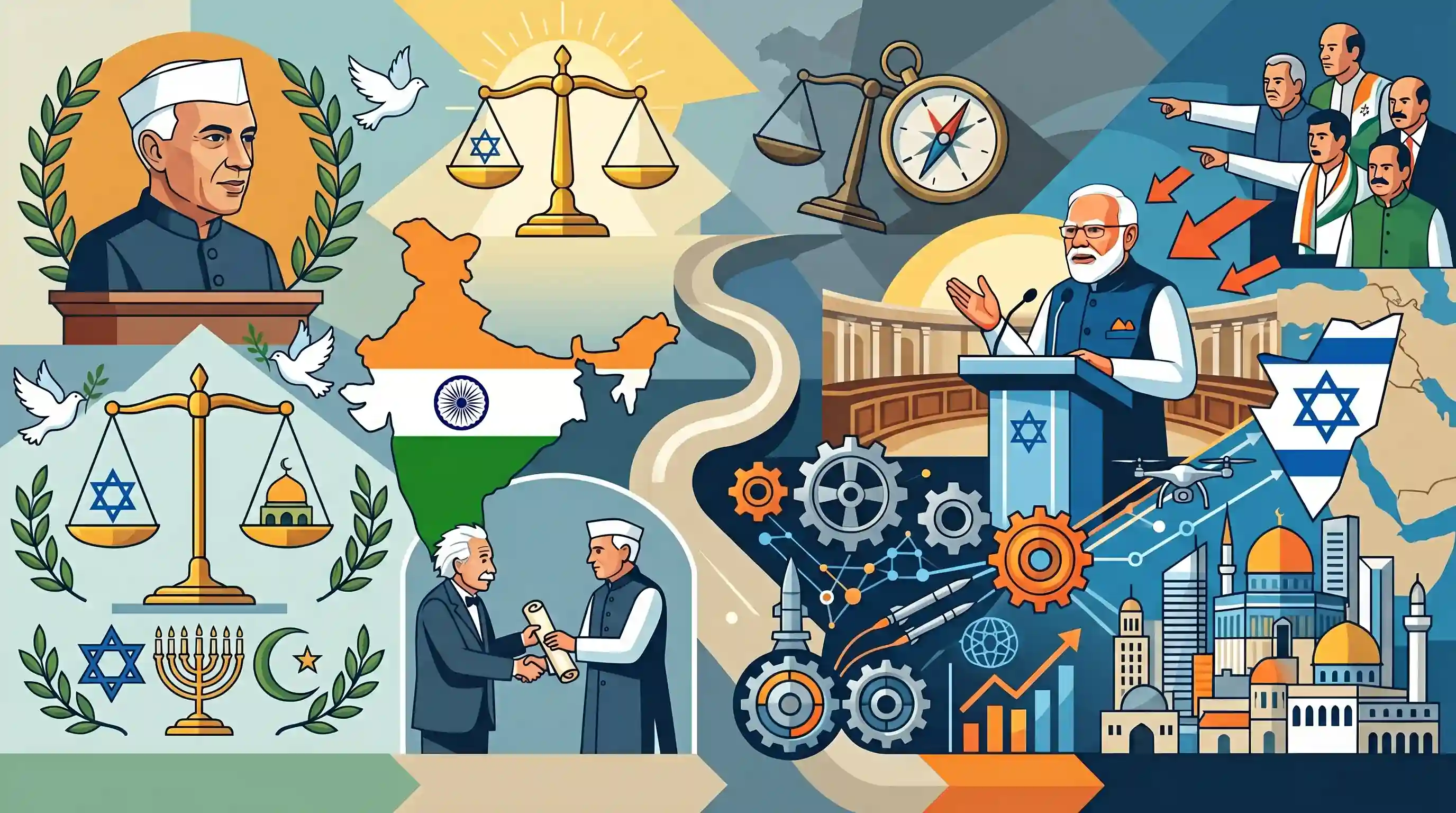
The article highlights the tension between realpolitik and moral diplomacy in India's foreign policy. For UPSC aspirants, understanding the historical context (such as Nehru's correspondence) and the modern strategic shift toward Israel is crucial for evaluating India's evolving role in Middle Eastern geopolitics and its standing in the Global South.
Summary
The Indian National Congress strongly criticized Prime Minister Narendra Modi's address to the Israeli Parliament, arguing that his "unabashed defence" of Israel diminishes India's moral standing on the global stage. Highlighting India's historical foreign policy approach, Congress leader Jairam Ramesh cited Jawaharlal Nehru's 1947 correspondence with Albert Einstein to emphasize India's traditional sympathy for both Jews and Arabs. The political debate underscores the transition in India's Middle Eastern diplomacy from Nehruvian non-alignment and moral balance to a highly strategic partnership with Israel under the current administration.
Key Points
- The Congress party criticized PM Modi\'s recent address to the Israeli Parliament (Knesset), claiming his strong defense of Israel and Prime Minister Netanyahu diminishes India\'s historical moral standing.
- During his address, PM Modi highlighted the \'Gaza Peace Initiative\' and reiterated India\'s deep solidarity with Israel in the wake of the October 7 Hamas attacks.
- Congress leader Jairam Ramesh contrasted the current stance with Jawaharlal Nehru\'s historical policy, citing Nehru\'s 1947 correspondence with Albert Einstein regarding the creation of Israel.
- Nehru\'s letters highlighted a balanced approach that expressed deep sympathy for both Jews and Arabs, noting the importance of Arab goodwill and blaming British colonial rule for complicating the Palestinian issue.
- The episode underlines an ongoing domestic debate over the evolution of India\'s foreign policy from traditional non-alignment and moral diplomacy to a more strategic, unabashed partnership with Israel.
Important Terms
Knesset

The unicameral national legislature of Israel, responsible for passing laws, electing the President and Prime Minister, and overseeing government operations.
UPSC context
GS Paper II: Important for understanding bilateral diplomatic milestones and the structure of international legislative bodies.
Hamas
A Palestinian Sunni-Islamic militant and political organization that governs the Gaza Strip; its actions and India's response are central to modern West Asian diplomacy.
UPSC context
GS Paper II/III: Critical for analyzing regional stability, terrorism, and India's evolving stance on non-state actors in West Asia.
Gaza Peace Initiative
A diplomatic framework or roadmap (referenced in recent contexts) aimed at establishing a just and durable peace in the Palestinian territories.
UPSC context
GS Paper II: Tests knowledge of current diplomatic efforts and India’s role in mediating or supporting Middle East peace processes.
Nehruvian Foreign Policy
India's traditional foreign policy based on non-alignment, anti-colonialism, and a moralistic approach that historically balanced relations between the Arab world and Israel.
UPSC context
GS Paper I/II: Essential for comparing historical continuity versus pragmatic shifts in India's international relations.
Indian National Congress (INC)
India's oldest political party; in this context, it acts as the primary critic of the government’s perceived departure from historical foreign policy norms.
UPSC context
GS Paper II: Relevant for studying the role of opposition parties in influencing and critiquing national foreign policy.
Prelims Trap
India supported the 1947 UN Partition Plan for Palestine due to historical sympathies.
India actually voted against the 1947 UN Partition Plan, proposing a federal state instead. It officially recognized Israel later in 1950.
Static Concepts Connected
What is India's "De-hyphenation Policy" regarding the Middle East?
- Independent ties: Treating relations with Israel and Palestine as mutually independent, evaluating each relationship on its own merits and strategic value.
- Strategic realism: Moving away from the historical zero-sum approach, allowing India to deepen defense and tech ties with Israel unabashedly.
- Balancing act: India continues to formally support the two-state solution for the Palestinian cause while simultaneously hosting Israeli leadership.
Why did Nehru oppose the 1947 UN Partition Plan for Palestine?
- Federal state preference: India proposed an independent federal state with constitutionally guaranteed autonomous Arab and Jewish regions, rather than an outright partition.
- Anti-imperialism: Nehru viewed the partition largely as a product of British imperial machinations, consistently opposing colonial-imposed borders.
- Geopolitical sensitivity: He sought to balance genuine sympathy for persecuted European Jews with the political sentiments of Arab nations and India's own population.
Cross-Topic Patterns
Ethics in IR: Idealism vs. Pragmatism
The shift from Nehru's moral diplomacy to current strategic realism serves as a perfect GS4 case study on balancing international ethical standing with core national security interests.
I2U2 and broader Middle East strategy
India's de-hyphenated approach enables participation in the I2U2 (India, Israel, UAE, US) grouping, seamlessly separating deep Israel defense ties from broader Arab economic partnerships.

Mains 2026 GS2 could ask to critically examine the shift from Nehruvian idealism to strategic realism in India's West Asia policy.
Linked PYQs · 2
Linked PYQs · 2
- 2018MainsGS2
“India’s relations with Israel have, of late, acquired a depth and diversity, which cannot be rolled back.” Discuss.
- 2020MainsGS4
‘The will to power exists, but it can be tamed and be guided by rationality and principles of moral duty.’ Examine this statement in the context of international relations.
