Veer Bharat Trust and Scindia Heritage Controversy in Madhya Pradesh
Source:india-tv ↗
Why It Matters
The topic touches upon the statutory regulations of public trusts in Madhya Pradesh, the executive powers and ex-officio roles of the Chief Minister, and the rich historical legacy of the Scindia dynasty. These core areas frequently appear in the MPPSC State Service Prelims under State Polity, Administration, and regional History.
Summary
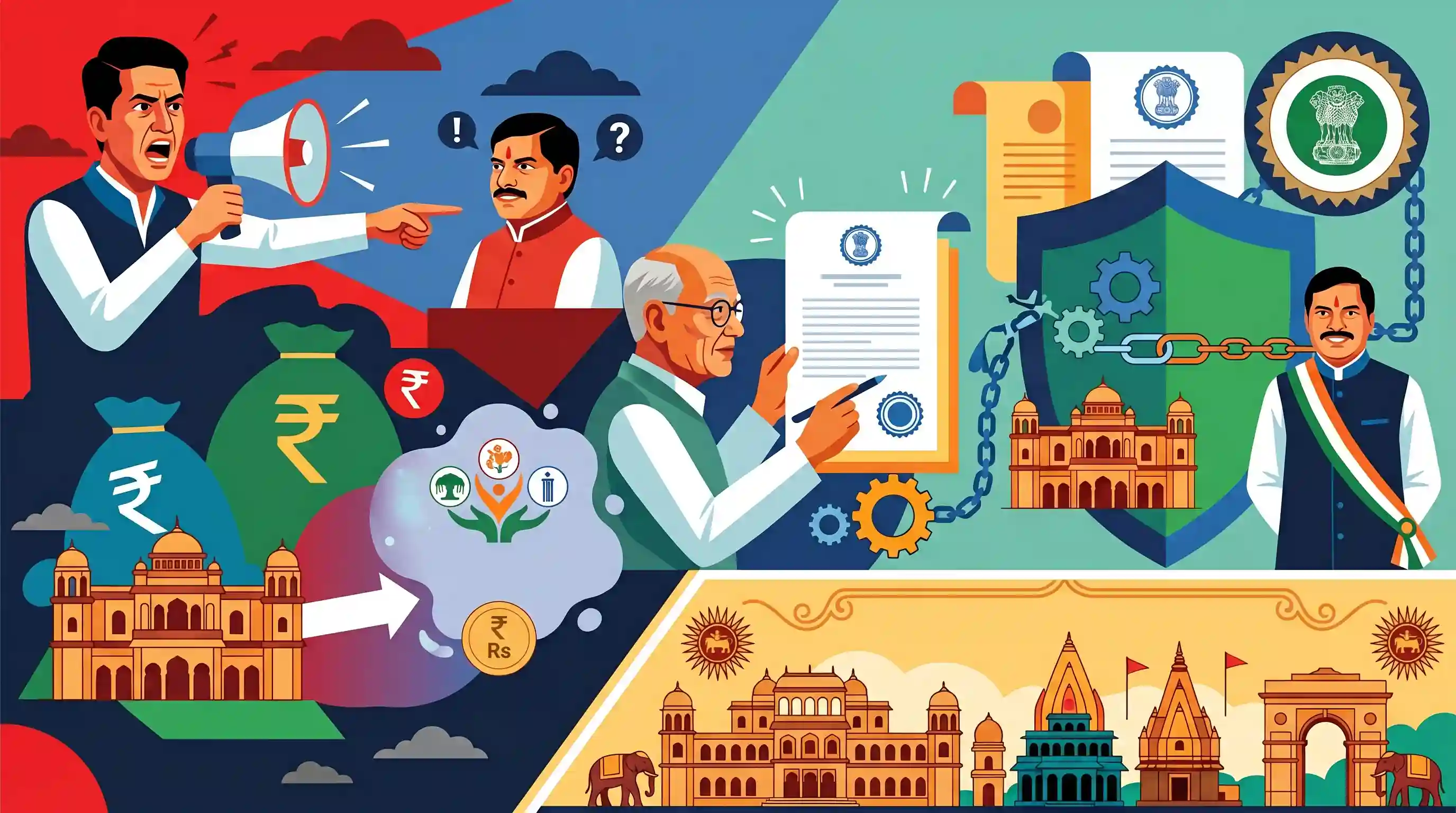
A political controversy erupted in Madhya Pradesh as State Congress President Jitu Patwari accused Chief Minister Mohan Yadav's government of a Rs 500-crore scam involving the leasing of a historical Scindia-built property in Ujjain to 'Veer Bharat Trust' for Rs 1. However, senior Congress leader Digvijaya Singh refuted the allegations, using public registry records to clarify that Veer Bharat Sansthan is an official government public trust, with the Chief Minister serving as its ex-officio Chairman. This highlights the administrative framework of state public trusts and the historical legacy of the Scindia dynasty in Ujjain.
Key Points
- Madhya Pradesh Congress President Jitu Patwari alleged a Rs 500-crore land scam, claiming that a valuable historical property in Ujjain built by the Scindia family was leased to the Veer Bharat Trust for a token amount of Rs 1.
- Former Chief Minister Digvijaya Singh contradicted these allegations, presenting official documents from the Registrar of Public Trusts to show that Veer Bharat Sansthan is a registered government public trust, not a private trust.
- The Chief Minister of Madhya Pradesh serves as the ex-officio Chairman of the Veer Bharat Sansthan; former CM Kamal Nath also held this position during his tenure.
- The historical property involved was constructed by the Scindia dynasty, which was established by Ranoji Scindia in 1731 with its initial capital at Ujjain before moving to Gwalior.
- The administration and registration of public trusts in the state are regulated under the Madhya Pradesh Public Trusts Act, 1951, which empowers the Registrar to oversee public welfare entities.
Important Terms
Madhya Pradesh Public Trusts Act, 1951

A state legislation enacted to regulate and manage the administration of public religious, charitable, and socio-cultural trusts in Madhya Pradesh.
UPSC context
GS Paper II: Governance and State Legislations. Tests understanding of statutory frameworks governing public trusts.
Registrar of Public Trusts
A statutory authority, typically the District Collector under state laws, responsible for supervising, registering, and auditing public charitable trusts to ensure compliance.
UPSC context
GS Paper II: Statutory Bodies. Tests understanding of administrative roles at the district level in regulating civil society.
Veer Bharat Sansthan
An official state-registered public trust in Madhya Pradesh, historically chaired by the incumbent Chief Minister, created to manage cultural legacies and designated properties.
UPSC context
GS Paper II: State Executive. Tests understanding of government-run trusts and their governance structure.
Ex-Officio Chairman
A position held by an individual automatically by virtue of holding another official designation, such as a Chief Minister serving as head of state trusts.
UPSC context
GS Paper II: Executive and Polity. Tests understanding of institutional mechanisms and ex-officio administrative structures.
Prelims Trap
The Scindia dynasty established Gwalior as its capital from its inception in 1731.
Ranoji Scindia established the capital at Ujjain in 1731. It was shifted to Gwalior much later in 1810 by Daulat Rao Scindia.
Static Concepts Connected
What are the historical origins and territorial shifts of the Scindia dynasty?
- Founder and origin: Founded by Ranoji Scindia in 1731, who served as a prominent Maratha commander under Peshwa Baji Rao I.
- Capital transition: Initially headquartered in Ujjain, the administrative capital was shifted to Gwalior in 1810 by Maharaja Daulat Rao Scindia.
- Cultural patronage: Rebuilt the historic Mahakaleshwar Temple in Ujjain, which was previously demolished by Delhi Sultanate ruler Iltutmish in 1235.
How are public trusts regulated and administered under state legislations?
- Registrar authority: State public trust laws often designate the District Collector as the ex-officio Registrar to supervise local public trusts.
- Ex-officio administration: High public officials, such as Chief Ministers, serve as ex-officio trustees of state-sponsored public welfare bodies to ensure transparency.
Cross-Topic Patterns
Maratha confederacy and temple revival
The rebuilding of Mahakaleshwar by Scindias parallels Ahilyabai Holkar's nationwide temple restorations, showcasing Maratha state-building through cultural patronage.
Collector's dual statutory roles
The District Collector's role as Registrar of Public Trusts highlights the fusion of regulatory, developmental, and judicial functions within district administration.

UPSC may test 18th-century Maratha confederacy capitals and their role in the cultural reconstruction of ancient temple sites.
Linked PYQs · 4
Linked PYQs · 4
- 2022MPPSC_PRELIMSGS1
Who among the following shall preside the meeting of Council of Ministers in Madhya Pradesh in the absence of the Chief Minister?
- 2022MPPSC_PRELIMSGS1
Who was the first Chief Minister of Madhya Pradesh?
- 2005MPPSC_PRELIMSGS1
Who founded the state of Gwalior?
- 2003MPPSC_PRELIMSGS1
Who established Gwalior state?
