Reserve Bank proposes compensation framework for digital fraud victims
Source:Indian Express ↗
Why It Matters
The article highlights a major shift in the RBI's regulatory approach to digital banking frauds, moving away from a strict 'customer liability' model towards enhanced consumer protection. This is crucial for GS-3 (Economy and Cybersecurity) as it reflects the challenges of securing digital public infrastructure and the need for banks to upgrade their institutional fraud-prevention mechanisms in an era of sophisticated cyber threats.
Summary
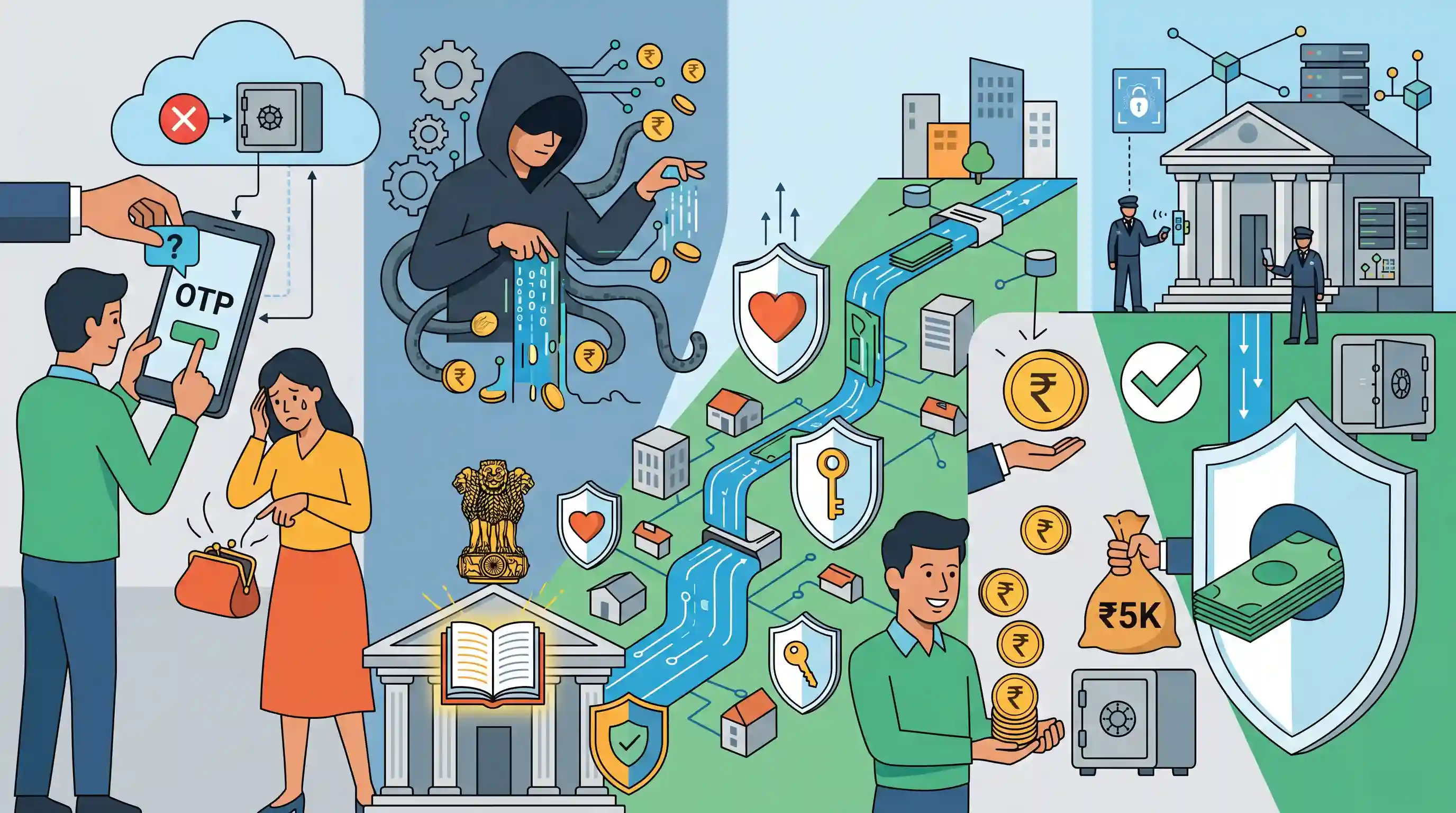
The Reserve Bank of India (RBI) is planning to introduce a new compensation framework for victims of digital banking frauds, proposing to reimburse up to Rs 25,000 even in cases where the customer inadvertently shared their One-Time Password (OTP). Currently, banks hold customers entirely liable for losses if credentials like OTPs are shared, citing gross negligence. The RBI's proposed shift acknowledges the growing complexity of cybercrimes and social engineering attacks that exploit vulnerabilities in human psychology rather than just technical flaws. By implementing this, the RBI aims to strengthen consumer protection in the digital payments space and incentivize banks to adopt more robust, proactive fraud-detection mechanisms.
Key Points
- The RBI is proposing a framework to compensate victims of digital financial fraud up to Rs 25,000, even if the victim mistakenly shared sensitive credentials like a One-Time Password (OTP).
- Under current guidelines, customers are held entirely liable for financial losses if they are found to have shared their payment credentials, as it is considered customer negligence.
- The proposal recognizes the increasing sophistication of cybercrimes and social engineering tactics, which often trick even cautious users into compromising their data.
- This regulatory shift is expected to compel banks to enhance their backend fraud detection, AI monitoring, and security infrastructure instead of relying solely on customer awareness.
- The move marks a significant step toward bolstering consumer protection and confidence in India's rapidly growing digital payments ecosystem.
Important Terms
Reserve Bank of India (RBI)

India's central bank and regulatory body responsible for the regulation of the Indian banking system, monetary policy, and oversight of payment and settlement systems.
UPSC context
GS Paper 3: Indian Economy; GS Paper 2: Statutory bodies. Vital for understanding monetary stability and financial regulation.
Social Engineering
A psychological manipulation technique used by cybercriminals to trick individuals into revealing confidential information or performing actions that compromise security, such as sharing OTPs.
UPSC context
GS Paper 3: Cyber Security. Tests knowledge of non-technical threats to internal security and digital literacy.
Deposit Education and Awareness (DEA) Fund
A fund managed by the RBI comprising unclaimed deposits for over 10 years, used for depositor education, awareness, and proposed as a source for digital fraud compensation.
UPSC context
GS Paper 3: Banking sector reforms. Relevant for prelims facts on RBI’s financial mechanisms and consumer protection.
Gross Negligence
A legal standard representing severe carelessness or reckless disregard for duty; in banking, sharing credentials like OTPs has traditionally been classified as such to deny liability.
UPSC context
GS Paper 3: Banking & Cyber Laws. Tests understanding of the shift from liability-sharing to a protection-oriented regulatory framework.
Indian Digital Payment Intelligence Corporation (IDPIC)
A specialized body established to detect, prevent, and analyze digital payment frauds using advanced technologies like AI, Machine Learning, and Big Data.
UPSC context
GS Paper 3: Science & Technology/Economy. Important for questions on institutional measures to secure India's digital economy.
Mule Account
A bank account used to receive and transfer funds acquired through illegal activities, often without the account holder's full knowledge of the criminal nature of the transactions.
UPSC context
GS Paper 3: Money Laundering and Cyber Crime. Relevant for understanding the mechanics of financial fraud and money laundering.
Prelims Trap
Customers will enjoy zero liability for unauthorized transactions even if they share their OTP.
Sharing an OTP still constitutes customer negligence. The RBI's proposal offers 'limited liability' capped at Rs 25,000 (or 85% of loss), not blanket 'zero liability'.
Static Concepts Connected
What are the existing conditions for 'Zero Liability' in digital banking?
- Bank fault: Zero customer liability applies unconditionally if the fraud stems from banking system vulnerabilities or bank negligence.
- Third-party breach: Zero liability applies if a breach occurs elsewhere and the customer reports it to the bank within three working days.
- Customer negligence: Under 2017 rules, if a customer shares credentials, they bear the entire loss until the fraud is formally reported to the bank.
What distinguishes 'Social Engineering' in cyber security?
- Psychological manipulation: It exploits human psychology, creating artificial urgency or fear, rather than relying on technical software vulnerabilities.
- Voluntary compromise: Methods like phishing and vishing trick victims into willingly surrendering sensitive data like passwords or OTPs.
Cross-Topic Patterns
Inter-agency cyber reporting infrastructure
Claiming RBI financial compensation directly intersects with the MHA's law enforcement ecosystem, mandating complaints via the National Cyber Crime Reporting Portal (1930).
Regulating DPI via institutional burden
As Digital Public Infrastructure matures, regulators are shifting the security burden away from user financial literacy towards mandating banks to deploy AI-based backend fraud-detection.

Expect a 2026 Prelims question mixing RBI's liability criteria for digital fraud with the MHA cyber portal (1930) reporting timelines.
Linked PYQs · 3
Linked PYQs · 3
- 2020MainsGS3
Discuss different types of cyber crimes and measures required to be taken to fight the menace.
- 2017MainsGS3
Discuss the potential threats of Cyber attack and the security framework to prevent it.
- 2018PrelimsGS1
Which one of the following links all the ATMs in India?
