Digital Fossil Mining and Evolutionary Origin of Squids
Source:The Hindu ↗
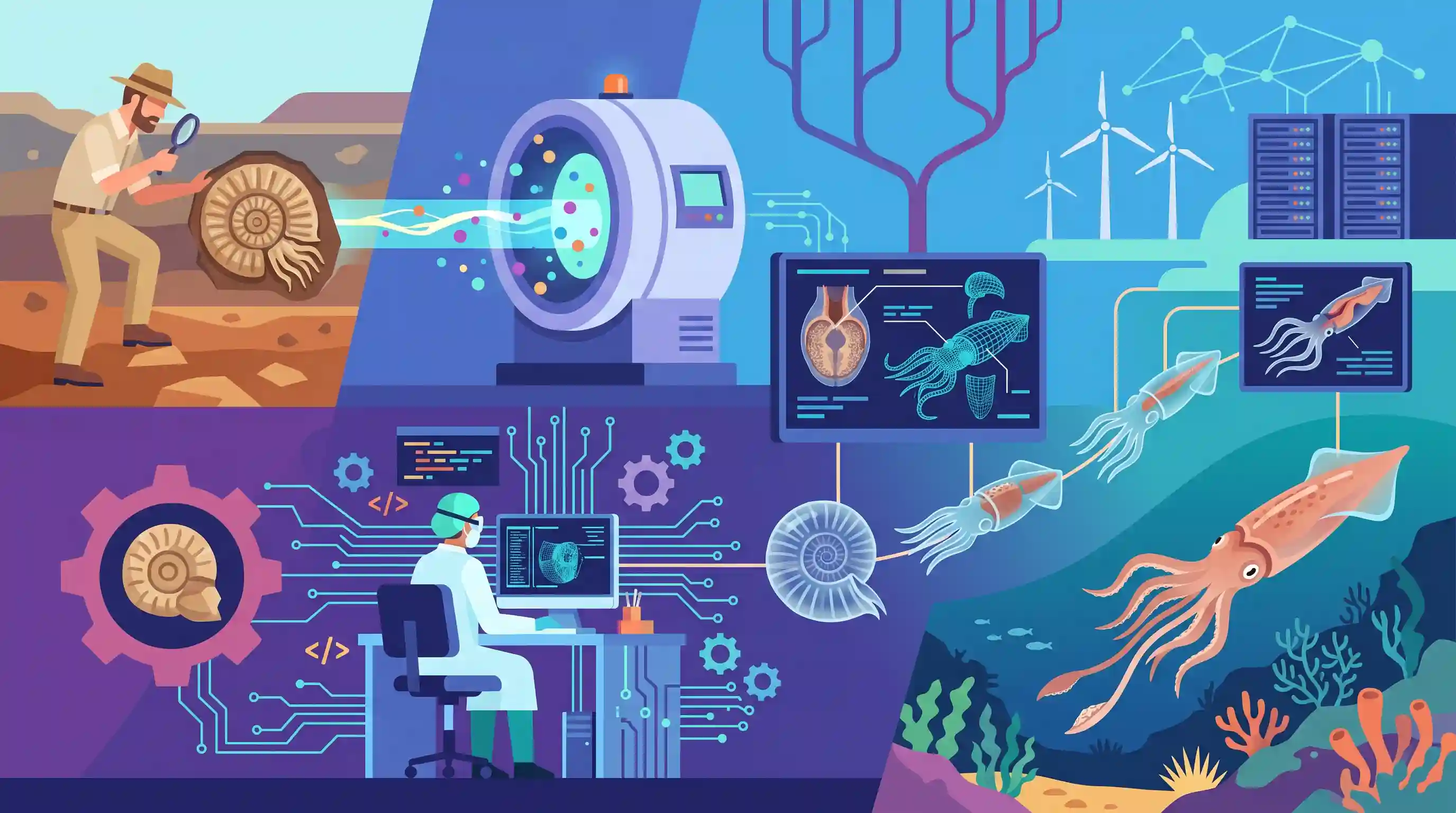
Why It Matters
Highlights the intersection of information technology and paleontology. It underscores the importance of advanced scientific tools (like 3D imaging and AI) in overcoming natural limitations (like soft-body fossil degradation) to understand marine biodiversity and Earth's evolutionary history.
Summary
A new scientific study demonstrates the power of 'digital fossil-mining' in uncovering the evolutionary origins of squids. Because cephalopods are mostly soft-bodied, their traditional fossil record is sparse. However, by leveraging advanced computational tools and 3D micro-CT scanning on previously excavated fossils, researchers have successfully reconstructed delicate anatomical features. This cross-disciplinary approach—merging paleontology with cutting-edge digital imaging—has successfully mapped the transition of modern squids from their ancient shelled ancestors, offering a breakthrough in evolutionary biology and showcasing the expanding applications of technology in scientific research.
Key Points
- Paleontologists are utilizing 'digital fossil-mining'—combining advanced 3D imaging, micro-CT scanning, and computational analysis—to extract new evolutionary data from existing fossil records.
- Due to their largely soft-bodied nature, squids and other cephalopods have a notoriously poor and fragmented fossil record, complicating traditional morphological studies.
- By digitally reconstructing ancient, poorly preserved specimens, scientists have been able to bridge evolutionary gaps and trace the specific origin of modern squids from their shelled marine ancestors.
- The application of digital and computational technologies to paleontology represents a significant cross-disciplinary advancement, transforming how biological history and Earth's early ecosystems are mapped.
Prelims Trap
Squids and octopuses are excluded from the Phylum Mollusca because they lack a hard external shell.
Squids are cephalopods, a class of marine Mollusks. They evolutionarily internalized and lost their external shells, compensating with advanced camouflage and mobility for survival.
Static Concepts Connected
What is Micro-CT scanning and how is it applied in paleontology?
- Non-destructive imaging: Uses X-rays to generate highly detailed 3D cross-sections of delicate specimens without physically breaking or altering them.
- Micron-level resolution: Provides much higher resolution than standard medical CT scans, allowing scientists to visualize microscopic internal structures and soft-tissue impressions.
- Digital preservation: Generates precise permanent digital replicas that can be computationally analyzed and shared globally without risking fossil degradation.
What is 'taphonomic bias' in evolutionary biology?
- Hard-tissue preference: The geological process of fossilization strongly favors organisms with biomineralized structures like bones, teeth, and shells.
- Soft-tissue decay: Organisms lacking hard parts, such as modern squids, decay rapidly and leave sparse fossil records unless buried under exceptional conditions.
- Anoxic requirements: Soft-bodied preservation typically requires rapid burial in anoxic (oxygen-free) environments to halt bacterial decomposition.
Cross-Topic Patterns
Emerging Tech in Archaeology & Paleontology
Just as LiDAR mapped hidden ancient cities, Micro-CT scanning is revolutionizing paleontology. UPSC frequently tests the modern applications of emerging tech in historical and archaeological excavations.
Adaptive Camouflage & Survival Mechanisms
The evolutionary loss of external shells in cephalopods directly drove the development of advanced survival traits, such as jet propulsion and chromatophores (specialized pigment cells) for camouflage.

Expect a Prelims tech-application question pairing Micro-CT, LiDAR, and AI with their uses in archaeology, paleontology, and heritage.
Linked PYQs · 3
Linked PYQs · 3
- 2019PrelimsGS1
The word 'Denisovan' is sometimes mentioned in media in reference to
- 2023MainsGS3
Introduce the concept of Artificial Intelligence (AI). How does Al help clinical diagnosis? Do you perceive any threat to privacy of the individual in the use of Al in healthcare?
- 2019PrelimsGS1
Consider the following statements: 1. Some species of turtles are herbivores. 2. Some species of fish are herbivores. 3. Some species of marine mammals are herbivores. 4. Some species of snakes are viviparous. Which of the statements given above are correct?
