Uttarakhand Police Arrest Haryana Youth over Social Media Threat
Source:republicworld ↗
Why It Matters
The incident highlights the critical intersection of cyber forensics, threat mitigation, and regional security in a highly visited pilgrimage state like Uttarakhand. It also underscores how local issues (e.g., in Karnprayag) can be leveraged online to threaten public infrastructure, demanding swift interstate coordination.
Summary
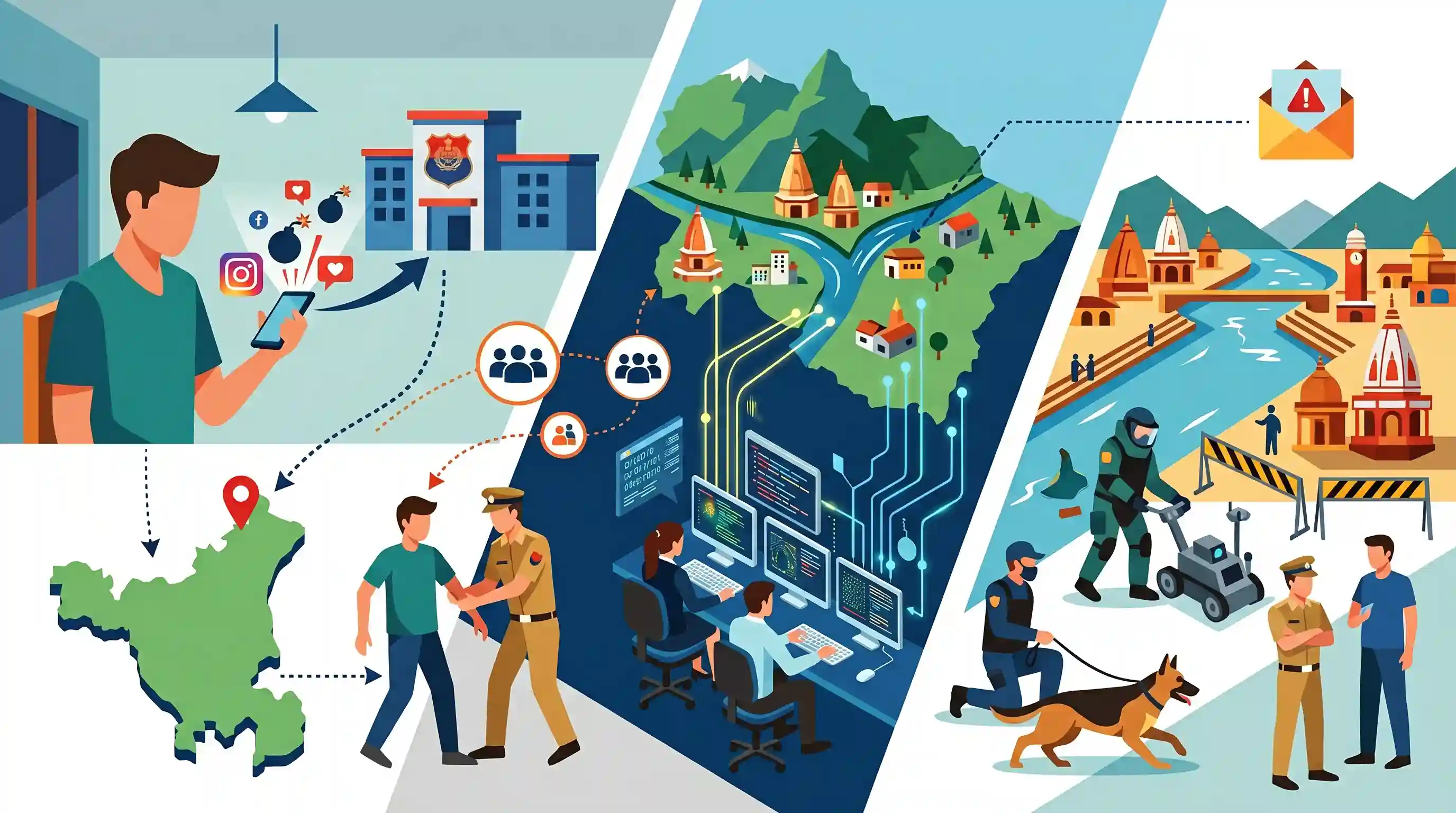
Uttarakhand Police arrested a Haryana-based youth, Jaspreet, from Ambala for issuing Instagram-based bomb threats against Uttarakhand police stations. The cyber team traced his digital footprint, revealing he acted under the influence of certain groups following an incident in Karnprayag. Concurrently, Haridwar authorities strengthened security using Bomb Disposal and Dog Squads following a separate email threat targeting religious and municipal hubs like Har Ki Pauri.
Key Points
- Uttarakhand Police arrested a youth named Jaspreet from Ambala, Haryana, for posting bomb threats targeting several state police stations via Instagram on June 21, 2026.
- The suspect's digital footprints were analyzed and traced by the cyber forensic cell of Uttarakhand Police, leading to his apprehension.
- During interrogation, the suspect confessed that he was influenced by certain organizations and posted the threat in connection with a recent incident that transpired in Karnprayag.
- Separately, a threat email received on June 24 targeted major public and religious landmarks in Haridwar, including Har Ki Pauri, prominent temples, and the local municipal corporation office.
- In response, high-security measures were implemented across Haridwar, with deployments of the Special Task Force (STF), Bomb Disposal Squad (BDS), and dog squads.
Important Terms
Bharatiya Nyaya Sanhita (BNS)

The primary substantive criminal code of India, enacted in 2023 to replace the colonial-era Indian Penal Code (IPC), emphasizing restorative justice and modernizing digital offenses.
UPSC context
GS-II: Criminal justice reforms. Tests understanding of major legislative overhauls and criminal law codification.
Information Technology Act, 2000
India's primary legislation governing cybercrime, digital transactions, and electronic commerce, providing legal validity to electronic records and signatures while outlining penalties for digital offenses.
UPSC context
GS-III: Cyber security. Tests understanding of legal frameworks regulating online transactions, data privacy, and digital threats.
Indian Penal Code (IPC)
The official penal code of British India drafted in 1834 and enacted in 1860, serving as the country's foundational criminal statute until its replacement by the BNS.
UPSC context
GS-II: Judicial history. Tests knowledge of India's legal evolution and the transition from colonial to modern criminal laws.
Special Task Force (STF)
A specialized police division constituted by Indian state governments to combat critical public safety threats, including organized crime networks, insurgencies, and high-profile criminal activities.
UPSC context
GS-III: Internal security. Tests knowledge of law enforcement structures and specialized counter-threat agencies at the state level.
Bomb Disposal Squad (BDS)
A specialized emergency response unit within the military or police forces trained to detect, defuse, and safely neutralize conventional explosives and improvised explosive devices (IEDs).
UPSC context
GS-III: Internal security and disaster management. Tests operational response to saboteur attacks and modern explosive threats.
Karnprayag
One of the sacred 'Panch Prayag' river confluences in the Garhwal region of Uttarakhand, where the Alaknanda River meets the Pindar River.
UPSC context
GS-I: Physical geography. Tests knowledge of the Himalayan river systems, drainage patterns, and cultural geography.
Prelims Trap
The Pindar River, which joins the Alaknanda at Karnprayag, originates from the Chorabari Glacier near Kedarnath.
Aspirants often confuse glacier origins; Chorabari is the source of Mandakini (Rudraprayag), while Pindar originates from the Pindari Glacier.
Static Concepts Connected
What are the five confluences (Panch Prayag) of the Alaknanda River and their geographical sequence?
- Upstream sequence: The chronological sequence from upstream (highest) to downstream is Vishnuprayag, Nandprayag, Karnprayag, Rudraprayag, and Devprayag.
- First three Prayags: Alaknanda meets Dhauliganga at Vishnuprayag; meets Nandakini at Nandprayag; and meets Pindar River (originating from Pindari Glacier) at Karnprayag.
- Rudraprayag & Devprayag: Mandakini (from Chorabari Glacier) meets Alaknanda at Rudraprayag. Bhagirathi meets Alaknanda at Devprayag to formally flow as the Ganga.
How does India's legal and security framework address online threat dissemination?
- BNS Transition: With Section 66A of the IT Act struck down, online threat actors are booked under Bharatiya Nyaya Sanhita (BNS) provisions for criminal intimidation.
- Interstate Coordination: State police forces deploy specialized Cyber Crime Cells to coordinate interstate tracking of digital footprints, IP addresses, and virtual private networks.
Cross-Topic Patterns
Hydrology + Cultural Tourism Infrastructure
Environmental carrying capacity of the Panch Prayag pilgrim corridors faces severe stress from climate-induced glacial melt and high-density religious tourism.
Social Media + Internal Security
Algorithmic radicalization on social platforms rapidly scales localized disputes into interstate law-and-order crises, challenging traditional policing.

Panch Prayag confluences and their matching glacier sources (Chorabari vs Pindari) are highly probable for a 2026 physical geography question.
Linked PYQs · 3
Linked PYQs · 3
- 2012UKPSC_PRELIMSGS1
In Cyber Law terminology 'DOS' means:
- 2007UKPSC_PRELIMSGS1
Name the river which flows between Kedarnath | Rudra Prayag?
- 2025UKPSC_PRELIMSGS1
What is the objective of 'DigiLocker' service?
