Digital Censorship Procedural Safeguards and Free Speech
Source:The Hindu ↗
Why It Matters
This issue is critical for GS Paper II (Polity & Governance) and GS Paper III (Internal Security), as it highlights the ongoing tension between state regulatory powers (like Section 69A of the IT Act) and the fundamental right to freedom of speech and expression. It underlines the importance of procedural safeguards, transparency, and judicial review in preventing arbitrary censorship and safeguarding democratic dissent.
Summary
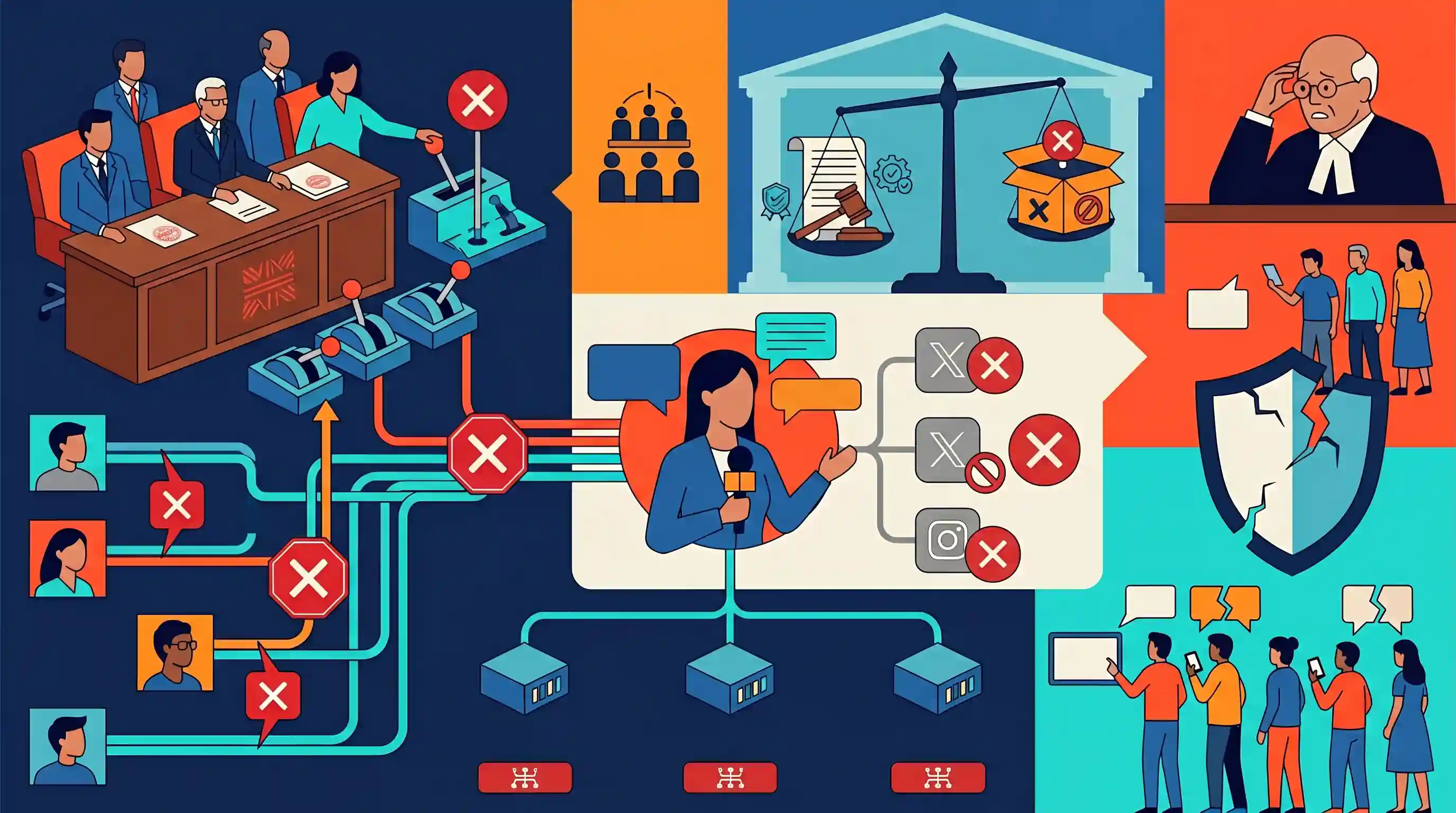
The editorial criticizes the Indian government's increasing reliance on digital censorship to block the social media accounts of activists, journalists, and critics. Although the Supreme Court upheld Section 69A of the IT Act 2000 in the Shreya Singhal (2015) case due to strict procedural safeguards, the government is bypassing these protections by exploiting Rule 16 of the 2009 Blocking Rules, which mandates confidentiality. This opacity deprives affected parties of their right to judicial review and violates the doctrine of proportionality. Furthermore, the article warns that decentralizing blocking powers to various ministries could lead to arbitrary "digital exile" and severe curtailment of the constitutional right to free speech.
Key Points
- Digital censorship in India has surged significantly, with the number of blocked URLs and accounts rising from 470 in 2014 to 9,800 in 2021.
- The government used emergency blocking powers under IT Rules during the 2020-21 farmers' protest and to ban a BBC documentary in 2023.
- In the 2015 Shreya Singhal case, the Supreme Court upheld Section 69A of the IT Act on the premise of procedural safeguards such as reasoned orders and judicial review.
- The government increasingly uses Rule 16 of the 2009 Blocking Rules to enforce confidentiality, preventing affected users from challenging the blocking orders in court.
- The review committee established under the 2009 Rules is entirely executive and has never overturned a government blocking order, violating the doctrine of proportionality.
- Proposed decentralization of blocking powers to multiple Ministries risks creating a regime of arbitrary censorship, subjecting critics to a "digital exile."
Important Terms
Information Technology Act 2000

India’s primary legislation for electronic governance and cybercrime. Section 69A empowers the Union government to block online content in interests like national security, public order, and sovereignty.
UPSC context
GS2: Statutory bodies/Laws; GS3: Internal Security. Tests understanding of digital governance and the legal basis for state censorship.
Blocking Rules 2009
Procedural framework under Section 69A of the IT Act for blocking public access to online information. Rule 16 controversially mandates strict confidentiality regarding all blocking requests and actions.
UPSC context
GS2: Executive accountability. Tests knowledge of procedural fairness and the conflict between state secrecy and the right to judicial review.
IT Rules
Commonly refers to the 2021 Intermediary Guidelines, which require social media platforms to perform due diligence, appoint compliance officers, and follow a three-tier grievance redressal mechanism for content regulation.
UPSC context
GS2: Government policies. Tests understanding of intermediary liability, "safe harbor" protection, and the regulation of digital news and social media.
Supreme Court of India
The apex judicial body that, in Shreya Singhal v. Union of India (2015), struck down Section 66A but upheld Section 69A subject to procedural safeguards.
UPSC context
GS2: Fundamental Rights and Judiciary. Tests the ability to apply landmark free-speech precedents to contemporary digital censorship issues.
Karnataka High Court
A state-level judicial authority that recently reviewed legal challenges by social media intermediaries against government blocking orders, notably emphasizing the need for reasoned orders and proportionality.
UPSC context
GS2: Judiciary/Separation of Powers. Tests awareness of judicial interventions in protecting digital expression against potentially arbitrary executive action.
Twitter (X)
A social media intermediary under the IT Act that has frequently litigated against Indian government directives to block accounts, highlighting the tension between national law and digital rights.
UPSC context
GS2: Digital Rights and Sovereignty. Tests the evolving relationship between global tech giants, state regulation, and constitutional free speech guarantees.
Prelims Trap
"The Review Committee for IT blocking orders must include an independent judicial member."
Aspirants assume censorship review requires judicial members. However, the Review Committee under the 2009 IT Blocking Rules is entirely executive, lacking independent judicial oversight.
Static Concepts Connected
What is the Doctrine of Proportionality in Indian Constitutional law?
- Puttaswamy Standard: Firmly established in the Puttaswamy case as a standard to test state action restricting fundamental rights, ensuring the infringement is not excessive.
- Four-Pronged Test: Requires a legitimate state aim, rational nexus (suitability), necessity (least restrictive measure), and strict balancing of fundamental rights versus state interest.
How did the Shreya Singhal (2015) judgment alter the IT Act 2000?
- Section 66A Struck: The Court invalidated Section 66A, ruling it was overly broad, vaguely worded, and had a 'chilling effect' on free speech.
- Section 69A Upheld: It upheld Section 69A's blocking powers because it contained adequate procedural safeguards, such as written reasoned orders and opportunities for judicial review.
Cross-Topic Patterns
Digital Rights & Anuradha Bhasin framework
Connects with the Anuradha Bhasin internet shutdown case, extending the principle that the right to freedom of speech over the internet enjoys constitutional protection under Article 19(1)(a).
Delegated Legislation & Executive Opacity
Demonstrates how the executive uses delegated legislation (Rule 16 of 2009 Rules) to enforce confidentiality, effectively bypassing the Supreme Court's mandate for reasoned, reviewable orders.

Section 69A blocking rules + entirely executive Review Committee + Doctrine of Proportionality will likely form a 2026 Prelims Q.
Linked PYQs · 3
Linked PYQs · 3
- 2014MainsGS2
What do you understand by the concept "freedom of speech and expression"? Does it cover hate speech also ? Why do the films in India stand on a slightly different plane from other forms of expression ? Discuss.
- 2024MainsGS3
Social media and encrypting messaging services pose a serious security challenge. What measures have been adopted at various levels to address the security implications of social media? Also suggest any other remedies to address the problem.
- 2016MainsGS3
Use of Internet and social media by non-state actors for subversive activities is a major security concern. How have these been misused in the recent past? Suggest effective guidelines to curb the above threat.
