Digital arrest scam victims must repay loans, rules High Court
Source:free-press-journal ↗
Why It Matters
This judicial precedent defines the legal boundary between consumer liability and cybercrime victimization, emphasizing that contractually secured credit card and loan facilities remain fully recoverable by banks regardless of third-party fraud. It highlights the critical need for immediate disclosure of cyber coercion to financial institutions and outlines the procedural legitimacy of Revenue Recovery Certificates (RRCs) in banking recovery.
Summary
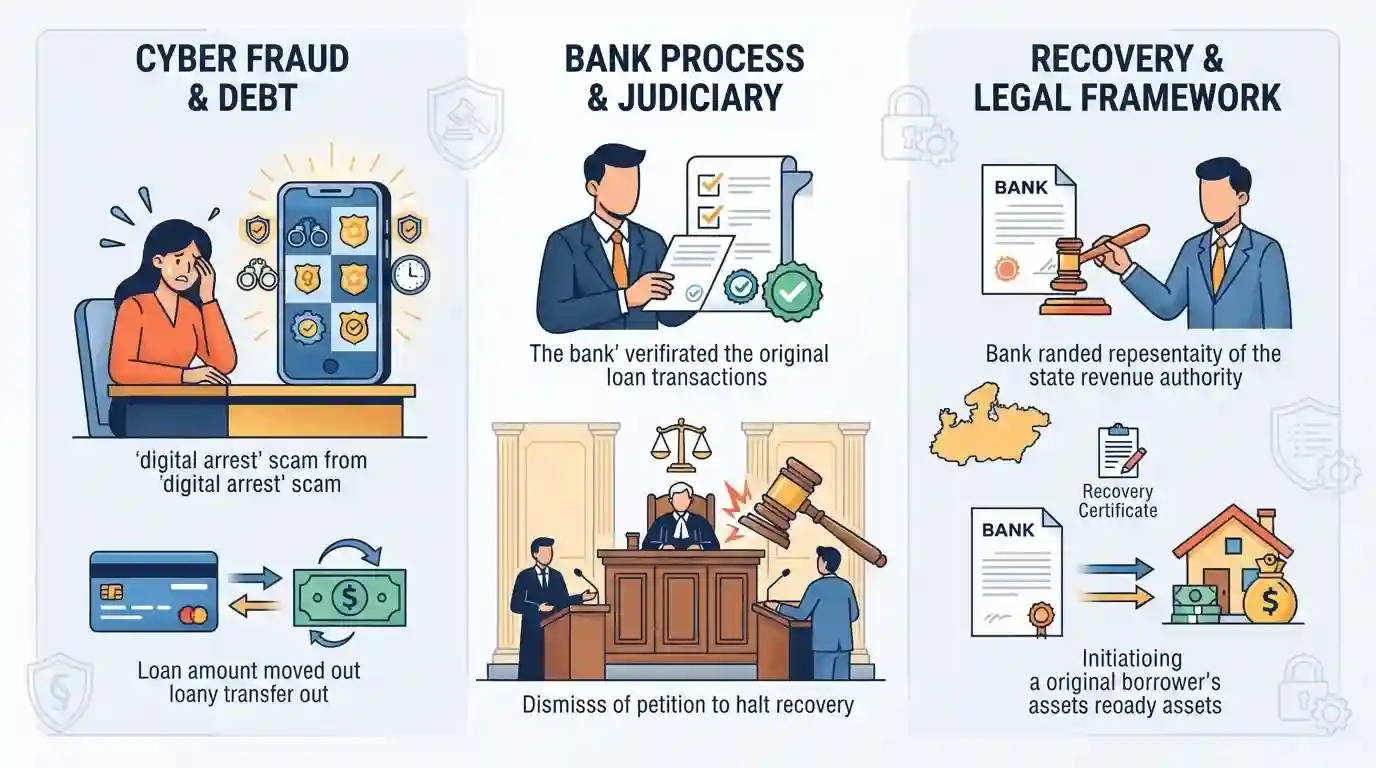
The Indore Bench of the Madhya Pradesh High Court, presided over by Justice Sandeep N. Bhatt, dismissed a petition seeking to halt loan recovery proceedings after the borrower was defrauded in a 'digital arrest' scam. The court ruled that although it sympathized with the victim, the bank's lawful right to recover advanced credit (procured via a credit card loan facility) cannot be defeated, especially since the bank had verified the transactions and the petitioner did not disclose any coercion during her interactions. The court also validated the bank's right to pursue recovery via Revenue Recovery Certificates (RRC) through state revenue authorities.
Key Points
- The Indore Bench of the Madhya Pradesh High Court ruled that falling victim to a 'digital arrest' cyber scam does not absolve a borrower of their loan repayment liabilities to a bank.
- The petitioner, Shreya Tayal, was defrauded into taking a loan facility on her credit card during a three-day 'digital arrest' and transferred the money to scammers.
- The court highlighted that the petitioner had personally visited the bank and confirmed the transactions via call without disclosing any coercion or cyber threats.
- The court upheld the legal validity of the bank's recovery process initiated through the state revenue authorities using Revenue Recovery Certificates (RRC).
- This ruling reinforces the contractual binding nature of financial credit, establishing that bank recovery rights cannot be defeated solely on grounds of third-party fraud victimization.
Important Terms
Reserve Bank - Integrated Ombudsman Scheme (RB-IOS)

A unified, cost-free grievance redressal mechanism launched by the RBI, integrating previous banking, NBFC, and digital transaction ombudsmen to resolve customer complaints against regulated financial entities.
UPSC context
GS Paper 2 (Economy & Governance), testing financial consumer protection, banking regulations, and dispute resolution.
Revenue Recovery Certificate (RRC)
A legal document issued by a competent authority, such as a District Collector, to recover outstanding public or corporate dues as arrears of land revenue.
UPSC context
GS Paper 2 (Administrative Law) and Land Revenue Code, testing state revenue recovery mechanisms.
Information Technology Act, 2000
India's primary cyber law legislation that provides legal recognition to electronic transactions, digital signatures, and electronic governance, while also defining cyber offences and punishments.
UPSC context
GS Paper 3 (Cyber Security & Law), testing regulatory frameworks governing digital spaces and IT regulations.
Madhya Pradesh High Court
The highest judicial court in the state of Madhya Pradesh, established in 1956 with its principal seat in Jabalpur and two permanent benches.
UPSC context
GS Paper 2 (State Judiciary), testing the constitutional structure, history, and jurisdiction of state-level courts.
Indore Bench of MP High Court
A permanent bench of the Madhya Pradesh High Court established in Indore under Section 51(2) of the States Reorganisation Act, 1956.
UPSC context
GS Paper 2 (State Judiciary), testing state-specific judicial geography, benches, and historical administrative setups.
Prelims Trap
Digital arrest is a recognized legal investigative procedure under the IT Act, 2000.
There is absolutely no legal provision or sanction for 'Digital Arrest' under the IT Act, 2000, Bharatiya Nagarik Suraksha Sanhita (BNSS), or CrPC. It is purely a cyber-scam phenomenon.
Static Concepts Connected
What is the historical evolution and structural setup of the Madhya Pradesh High Court?
- Origin: Created on Jan 2, 1936, as the Nagpur High Court via Letters Patent under Section 108 of the Government of India Act, 1935.
- Reorganization: Shifted to its principal seat in Jabalpur on Nov 1, 1956, following the States Reorganisation Act.
- Benches: Two permanent benches established at Indore and Gwalior on Nov 28, 1968, under Section 51(2) of the States Reorganisation Act, 1956.
What is a Revenue Recovery Certificate (RRC) under Madhya Pradesh's legal framework?
- Definition: A legal certificate issued to the District Collector to recover public/bank dues as arrears of land revenue.
- Legal Basis: Governed under the MP Land Revenue Code, 1959, bypassing lengthy civil court processes to fast-track recoveries.
- Enforcement: Empowers state revenue authorities to attach, auction, or sell the debtor's properties to satisfy the certified debt.
Cross-Topic Patterns
Cyber Victimhood vs Contractual Liabilities
Highlights the intersection where civil victimization under cyber crime cannot override statutory contractual liabilities under the Indian Contract Act, 1872.
MP Land Revenue Code in Banking Recovery
Demonstrates how provincial land revenue machinery (RRC under MP Land Revenue Code, 1959) is deployed to recover commercial banking dues, bridging state administration and corporate finance.

MPHC's validation of RRC recovery for cyber-fraud victims likely to feature in GS Paper 2 (Polity/Cyber Law) or State Admin essays.
Linked PYQs · 3
Linked PYQs · 3
- 2019MPPSC_PRELIMSGS1
First cyberlaw which provides the legal infrastructure for e-commerce in India is
- 2022MPPSC_PRELIMSGS1
The feature(s) of cyber security is/are:
- 2020MPPSC_PRELIMSGS1
On which date, the Ombudsman Scheme for the nonBanking Financial Companies (NBFC), 2018 was effectively introduced by Reserve Bank of India?
