Supreme Court Proposes CBI Probe into Digital Arrest Scams
Source:The Hindu ↗
Why It Matters
This development highlights the evolving nature of cybercrimes (specifically 'digital arrests' via AI and deepfakes) and the complex intersection of transnational organized crime, money laundering, and human trafficking. It is crucial for GS3 (Internal Security) regarding the regulation of emerging technologies and international cooperation in combating cyber threats. Additionally, it touches upon GS2 themes related to the jurisdiction of central agencies (CBI) across states and international treaties like the UN Convention against Cybercrime.
Summary
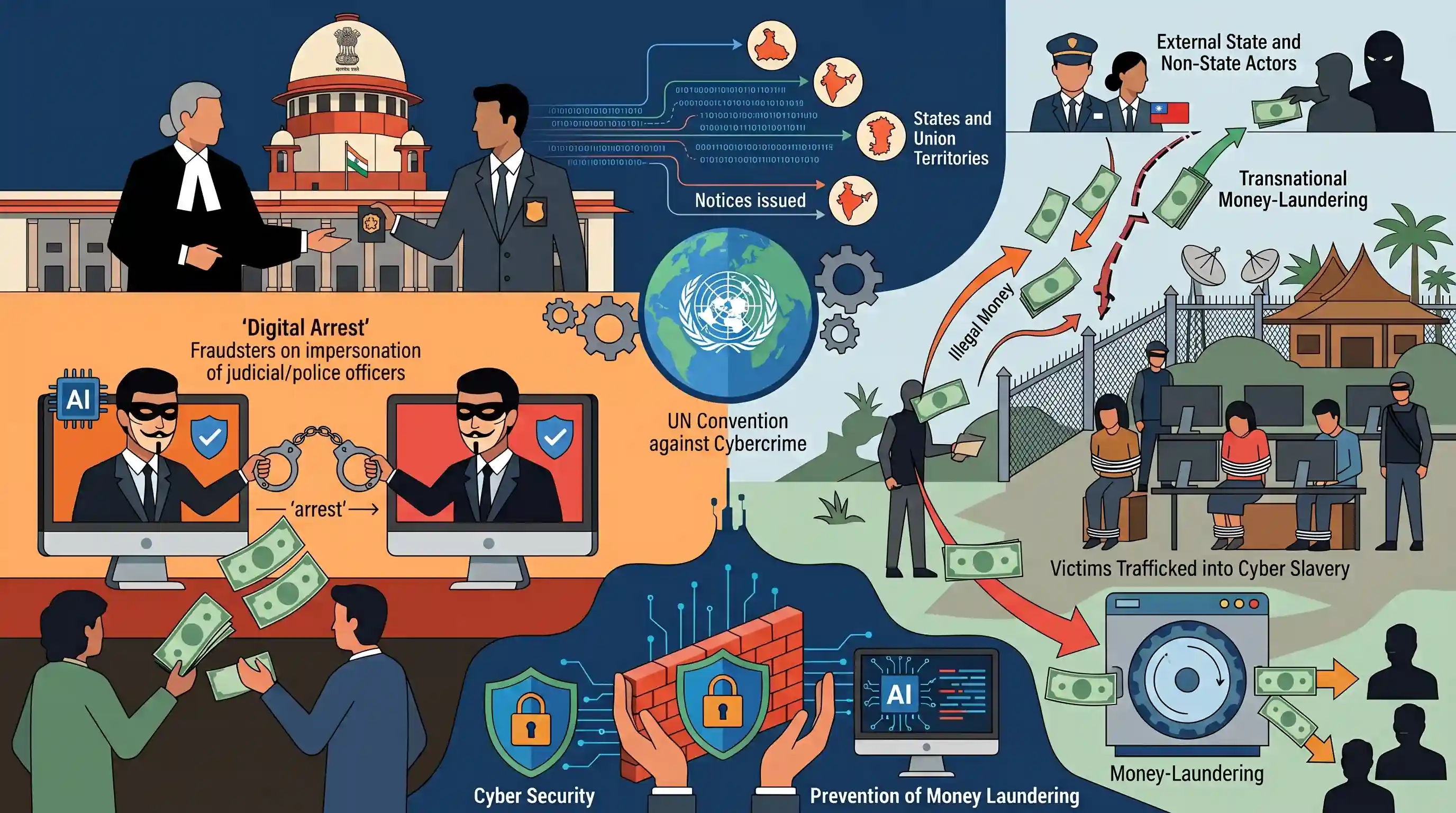
The Supreme Court of India is inclined to hand over the investigation of all "digital arrest" scams to the Central Bureau of Investigation (CBI), recognizing the nationwide magnitude and cross-border nature of these cybercrimes. Fraudsters are misusing Artificial Intelligence to impersonate judicial and law enforcement officers, extorting huge sums of money from citizens. The Attorney General and Solicitor General noted that these crimes are linked to transnational money-laundering gangs and "scam compounds" operating out of Southeast Asian countries like Myanmar and Thailand, where victims are often trafficked into cyber slavery. Emphasizing the need for a coordinated response, the Court suggested invoking the United Nations Convention against Cybercrime and issued notices to all States and Union Territories to submit details of pending cyber arrest cases.
Key Points
- The Supreme Court has taken suo motu cognizance of the nationwide "digital arrest" menace and proposed transferring all such investigations to the Central Bureau of Investigation (CBI).
- Fraudsters are utilizing Artificial Intelligence (AI) and advanced technology to morph courtrooms and impersonate judges and police officers to extort money, notably targeting senior citizens.
- The Union government highlighted that these crimes are orchestrated by cross-border "money-laundering gangs" operating from "scam compounds" in Southeast Asia, leading to cyber slavery.
- Given the transnational nature of the crime and its shift from Myanmar to Thailand, the Court suggested exploring the United Nations Convention against Cybercrime to bolster international cooperation.
- The Supreme Court issued notices to all States and Union Territories, directing them to provide detailed reports on pending FIRs and cyber arrests within their jurisdictions.
Important Terms
Digital Arrest

A cyber-extortion tactic where fraudsters impersonate law enforcement via video calls, creating 'virtual confinement' to panic victims into transferring money under the pretext of legal clearance.
UPSC context
GS Paper III (Internal Security). Tests awareness of emerging cyber-threats and psychological tactics used for financial fraud.
United Nations Convention against Cybercrime
A 2024 global treaty designed to enhance international cooperation, evidence sharing, and capacity building to combat serious crimes committed via information and communications technology.
UPSC context
GS Paper II (International Relations). Tests knowledge of global legal frameworks for addressing cross-border digital offenses.
Central Bureau of Investigation (CBI)
India's premier federal investigative agency, established under the DSPE Act 1946, handling high-profile corruption, economic crimes, and complex inter-state or international investigations.
UPSC context
GS Paper II (Constitutional/Statutory Bodies). Tests understanding of federal investigative powers and law enforcement architecture.
Cyber Slavery
A form of human trafficking where individuals are lured by fake job offers and coerced into working in foreign 'scam compounds' to conduct online frauds.
UPSC context
GS Paper III (Internal Security). Highlights the nexus between human trafficking and transnational cybercrime in Southeast Asia.
Transnational Organized Crime
Organized criminal activities coordinated across national borders, involving groups engaged in illicit acts like money laundering and cyber-scams that exploit jurisdictional gaps.
UPSC context
GS Paper III (Internal Security). Tests the ability to analyze security challenges originating from non-state actors outside India.
Indian Cyber Crime Coordination Centre (I4C)
A nodal agency under the Ministry of Home Affairs that provides a comprehensive framework for law enforcement agencies to coordinate and combat cybercrime across India.
UPSC context
GS Paper III (Internal Security). Relevant for India's institutional preparedness and digital security infrastructure.
Prelims Trap
The CBI requires prior State consent even if the Supreme Court orders a probe into cybercrimes.
While Section 6 of the DSPE Act mandates state consent for CBI probes, Constitutional Courts (Supreme Court and High Courts) can bypass this and order investigations.
Static Concepts Connected
What are the jurisdictional limitations of the CBI in Indian States?
- State Consent: Under Section 6 of the DSPE Act, 1946, the CBI requires the consent (general or specific) of the State Government to investigate crimes within its territory.
- Constitutional Override: The Supreme Court and High Courts possess the constitutional authority to order a CBI investigation anywhere in India without needing the State Government's consent.
- UT Jurisdiction: The CBI can only take up cases suo motu (on its own) within Union Territories.
How does the UN Convention against Cybercrime contrast with the Budapest Convention?
- Budapest Convention: A Council of Europe treaty. India is NOT a signatory, arguing it was not involved in drafting and that data-sharing rules infringe on national sovereignty.
- UN Convention: Adopted recently, it is the first universal, legally binding UN framework on cybercrime. India actively participated in its negotiation and drafting.
Cross-Topic Patterns
Cyber Slavery & Human Trafficking
Transnational 'scam compounds' in Southeast Asia rely on trafficked Indians for labor. This directly links internal security cyber-threats with the social justice issue of human trafficking.
Deepfakes and Transnational Extortion
Generative AI is shifting from a science-and-tech topic to a core internal security threat, acting as a force multiplier for transnational money-laundering syndicates through deepfakes.

Expect a 2026 Prelims question contrasting the new UN Cybercrime Convention with the Budapest Convention, focusing on India's stance.
Linked PYQs · 5
Linked PYQs · 5
- 2020MainsGS3
Discuss different types of cyber crimes and measures required to be taken to fight the menace.
- 2017MainsGS3
Discuss the potential threats of Cyber attack and the security framework to prevent it.
- 2021MainsGS3
Discuss how emerging technologies and globalisation contribute to money laundering. Elaborate measures to tackle the problem of money laundering both at national and international levels.
- 2022MainsGS3
Discuss the types of organised crimes. Describe the linkages between terrorists and organised crime that exist at the national and transnational levels.
- 2021MainsGS2
The jurisdiction of the Central Bureau of Investigation (CBI) regarding lodging an FIR and conducting probe within a particular State is being questioned by various States. However, the power of the States to withhold consent to the CBI is not absolute. Explain with special reference to the federal character of India.
