CBI Crackdown on Digital Arrest Scams and Judicial Oversight
Source:The Hindu ↗
Why It Matters
'Digital arrest' scams represent an evolving and grave cyber security threat affecting citizens across India, prompting high-level law enforcement interventions by agencies like the CBI and judicial oversight by the Supreme Court, making it critical for GS-3 (Internal Security) and GS-2 (Governance/Judiciary).
Summary
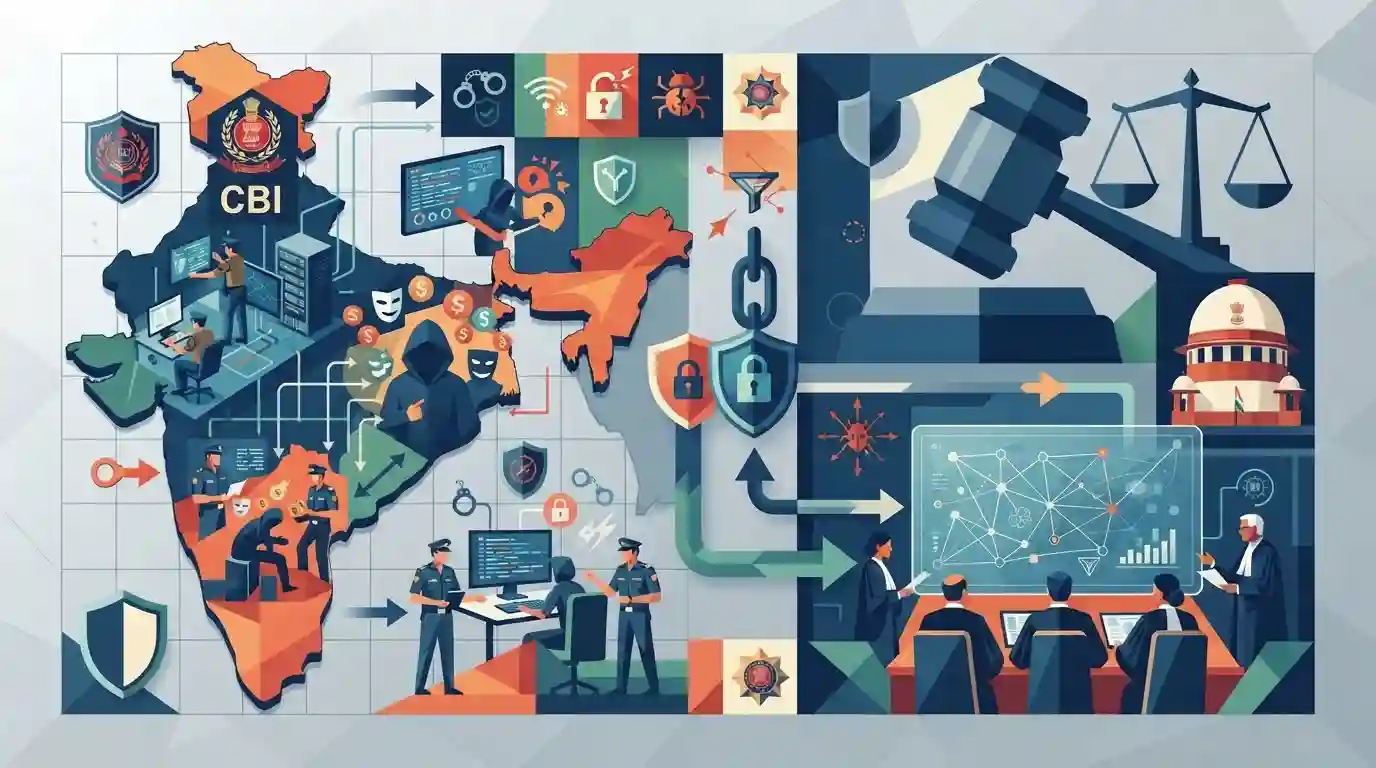
The article details the nationwide crackdown by the Central Bureau of Investigation (CBI) on 'digital arrest' scams—a sophisticated form of cyber fraud where criminals impersonate law enforcement officials to extort money. It also highlights the continuing oversight of the Supreme Court of India regarding institutional mechanisms to tackle such emerging cyber-security and financial threats.
Key Points
- The Central Bureau of Investigation (CBI) initiated a nationwide crackdown on 'digital arrest' scams, targeting organized cyber-fraud networks.
- Digital arrest scams involve cybercriminals impersonating law enforcement officers (like CBI, police, or customs) via video calls to mentally intimidate victims and extort money under the pretext of an inquiry.
- The Supreme Court of India is exercising continuing oversight over the measures taken by investigative agencies and the government to curb this menace.
- The rising trend highlights major challenges in national security, financial fraud prevention, and international coordination against organized cybercrime syndicates.
Important Terms
CBI

India's premier federal investigating agency under the Ministry of Personnel, Public Grievances and Pensions, tasked with probing high-profile corruption, economic offences, and complex cyber frauds nationwide.
UPSC context
UPSC GS Paper II (Polity & Governance — Statutory Bodies) and GS Paper III (Internal Security — Cyber Crimes).
Supreme Court of India
The apex judicial body of India and the ultimate guardian of the Constitution, exercising original, appellate, and writ jurisdictions as well as continuous oversight on governance and fundamental rights.
UPSC context
UPSC GS Paper II (Indian Constitution — Structure, Powers, and Functioning of Judiciary and Judicial Oversight).
Prelims Trap
Digital arrest is a permissible summary investigation procedure under the Code of Criminal Procedure for cyber-related offences.
Aspirants often assume 'digital arrest' is a legally valid provision under IT Act or CrPC for minor offenses, whereas Indian criminal law does not recognize any such concept.
Static Concepts Connected
What are the primary institutional mechanisms and legal frameworks governing cyber security in India?
- CERT-In Mandate: CERT-In operates as the national nodal agency for responding to computer security incidents under Section 70B of the Information Technology Act, 2000.
- I4C Integration: I4C acts as a nodal center under the Ministry of Home Affairs to coordinate all aspects of cybercrime prevention and investigation pan-India.
- Legal Status: The IT Act lacks specific statutory recognition for 'digital arrest', making such actions by private individuals or fraudsters outright criminal extortion.
Cross-Topic Patterns
Cyber Fraud + Anti-Money Laundering Frameworks
Digital fraud networks rely heavily on shell companies and mule accounts, connecting cyber crime directly to anti-money laundering and banking compliance frameworks.
Transnational Organized Crime + International Diplomacy
Cross-border cyber syndicates operating from Southeast Asia test India's bilateral intelligence sharing and extradition frameworks under international law.

Expect a statement-based question separating legal reality ('digital arrest' has zero statutory backing) from investigative agency powers.
Linked PYQs · 2
Linked PYQs · 2
- 2020MainsGS3
Discuss different types of cyber crimes and measures required to be taken to fight the menace.
- 2024MainsGS2
Explain the reasons for the growth of public interest litigation in India. As a result of it, has the Indian Supreme Court emerged as the world's most powerful judiciary ?
