Digital Arrests Emerging as Severe Cyber Threat in India
Source:The Hindu ↗
Why It Matters
The rise of "digital arrests" illustrates the evolving nature of cybercrimes and social engineering, directly relevant to the GS3 syllabus on internal security and cybersecurity. It also touches upon GS2 governance themes by emphasizing the need for police reforms to shed colonial legacies and build a citizen-centric law enforcement framework.
Summary
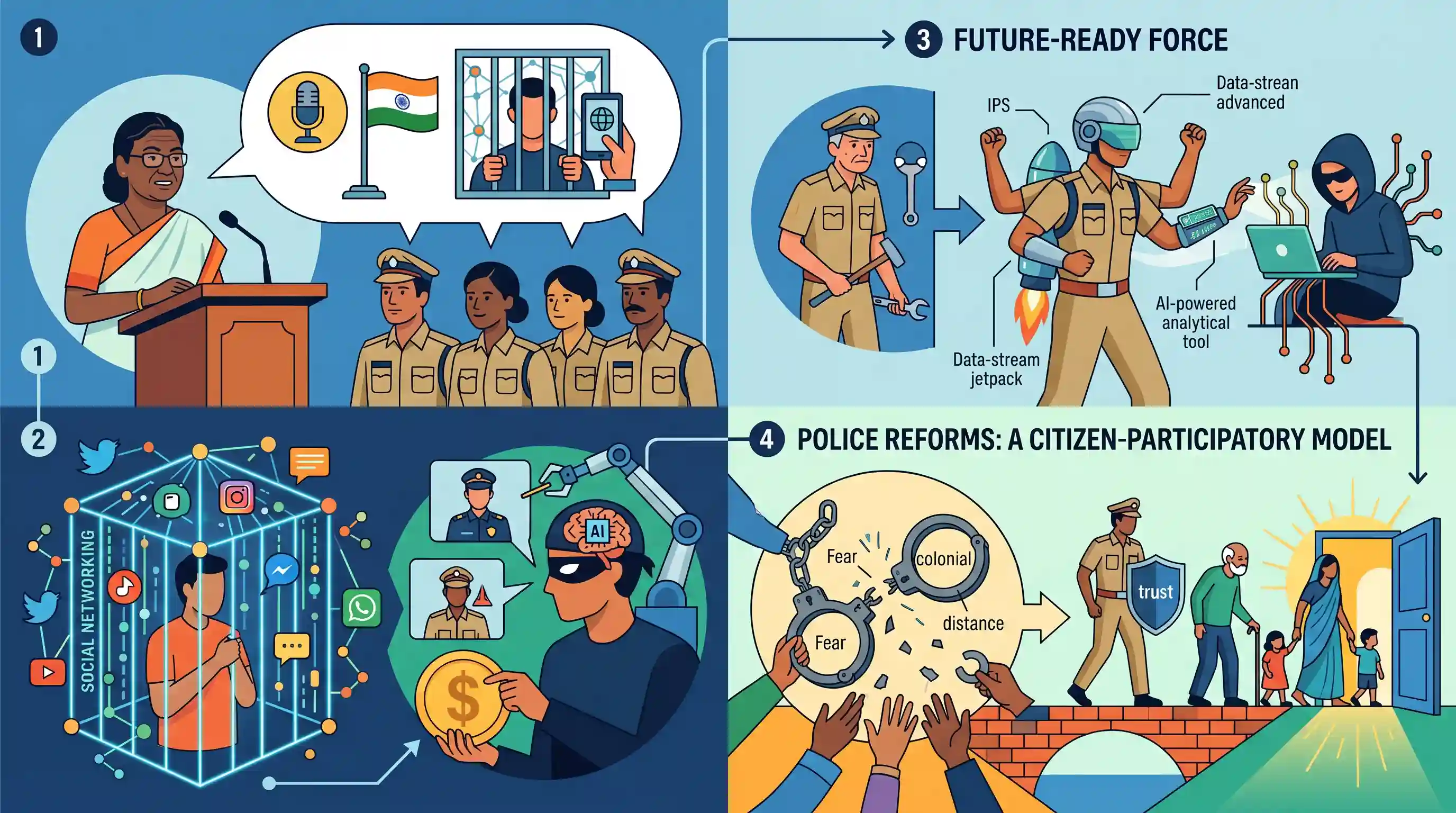
President Droupadi Murmu, addressing Indian Police Service (IPS) probationers, highlighted "digital arrests" as one of the most dreaded emerging cyber threats faced by citizens today. She warned that fraudsters are increasingly using technology, including Artificial Intelligence (AI), to impersonate law enforcement and extort money. Emphasizing the need for a future-ready police force, she urged officers to outpace criminals in technological adoption. Furthermore, the President called for reforming the colonial legacy of policing—which was rooted in fear and distrust—into a citizen-participatory model defined by integrity, compassion, and support for the marginalized.
Key Points
- "Digital arrests" have emerged as a severe cyber threat where fraudsters impersonate law enforcement officers to extort money by threatening arrest or freezing bank accounts.
- With India's expanding digital space and large AI user base, law enforcement agencies must proactively adopt new technologies to stay ahead of cybercriminals.
- President Murmu advocated for a shift from the colonial-era policing model—historically based on fear and distrust—towards a citizen-centric, compassionate approach.
- The Supreme Court has taken cognizance of rising digital arrest scams, seeking responses from the Centre and the CBI.
- Effective policing and maintaining law and order are highlighted as essential preconditions for attracting economic investment and building a 'Viksit Bharat'.
Important Terms
Digital Arrest

A cyber-extortion scam where fraudsters impersonate law enforcement (Police, CBI, ED) via video calls to "digitally" detain victims under false accusations, extorting money through intimidation.
UPSC context
GS Paper III (Cybersecurity). Tests knowledge of emerging internal security challenges and the "modus operandi" of technology-driven financial crimes.
Indian Police Service (IPS)
One of the three All India Services established under Article 312, providing senior leadership for maintaining public order, law enforcement, and internal security across India.
UPSC context
GS Paper II (Civil Services). Relevant for understanding the federal administrative structure and the role of services in governance and security.
Police Reforms
Systemic attempts to transform the police from a colonial-era instrument of state control into a professional, accountable, and citizen-centric service, notably through the Prakash Singh directives (2006).
UPSC context
GS Paper II (Governance) and GS Paper III (Internal Security). Tests awareness of institutional accountability and judicial interventions in law enforcement.
Central Bureau of Investigation (CBI)
The premier investigative agency of India, governed by the Delhi Special Police Establishment (DSPE) Act, 1946, handling anti-corruption, economic offenses, and high-profile conventional crimes.
UPSC context
GS Paper II (Statutory/Regulatory Bodies). Crucial for questions on federalism, investigative autonomy, and the role of central agencies.
Supreme Court of India
The highest judicial body in India, which exercises oversight over investigative agencies and issued landmark mandates for police autonomy and the protection of fundamental rights.
UPSC context
GS Paper II (Judiciary). Tests knowledge of judicial activism, constitutional protection, and its role in enforcing administrative accountability.
Police Act of 1861
A colonial statute enacted after the 1857 Revolt to establish a police force focused on maintaining order through fear and coercion; still the basis for many state police acts.
UPSC context
GS Paper I (Modern History) and GS Paper II (Governance). Highlights the "colonial legacy" in Indian administration and the need for legal decolonization.
Prelims Trap
"Digital Arrest is a newly introduced preventive detention measure under the Information Technology Act."
'Digital Arrest' is not a legal provision or statutory term. It is entirely a cybercrime modus operandi where fraudsters impersonate police to extort money.
Static Concepts Connected
How does the CBI acquire jurisdiction across states, and what are the exceptions?
- DSPE Act constraint: CBI operates under the DSPE Act, 1946, requiring State consent (Section 6) to investigate within a specific state's territory.
- Constitutional Court exception: The Supreme Court and High Courts can order CBI probes anywhere in India without requiring the respective state's consent.
- General vs. Specific consent: When states withdraw 'general consent', the CBI is forced to seek 'specific consent' on a case-by-case basis for new investigations.
What is the mandate and structure of the Indian Cyber Crime Coordination Centre (I4C)?
- Nodal Agency: Established under the Ministry of Home Affairs to act as the central nodal point in the fight against cybercrime in India.
- Key infrastructure: Operates the 1930 National Cyber Helpline and the National Cybercrime Reporting Portal to freeze defrauded money.
- Threat Analytics: Includes the National Cyber Crime Threat Analytics Unit (NCTAU) to analyze multi-jurisdictional cyber threats like digital arrests.
Cross-Topic Patterns
AI voice cloning + Cyber extortion
The intersection of generative AI (voice clones/deepfakes) with extortion necessitates a shift from standard IT Act provisions to AI-specific regulations and capacity-building in law enforcement.
Federalism + Cybercrime jurisdiction
The SC allowing CBI to probe digital arrests nationwide highlights how borderless cybercrimes force judicial exceptions to the federal constraints of Section 6 of the DSPE Act.

Expect a Prelims question mixing 'Digital Arrest' as a cyber-fraud term, I4C's mandate, and CBI's jurisdiction under the DSPE Act.
Linked PYQs · 3
Linked PYQs · 3
- 2020MainsGS3
Discuss different types of cyber crimes and measures required to be taken to fight the menace.
- 2017MainsGS3
Discuss the potential threats of Cyber attack and the security framework to prevent it.
- 2023MainsGS3
What are the internal security challenges being faced by India? Give out the role of Central Intelligence and Investigative Agencies tasked to counter such threats.
