Digital Arrest Scams and Southeast Asian Syndicates
Source:The Hindu ↗
Why It Matters
This issue sits perfectly at the intersection of GS3 Internal Security topics: cybercrimes, money laundering, and cross-border organized crime. It illustrates how geopolitical instability in neighboring countries (like Myanmar) directly fuels non-traditional security threats, human trafficking, and financial crimes in India.
Summary
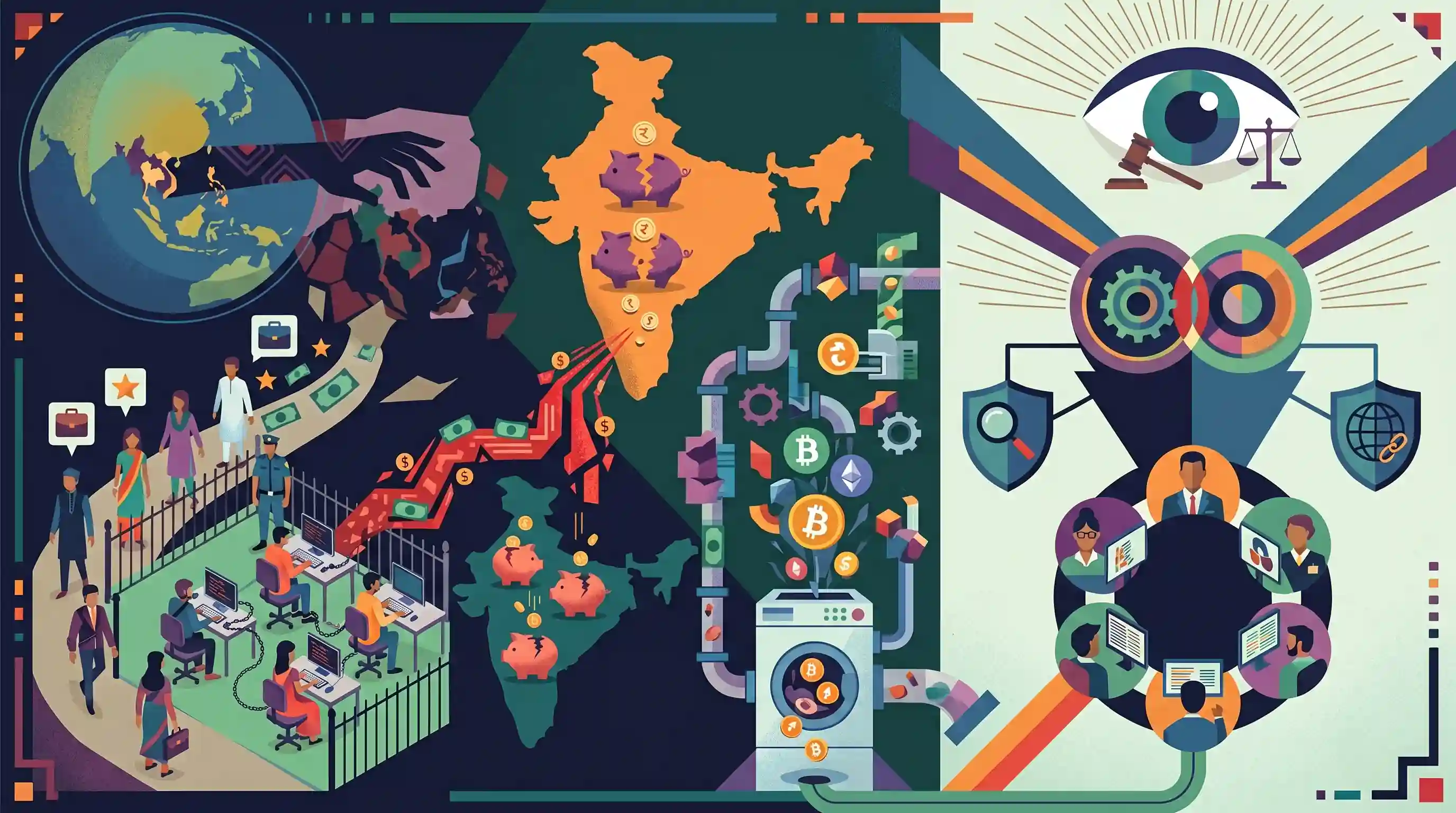
The article highlights the severe threat of 'digital arrest' cyber scams orchestrated by transnational criminal syndicates based in Southeast Asia, which have defrauded Indians of thousands of crores. It underscores the human trafficking angle, where Indian youth are lured with fake job offers and forced into 'digital slavery' within scam compounds situated in politically unstable regions of Myanmar. The proceeds are heavily laundered via cryptocurrency. In response, the Ministry of Home Affairs has set up a dedicated inter-departmental committee, monitored by the Supreme Court, to synergize efforts among law enforcement agencies like the CBI and Interpol.
Key Points
- Transnational cyber scam networks are executing 'digital arrests', causing Indians to lose an estimated ₹3,000 crore.
- Indian youth are being trafficked under the guise of overseas job offers and forced into 'digital slavery' to run these scams.
- Myanmar's political instability post-coup has enabled warlords to establish untouchable criminal enclaves like Shwe Kokko and KK Park near the Thailand border.
- The scam proceeds are primarily laundered using cryptocurrency, complicating tracing and recovery efforts.
- An inter-departmental committee chaired by the MHA and monitored by the Supreme Court is coordinating the response with the CBI and Interpol.
Important Terms
Digital Arrest

A cyber-extortion tactic where fraudsters impersonate law enforcement officials via video calls, placing victims under 'virtual custody' to extort money through psychological pressure and fabricated legal threats.
UPSC context
GS III (Internal Security/Cyber Security); tests understanding of evolving cybercrime threats and the socio-psychological dimension of internal security.
Digital Slavery
A modern form of human trafficking where victims are lured by fake jobs and coerced into running online scams from guarded compounds in Southeast Asian countries like Myanmar.
UPSC context
GS III (Organized Crime & Internal Security); highlights the nexus between human trafficking, transnational crime, and cyber-enabled fraud.
Ministry of Home Affairs (MHA)
India's primary agency for internal security, which has established a high-level inter-departmental committee to synchronize the multi-agency response against transnational digital arrest syndicates.
UPSC context
GS II (Governance/Executive) and GS III (Internal Security); reflects the government's institutional response and policy-making role in security.
Central Bureau of Investigation (CBI)
India's premier investigative body and designated National Central Bureau (NCB) for Interpol; it spearheads operations (e.g., Operation Chakra) to dismantle international cybercrime networks.
UPSC context
GS II (Statutory/Regulatory Bodies) and GS III (Internal Security); tests knowledge of central agencies' mandates in investigating cross-border crime.
Interpol
The world's largest international police organization; its 'Operation Storm Makers II' recently targeted the global trend of human trafficking-fuelled cyber fraud in Asia.
UPSC context
GS II (International Organizations); tests the role of global policing frameworks in tackling transnational threats to India’s security.
Indian Cyber Crime Coordination Centre (I4C)
A central nodal point under the MHA for all cybercrime investigations in India, facilitating coordination between state and central law enforcement agencies.
UPSC context
GS III (Cyber Security/Internal Security); a key technological infrastructure for preventing and reporting digital fraud.
Transnational Organized Crime
Planned criminal activities that occur across national borders; in this context, syndicates utilizing slave labor and cryptocurrency to defraud citizens globally.
UPSC context
GS III (Internal Security); covers the linkages between organized crime and state/non-state actor threats in a globalized world.
Prelims Trap
"Digital arrest is a statutory provision under the IT Act allowing agencies to detain suspects virtually."
'Digital arrest' is an extortion scam, not a legal procedure. Indian law enforcement agencies never issue arrest warrants or conduct interrogations via Skype or WhatsApp video calls.
Static Concepts Connected
What is the mandate of the Indian Cyber Crime Coordination Centre (I4C)?
- Nodal Agency: Established under the MHA to act as a nodal point in the fight against cybercrime comprehensively and in a coordinated manner.
- Key Components: Operates the National Cybercrime Reporting Portal (NCRP) and coordinates Joint Cybercrime Investigation Teams across multiple states.
- Capacity Building: Provides an ecosystem to law enforcement agencies for preventing, detecting, and investigating cybercrimes, including advanced financial frauds.
Where are the major 'scam compounds' located geographically in Southeast Asia?
- Myanmar-Thailand Border: Notorious semi-autonomous enclaves like Shwe Kokko and KK Park are situated in Myanmar's Kayin (Karen) State, separated from Thailand by the Moei River.
- Golden Triangle Proximity: Syndicates exploit the historically lawless tri-junction region where the borders of Myanmar, Laos, and Thailand meet, utilizing armed militias for protection.
- Cambodia: Coastal areas like Preah Sihanouk province have heavily developed high-rise compounds functioning as digital sweatshops.
Cross-Topic Patterns
Cybercrime + Human Trafficking (Digital Slavery)
The evolution of human trafficking from manual labor to "digital slavery" bridges GS1/GS2 social justice issues with GS3 cybersecurity, highlighting the need for updated extradition and Mutual Legal Assistance Treaties (MLATs).
Crypto Laundering + FATF frameworks
Syndicates bypass traditional banking via crypto, exposing regulatory gaps evaluated by the FATF and emphasizing the urgency of implementing the G20-endorsed global crypto regulatory framework.

Expect a 2026 GS3 question linking Myanmar's border instability directly to the rise of transnational cyber-extortion networks.
Linked PYQs · 5
Linked PYQs · 5
- 2021MainsGS3
Discuss how emerging technologies and globalisation contribute to money laundering. Elaborate measures to tackle the problem of money laundering both at national and international levels.
- 2020MainsGS3
Discuss different types of cyber crimes and measures required to be taken to fight the menace.
- 2022MainsGS3
Discuss the types of organised crimes. Describe the linkages between terrorists and organised crime that exist at the national and transnational levels.
- 2020MainsGS3
Analyze internal security threats and transborder crimes along Myanmar, Bangladesh and Pakistan borders including Line of Control (LoC). Also discuss the role played by various security forces in this regard.
- 2019MainsGS3
Cross-border movement of insurgents is only one of the several security challenges facing the policing of the border in North-East India. Examine the various challenges currently emanating across the India-Myanmar border. Also, discuss the steps to counter the challenges.
