Centre Forms Multi Agency Panel to Tackle Digital Arrest Scams
Source:Indian Express ↗
Why It Matters
This article is crucial for GS3 (Internal Security - Cyber Security) as it highlights a novel and prevalent form of cybercrime ('digital arrests'). It also touches upon institutional responses (multi-agency panels, I4C) and the necessity of structural reforms to counter sophisticated socio-engineering cyber threats.
Summary
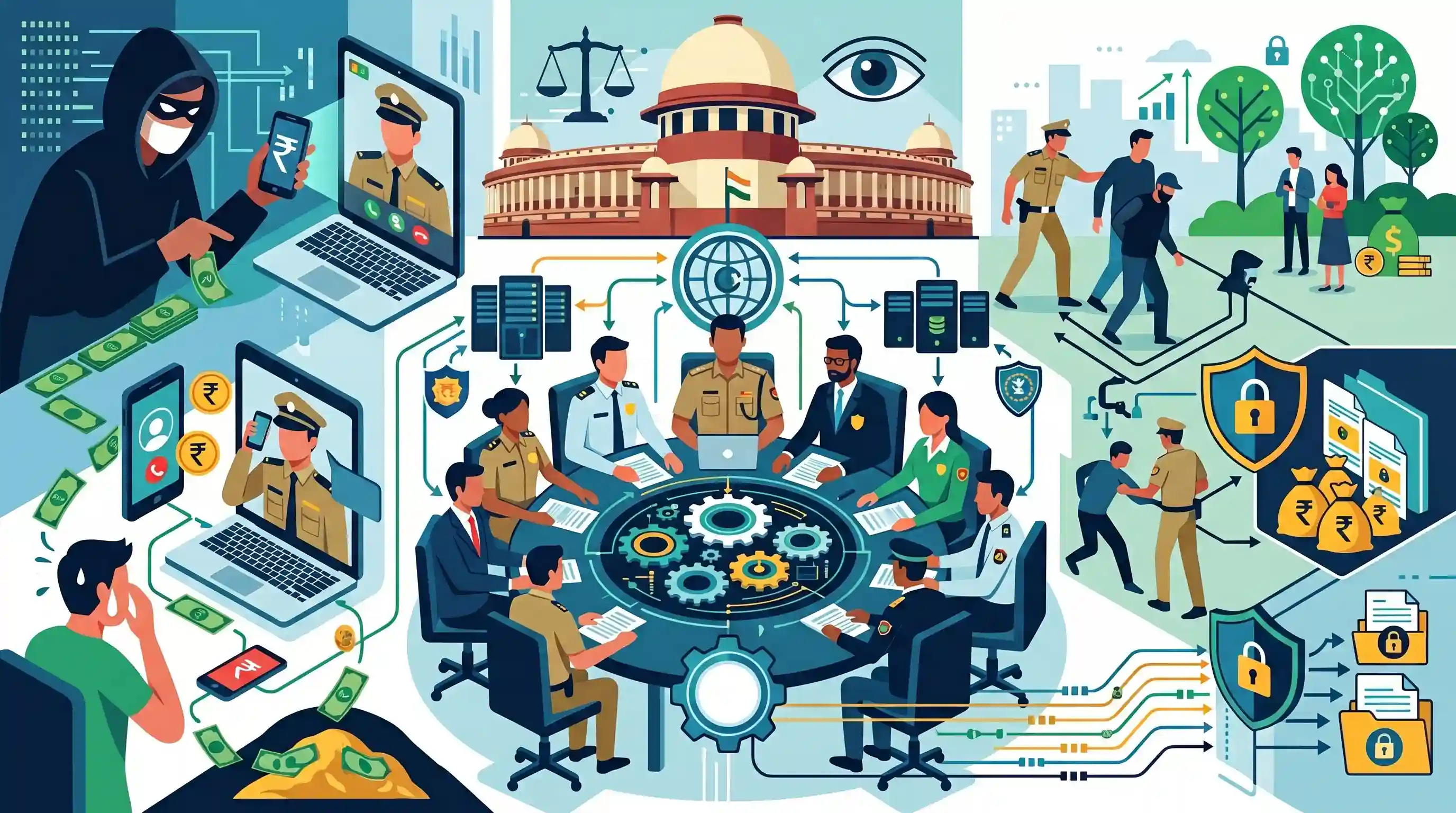
In response to the alarming rise in "digital arrest" cyber frauds, the Central Government has formed a multi-agency panel to coordinate enforcement actions. These scams involve criminals extorting money by impersonating law enforcement officers on video calls. As the Supreme Court prepares to hear the matter, the move highlights the growing necessity for robust institutional frameworks and cross-agency coordination, including bodies like I4C, to protect citizens' digital security and financial assets.
Key Points
- The Centre has established a multi-agency panel to tackle the rising incidence of "digital arrest" cyber scams.
- "Digital arrests" involve fraudsters impersonating law enforcement agencies (like CBI, Customs, or Police) via video calls to extort money by threatening fake imminent arrests.
- The Supreme Court is set to hear a plea addressing the proliferation of these cyber frauds, indicating active judicial oversight on digital safety.
- The crackdown emphasizes the need for institutional coordination among cyber enforcement bodies (like I4C), telecom operators, and financial institutions to trace and block fraudulent networks.
Important Terms
Indian Cyber Crime Coordination Centre (I4C)

A nodal agency under the Ministry of Home Affairs providing a platform for law enforcement agencies to coordinate against cybercrime and manage the national reporting portal.
UPSC context
GS Paper III (Internal Security); tests knowledge of institutional frameworks for cybersecurity and the National Cybercrime Reporting Portal.
Digital Arrest
A cyber-fraud tactic where criminals impersonate law enforcement via video calls to extort money by placing victims under 'virtual custody' through psychological intimidation.
UPSC context
GS Paper III (Cyber Security); relevant for understanding emerging threats and the evolution of organized digital crime.
Mule Account
A bank account used by cybercriminals to receive and transfer illegally obtained funds, often using forged IDs or exploiting third parties to hide the perpetrator's identity.
UPSC context
GS Paper III (Money Laundering); tests understanding of financial conduits in organized crime and banking security vulnerabilities.
Inter-Departmental Committee (IDC)
A high-level panel chaired by the MHA to coordinate between banks, telecom, and law enforcement for a unified response to digital fraud and cybercrime.
UPSC context
GS Paper II (Governance); highlights inter-ministerial coordination and administrative responses to systemic internal security challenges.
Supreme Court (Suo Motu Cognisance)
The apex court's power to initiate legal proceedings on its own, used here to direct a national investigation into the systemic 'digital arrest' menace.
UPSC context
GS Paper II (Judiciary); illustrates judicial oversight in protecting citizens' digital rights and mandating executive accountability.
Prelims Trap
Digital arrest is a new preventive detention measure under the IT Act.
Digital arrest is not a legal provision. It is purely a social engineering cyber scam where fraudsters impersonate law enforcement officers to extort victims.
Static Concepts Connected
What is the mandate and structure of I4C?
- Nodal Agency: Established under the Ministry of Home Affairs to act as the apex coordination center for cybercrime enforcement across the country.
- Key Initiatives: Operates the National Cyber Crime Reporting Portal (NCRP) and the centralized 1930 helpline for financial fraud.
- Legal Status: It is not a statutory body. However, it was recently notified under the PMLA to allow seamless intelligence sharing with the Enforcement Directorate.
Which legal frameworks penalize cyber impersonation in India?
- IT Act 2000: Section 66D penalizes cheating by personation by using a computer resource or communication device.
- BNS 2023: Replaces the IPC; covers cheating, extortion, and the specific offense of impersonating a public servant.
Cross-Topic Patterns
Cyber Extortion + PMLA Integration
I4C's integration into the PMLA framework underscores how modern cyber extortion relies heavily on organized money laundering networks, crypto-assets, and digital mule accounts.
Encrypted Platforms + Intermediary Liability
Scammers utilizing WhatsApp and Skype for fake interrogations accelerates government demands to dilute end-to-end encryption and enforce intermediary traceability under the IT Rules 2021.

Expect a 2026 Prelims question mapping cyber threats (Digital Arrest, Smishing) to definitions, or testing I4C's non-statutory status.
Linked PYQs · 4
Linked PYQs · 4
- 2020MainsGS3
Discuss different types of cyber crimes and measures required to be taken to fight the menace.
- 2022MainsGS3
What are the different elements of cyber security ? Keeping in view the challenges in cyber security, examine the extent to which India has successfully developed a comprehensive National Cyber Security Strategy.
- 2017MainsGS3
Discuss the potential threats of Cyber attack and the security framework to prevent it.
- 2023MainsGS3
What are the internal security challenges being faced by India? Give out the role of Central Intelligence and Investigative Agencies tasked to counter such threats.
