Digital Agriculture Extension Pilot Initiative in Erode
Source:The Hindu ↗
Why It Matters
This article provides a concrete case study of how emerging technologies like Generative AI are being operationalized in Indian agriculture through extension services. It is highly relevant for GS3 Mains answers regarding e-technology aiding farmers and overcoming digital literacy barriers in rural areas.
Summary
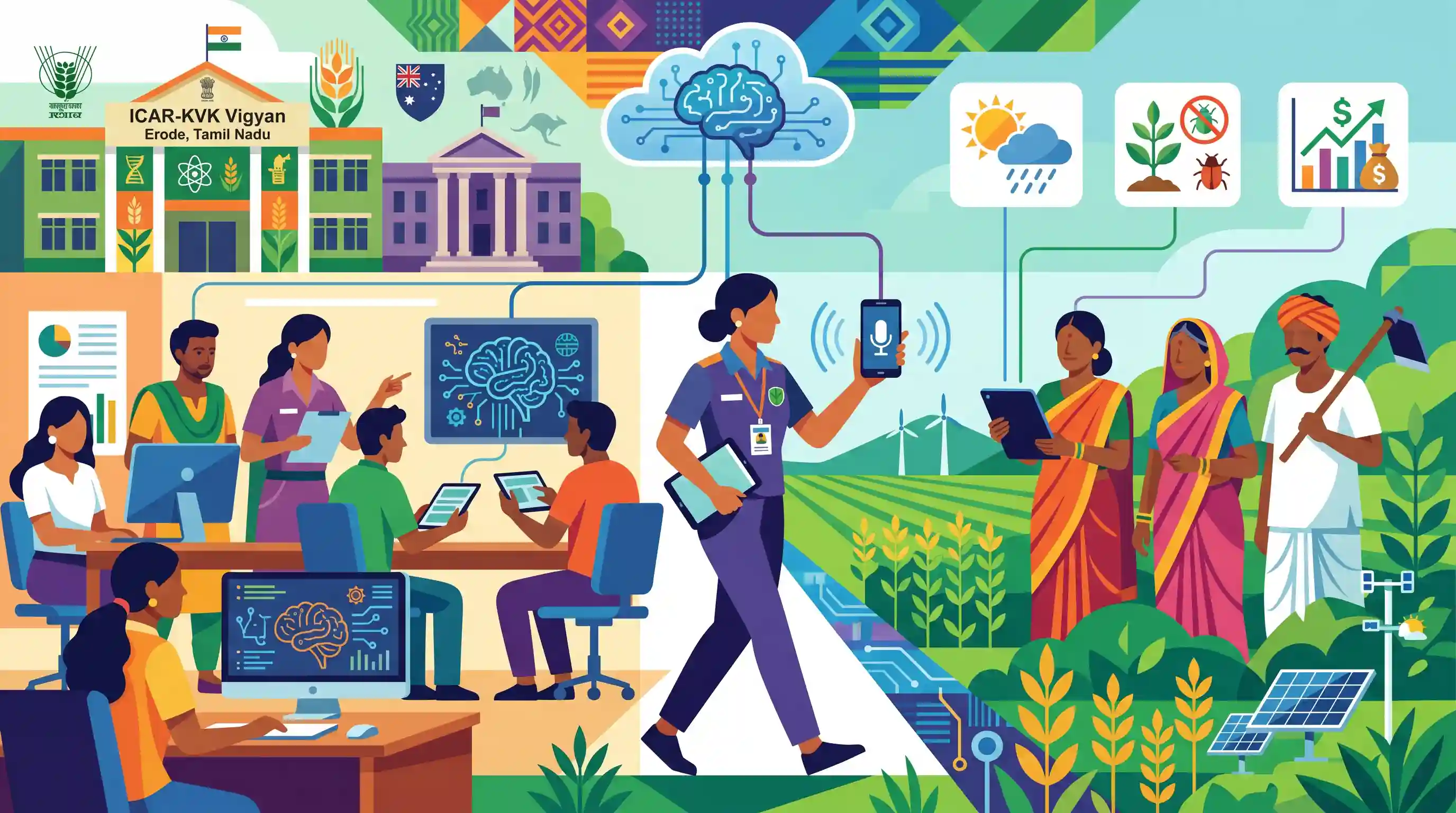
A pioneering pilot course titled 'Digital Agriculture Extension Promoter (DAEP)' has been launched at the ICAR-Krishi Vigyan Kendra (KVK), MYRADA, in Erode, Tamil Nadu. Designed in collaboration with the University of Adelaide, the course aims to equip agriculture professionals and rural youth with skills in digital tools, specifically Generative AI and voice-based advisory systems. The objective is to overcome the digital divide by training intermediaries who can deliver critical agricultural, meteorological, and marketing advisories to farmers who lack direct digital access. This initiative represents a significant step toward modernizing agriculture extension services in India.
Key Points
- A pilot course on Digital Agriculture Extension Promoter (DAEP) was launched at ICAR-KVK MYRADA in Erode to enhance digital extension services.
- The course trains participants to utilize Generative AI and voice-based advisory tools to support farmers with limited digital literacy.
- Developed with the University of Adelaide, the program aims to create a cadre of professionals who can deliver tech-driven advisories for better farm management and marketing.
- The initiative directly addresses the challenge of technology adoption at the grassroots level by focusing on accessible formats like voice.
Important Terms
Digital Agriculture Extension Promoter (DAEP)

A specialized job role (NSQF Level 5.5) designed to train intermediaries in using digital tools like Generative AI and voice-based advisory to deliver real-time agricultural information to farmers.
UPSC context
GS Paper III: e-Technology in aid of farmers. Tests understanding of human-intermediated technology adoption in rural areas.
Krishi Vigyan Kendra (KVK)
District-level agricultural knowledge centers in India established by ICAR to bridge the gap between agricultural research and practical application through training and technology demonstration.
UPSC context
GS Paper III: Agricultural Extension Services. Tests knowledge of the primary institutional mechanism for grassroots technology transfer.
Indian Council of Agricultural Research (ICAR)
The apex autonomous body under the Ministry of Agriculture and Farmers Welfare responsible for coordinating agricultural education and research across India.
UPSC context
GS Paper III: Public institutional frameworks. Tests understanding of the national body governing agricultural innovation and policy implementation.
Agriculture Extension Services
Systems that facilitate the access of farmers to data, technology, and information through training and advisory to improve farm productivity and income.
UPSC context
GS Paper III: Extension services. A direct syllabus keyword assessing strategies to modernize traditional farming through knowledge dissemination.
e-Technology in Agriculture
The application of ICT, including AI, drones, and mobile platforms, to optimize farm management, input usage, weather forecasting, and market access.
UPSC context
GS Paper III: e-Technology. Tests the role of digital innovation in achieving 'Precision Agriculture' and doubling farmers' income.
MYRADA
A prominent Indian non-governmental organization (NGO) focused on rural development, which hosts and manages the KVK in Erode for this digital pilot.
UPSC context
GS Paper II: Role of NGOs/SHGs. Illustrates the Public-Private-NGO partnership model in delivering government-backed agricultural programs.
Prelims Trap
The DAEP scheme directly provides AI-enabled smartphones to marginal farmers for self-advisory.
DAEP trains local intermediaries (promoters) to use AI tools, rather than giving technology directly to farmers, specifically to bypass rural digital illiteracy.
Static Concepts Connected
What is the administrative and functional mandate of Krishi Vigyan Kendras (KVKs)?
- Core Mandate: Serve as district-level frontline Farm Science Centers for technology assessment, refinement, and demonstration of agricultural innovations.
- Funding & Control: They are 100% centrally sponsored by ICAR, but can be administratively hosted by State Agricultural Universities, ICAR institutes, or NGOs.
How severe is India's agricultural extension deficit?
- Skewed Ratio: India's extension worker-to-farmer ratio is roughly 1:1000, severely limiting direct physical outreach and timely technical advice.
- Low Coverage: Historically, data shows less than 10% of Indian farmers receive formal, government-backed extension advice, necessitating digital gap-fillers.
Cross-Topic Patterns
Gen-AI + Vernacular DPI (Bhashini)
Voice-based AI advisories for illiterate farmers strongly connect with India's Bhashini mission, aiming to break language barriers in digital public infrastructure at the grassroots level.
NGOs in ICAR Extension Architecture
The involvement of NGOs like MYRADA running KVKs highlights the decentralized, multi-agency approach ICAR uses to execute frontline farm extension alongside State Agricultural Universities.

Expect a GS3 Mains question integrating Generative AI, Bhashini, and the digital divide to solve India's 1:1000 agriculture extension ratio.
Linked PYQs · 3
Linked PYQs · 3
- 2023MainsGS3
How does e-Technology help farmers in production and marketing of agricultural produce? Explain it.
- 2015MainsGS3
How can the 'Digital India' programme help farmers to improve farm productivity and income ? What steps has the Government taken in this regard?
- 2020PrelimsGS1
With the present state of development, Artificial Intelligence can effectively do which of the following? 1. Bring down electricity consumption in industrial units 2. Create meaningful short stories and songs 3. Disease diagnosis 4. Text-to-Speech Conversion 5. Wireless transmission of electrical energy Select the correct answer using the code given below:
