ISRO Operations Utilize Diverse Satellite Orbit Classifications
Source:Indian Express ↗
কেন এটি গুরুত্বপূর্ণ
Understanding satellite orbits and space technology fundamentals is crucial for both Prelims (direct orbit-related questions) and Mains (applications of space technology in socio-economic development).
সারসংক্ষেপ
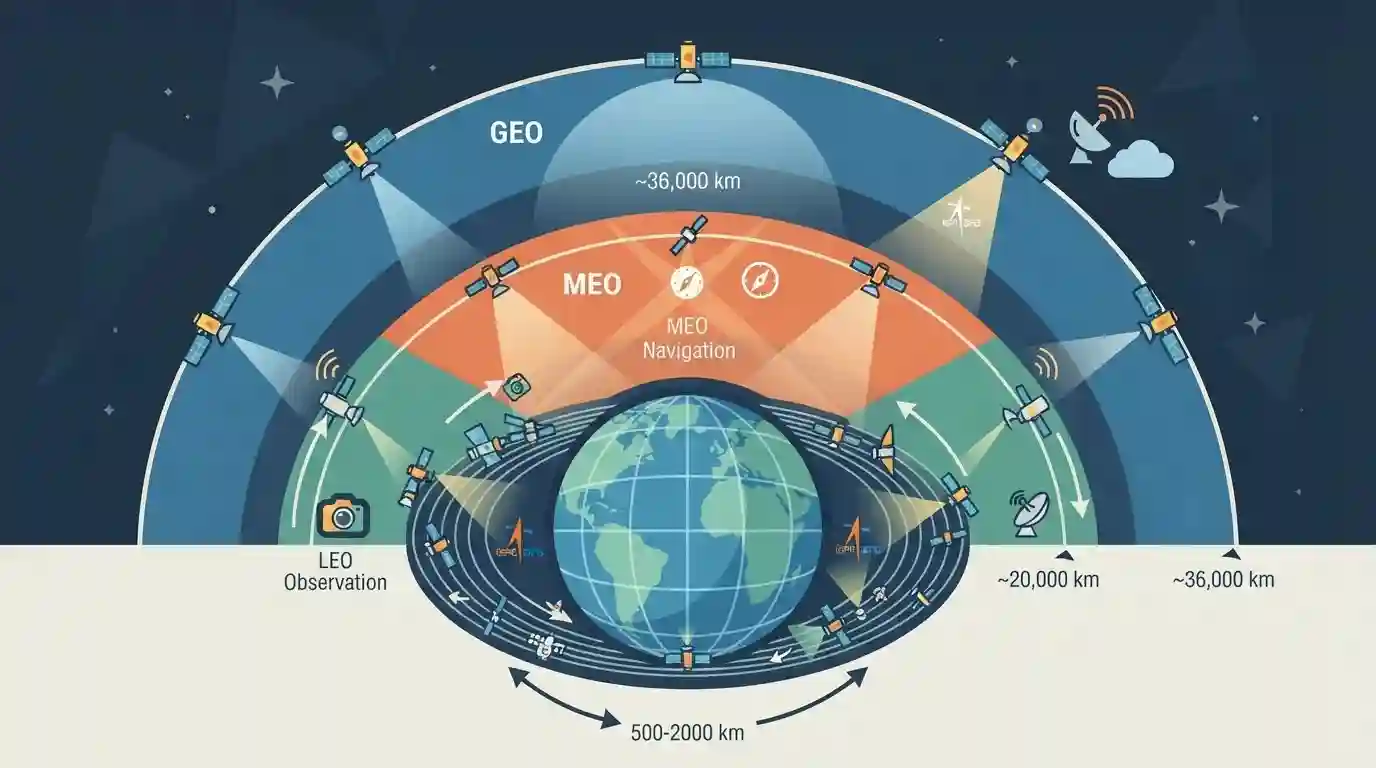
The article explains the different types of satellite orbits used by ISRO and global space agencies—including Low Earth Orbit (LEO), Medium Earth Orbit (MEO), and Geostationary/Geosynchronous Orbit (GEO)—detailing their characteristics, altitudes, and specific applications in communication, weather monitoring, and earth observation.
মূল বিষয়
- Satellites are placed in various orbits depending on their application, such as Low Earth Orbit (LEO), Medium Earth Orbit (MEO), and Geostationary/Geosynchronous Orbit (GEO).
- LEO is close to the Earth (up to 2,000 km) and is heavily used for earth observation, reconnaissance, and mega-constellations like Starlink.
- GEO sits at around 35,786 km and matches Earth's rotation speed, making it ideal for continuous communication and weather forecasting over a specific region.
- ISRO utilizes diverse launch vehicles and orbit-raising techniques (such as transfer orbits) to maneuver satellites into their designated operational positions.
গুরুত্বপূর্ণ শব্দ
Low Earth Orbit (LEO)

An orbit located between 160 km and 2,000 km above Earth's surface, characterized by rapid orbital periods and low latency, making it ideal for Earth observation and remote sensing.
UPSC context
UPSC GS Paper III (Science and Technology - Space): Tests understanding of satellite orbits, applications in earth observation, and space technology advancements.
Geostational/Geosynchronous Orbit (GEO/GSO)
An orbit positioned at approximately 35,786 km above Earth's equator where satellites match Earth's rotational speed, appearing stationary to monitor wide regions continuously.
UPSC context
UPSC GS Paper III (Science and Technology - Space): Important for questions on communication, meteorology, and satellite deployment mechanisms.
Medium Earth Orbit (MEO)
An intermediate orbital band between LEO and GEO, located roughly 2,000 to 35,786 km above Earth, primarily used for global navigation satellite systems.
UPSC context
UPSC GS Paper III (Science and Technology - Space): Tests knowledge of various orbital regimes and their specific utility in navigation and communication.
ISRO
India's national space agency responsible for planning, executing, and managing space exploration missions, satellite deployment, and launch vehicle development.
UPSC context
UPSC GS Paper III (Science and Technology - Space): Essential for evaluating India's achievements, space policy, commercial space sector reforms, and technological milestones.
প্রিলিমস ফাঁদ
Geosynchronous and geostationary orbits are identical terms used interchangeably for any satellite matching Earth's rotation period.
Aspirants often confuse geosynchronous orbits with geostationary orbits. While all geostationary orbits are geosynchronous, not all geosynchronous orbits are geostationary (geosynchronous can have an inclination relative to the equator).
সংযুক্ত স্থির ধারণা
What are the key differences between Low Earth Orbit (LEO), Medium Earth Orbit (MEO), and Geostationary Orbit (GEO)?
- LEO Characteristics: Altitude range from 160 km to 2,000 km with very high speeds, used for Earth observation and reconnaissance.
- MEO Applications: Situated between 2,000 km and 35,786 km; best known for hosting global navigation satellite systems like GPS and Galileo.
- GEO Position: Positioned at 35,786 km matching Earth's rotation period, appearing stationary over the equator for continuous communication.
আন্তঃবিষয় প্যাটার্ন
Launch Vehicles + Satellite Data Governance
Launch vehicle capabilities (like GSLV/LVM3 for GTO) link space tech directly to strategic telecommunications policy and remote sensing data governance under national security frameworks.

Expect a match-the-following or statement-based question on orbit altitudes, speeds, and applications (LEO vs GEO vs MEO).
সংযুক্ত PYQ · 2
সংযুক্ত PYQ · 2
- 2011PrelimsGS1
Satellites used for telecommunication relay are kept in a geostationary orbit. A satellite is said to be in such an orbit when: 1. The orbit is geosynchronous. 2. The orbit is circular. 3. The orbit lies in the plane of the Earth's equator. 4. The orbit is at an altitude of 22,236 km.
- 2016MainsGS3
Discuss India's achievements in the field of Space Science and Technology. How the application of this technology has helped India in its socio-economic development?
