ISRO Satellite Orbits and Their Applications in Space Technology
Source:Indian Express ↗
Why It Matters
Understanding satellite orbits is fundamental for grasping space technology concepts, satellite communication, remote sensing, and ISRO's launch capabilities, which frequently appear in UPSC Prelims and Mains.
Summary
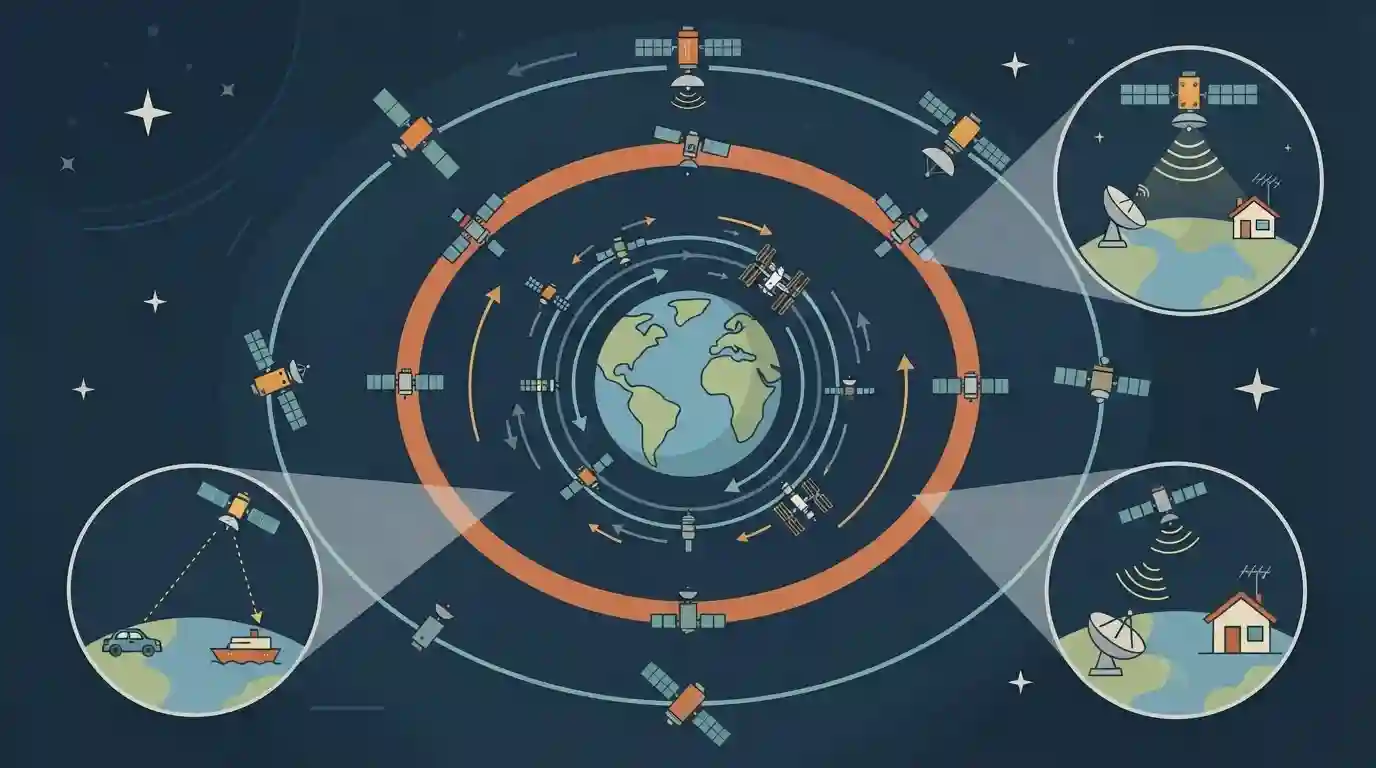
The article explains the different types of satellite orbits utilized by space agencies like ISRO, including Low Earth Orbit (LEO), Medium Earth Orbit (MEO), and Geosynchronous/Geostationary Earth Orbit (GEO), detailing their distinct characteristics, altitude ranges, and applications.
Key Points
- Satellite orbits are categorized based on their altitude and inclination, primarily into Low Earth Orbit (LEO), Medium Earth Orbit (MEO), and Geostationary/Geosynchronous Earth Orbit (GEO).
- LEO satellites are closer to the Earth and are used for Earth observation, remote sensing, and communication mega-constellations.
- GEO and geosynchronous orbits match the Earth's rotational speed, making them ideal for meteorology, telecommunication, and broadcasting as they appear stationary from the ground.
- ISRO utilizes various orbits depending on the specific mission objectives, payloads, and application requirements.
Important Terms
ISRO

The national space agency of India, responsible for designing and executing space programmes, launch vehicles, and satellite missions for national development and scientific exploration.
UPSC context
UPSC Prelims & Mains (GS Paper III): Key institution under Space Technology, covering achievements, satellite series, and indigenous space capabilities.
Low Earth Orbit (LEO)
An orbit located between 160 km and 2,000 km above the Earth's surface, characterized by high speeds, short orbital periods, and low signal latency, commonly used for Earth observation.
UPSC context
UPSC Prelims (Science & Technology): Tests understanding of orbital regimes, satellite applications, and remote sensing.
Geostationary / Geosynchronous Earth Orbit (GEO/GSO)
An orbit situated exactly 35,786 km above the Earth's equator where a satellite's orbital period matches Earth's rotation, making it appear stationary to ground observers.
UPSC context
UPSC Prelims (Science & Technology): Important for understanding communication, broadcasting, and weather satellite placement mechanisms.
Prelims Trap
All geosynchronous orbits are stationary directly above the Earth's equator.
A geosynchronous orbit does not have to be directly above the equator; it only needs an orbital period matching Earth's rotational period (24 hours). Only geostationary orbits are strictly equatorial and stationary.
Static Concepts Connected
What are the key characteristics and altitude ranges of LEO, GEO, and SSO orbits?
- LEO Range: Altitude ranges roughly from 160 km to 2,000 km, offering low latency and high-resolution imaging for remote sensing and communication mega-constellations.
- GEO Range: Altitude sits at exactly 35,786 km above the equator, matching Earth's rotation period so the satellite appears stationary from the ground.
- SSO Definition: A specialized polar or near-polar LEO where satellites pass over any given point at the exact same local solar time daily.
Cross-Topic Patterns
Launch Vehicles + Orbital Mechanics
Satellite launch vehicle capacity (PSLV vs GSLV) is frequently tested alongside orbital mechanics and transfer orbit physics like GTO.
SSO Satellites + Agriculture & Climate Data
Earth observation satellites in Sun-synchronous orbits directly support climate monitoring and agriculture data networks tested in geography.

Expect a matching or statement-based question pairing satellite orbits (LEO, MEO, GEO, SSO) with their exact altitude and application.
Linked PYQs · 1
Linked PYQs · 1
- 2011PrelimsGS1
Satellites used for telecommunication relay are kept in a geostationary orbit. A satellite is said to be in such an orbit when: 1. The orbit is geosynchronous. 2. The orbit is circular. 3. The orbit lies in the plane of the Earth's equator. 4. The orbit is at an altitude of 22,236 km.
