Satellite Orbits and ISRO Launch Applications for Space Missions
Source:Indian Express ↗
આ શા માટે મહત્વનું છે
Understanding satellite orbits is fundamental for grasping space technology fundamentals, satellite communication networks, and remote sensing applications crucial for socio-economic development and disaster management in India.
સારાંશ
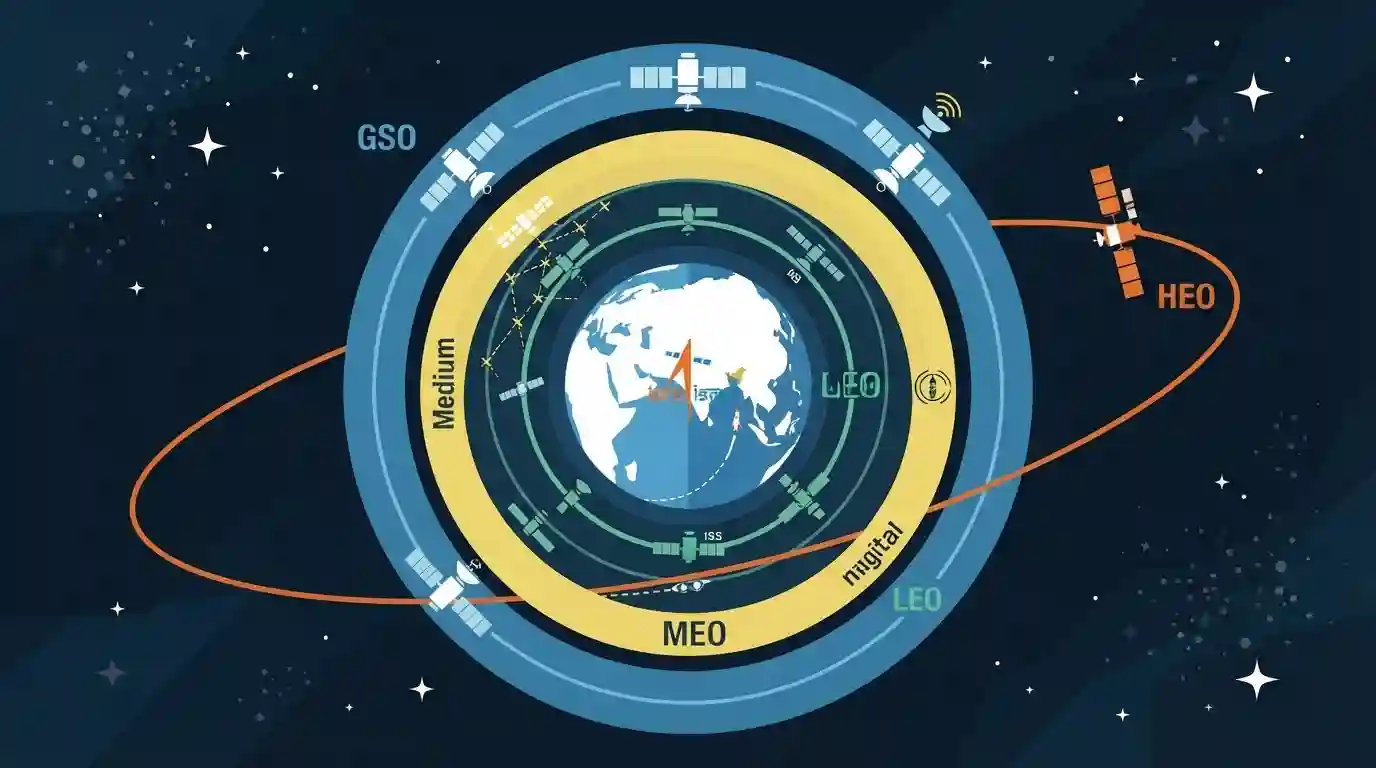
The article explains the different types of satellite orbits utilized by space agencies like ISRO—such as Low Earth Orbit (LEO), Medium Earth Orbit (MEO), Geosynchronous/Geostationary Orbits (GSO), and High Elliptical Orbits (HEO)—detailing their altitudes, characteristics, and specific applications like communication, weather monitoring, and remote sensing.
મુખ્ય મુદ્દા
- Satellite orbits are categorised based on their altitude and inclination, primarily including Low Earth Orbit (LEO), Medium Earth Orbit (MEO), Geostationary/Geosynchronous Orbit (GSO), and High Elliptical Orbit (HEO).
- LEO is closest to Earth, commonly used for Earth observation, remote sensing, and satellite constellations like Starlink, because it offers high-resolution imaging and low latency.
- Geosynchronous and Geostationary orbits match Earth's rotational speed, making satellites appear stationary from the ground, which is crucial for continuous communication and weather forecasting.
- ISRO utilizes various launch vehicles (like PSLV, GSLV, LVM3) to place satellites into these specific orbits depending on their mission objectives.
મહત્વપૂર્ણ શબ્દો
ISRO

India's national space agency responsible for planning, developing, and launching space rockets, satellites, and deep-space missions.
UPSC context
UPSC Paper III (Science & Technology - Space Technology): Core organization driving India's space achievements and satellite deployment programs.
Low Earth Orbit (LEO)
An orbit located close to Earth (up to 2,000 km altitude), widely used for remote sensing, earth observation, and low-latency communication.
UPSC context
UPSC Paper III (Space Technology): Tests understanding of satellite orbital mechanics and applications like Earth observation.
Geosynchronous/Geostationary Orbit (GSO/GEO)
An orbit positioned at approximately 35,786 km altitude where the satellite's orbital period matches Earth's rotation, making it appear stationary over a fixed region.
UPSC context
UPSC Paper III (Space Technology): Crucial for continuous weather tracking, television broadcast, and communication payloads.
સંલગ્ન સ્થિર ખ્યાલો
What are the key operational differences between Geostationary (GEO) and Sun-Synchronous Orbits (SSO)?
- Altitude Profile: Altitude profile: GEO sits at ~35,786 km above the equator, whereas SSO is typically a low polar/near-polar orbit between 600-800 km altitude.
- Illumination Consistency: Lighting conditions: SSO maintains constant local solar illumination for imaging; GEO provides continuous staring coverage of the same hemisphere.
- Core Applications: Primary applications: GEO is used for weather broadcasting and telecommunications; SSO is tailored for earth observation and resource mapping.
આંતર-વિષય પેટર્ન
Space Tech + Commercial Space Policy FDI
ISRO's shift toward multi-orbit constellations and reusable launch vehicles intersects directly with the draft Space Policy 2023 and private sector FDI rules in space.
Remote Sensing + Disaster Management Protocols
High-resolution LEO imaging for earth observation feeds directly into disaster management protocols under NDMA guidelines.

Expect statement-based questions pairing specific satellite orbits (SSO vs. GSO) with exact altitude ranges and primary utility.
સંલગ્ન PYQ · 2
સંલગ્ન PYQ · 2
- 2011PrelimsGS1
Satellites used for telecommunication relay are kept in a geostationary orbit. A satellite is said to be in such an orbit when: 1. The orbit is geosynchronous. 2. The orbit is circular. 3. The orbit lies in the plane of the Earth's equator. 4. The orbit is at an altitude of 22,236 km.
- 2016MainsGS3
Discuss India's achievements in the field of Space Science and Technology. How the application of this technology has helped India in its socio-economic development?
