Evaluation of Press Note 3 FDI Restrictions and Economic Impact
Source:The Hindu ↗
Why It Matters
The balance between national security and economic development is a core UPSC theme. Understanding how geopolitical tensions translate into economic policies (like Press Note 3) and how those policies impact India's manufacturing capabilities and global supply chain integration is crucial for GS2 (IR) and GS3 (Economy) analysis.
Summary
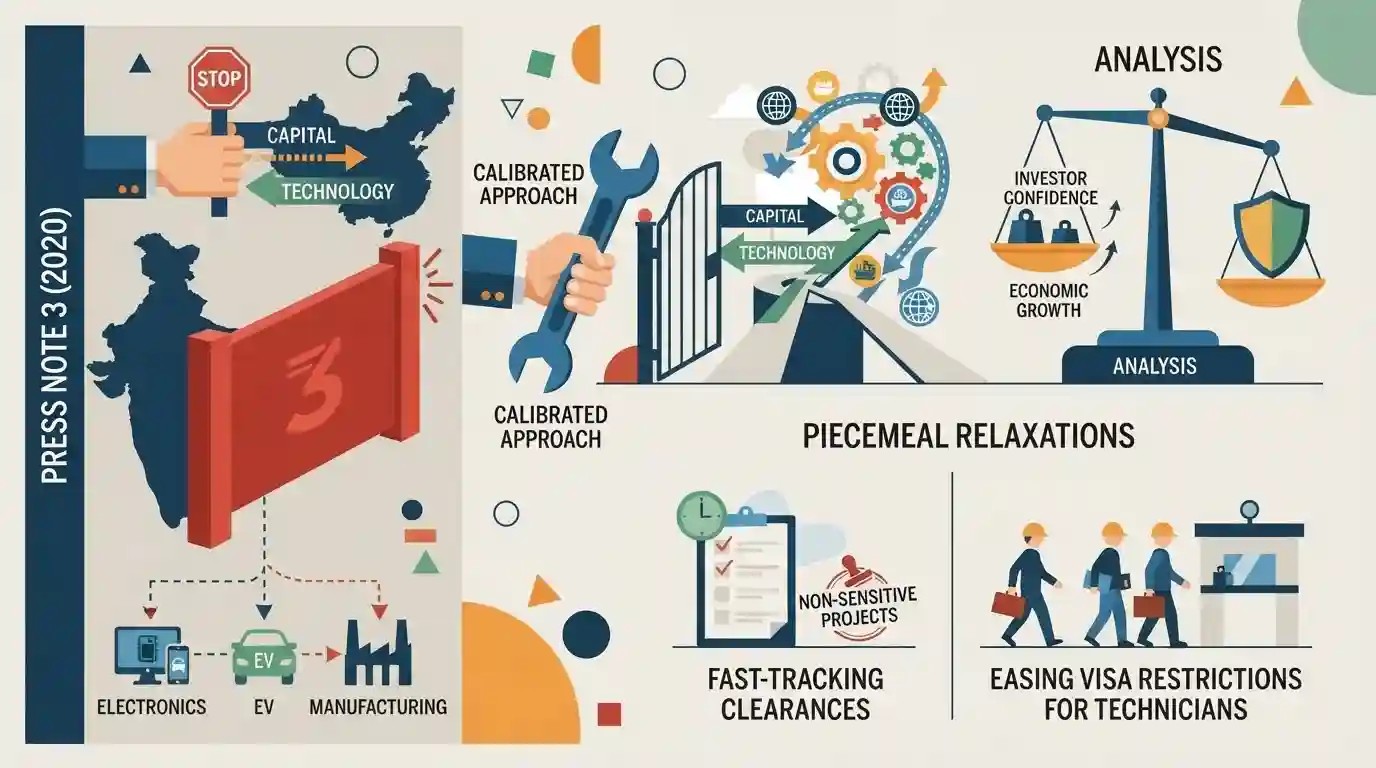
The article evaluates the impact of recent relaxations to the stringent Foreign Direct Investment (FDI) rules introduced under Press Note 3 (2020). Originally designed to prevent opportunistic acquisitions of Indian companies by entities from land-border-sharing countries—primarily China—the policy severely throttled capital inflows and technological tie-ups in sectors like electronics, EVs, and manufacturing. Recognizing the adverse effects on India's ambitions to integrate into Global Value Chains (GVCs) and boost export-led manufacturing, the government has adopted a more calibrated approach. By fast-tracking clearances for specific non-sensitive projects and easing visa restrictions for essential foreign technicians, policymakers are attempting to revive stalled FDI. The analysis weighs whether these piecemeal relaxations are sufficient to restore investor confidence and stimulate economic growth while continuing to safeguard national security.
Key Points
- Press Note 3 of 2020 mandated prior government approval for Foreign Direct Investment (FDI) from countries sharing a land border with India to curb opportunistic takeovers during the COVID-19 pandemic.
- The policy disproportionately impacted Chinese investments, leading to hundreds of stalled proposals and a sharp decline in FDI inflows for critical sectors like electronics manufacturing, electric vehicles (EVs), and pharmaceuticals.
- Policymakers are re-evaluating the restrictions, noting that integrating India into Global Value Chains (GVCs) and boosting domestic manufacturing requires capital and technical expertise from China.
- Recent selective relaxations—such as fast-tracking security clearances for non-sensitive sectors and easing visa norms for Chinese technicians—aim to attract delayed FDI without compromising national security.
Important Terms
Press Note 3 (2020)

A government directive requiring prior state approval for any Foreign Direct Investment (FDI) originating from or beneficially owned by entities in countries sharing a land border with India, primarily targeting opportunistic acquisitions.
UPSC context
GS Paper III (Economy/Investment Models); tests knowledge of foreign investment regulations, national security policies, and India-China economic relations.
Foreign Exchange Management Act (FEMA)
Enacted in 1999 to replace FERA, this law regulates foreign exchange transactions, manages cross-border payments, and provides the overarching legal framework for Foreign Direct Investment (FDI) compliance in India.
UPSC context
GS Paper III (Economy/Indian Economy); tests understanding of external sector regulations, capital/current account transactions, and regulatory frameworks.
Production Linked Incentive (PLI) scheme
A flagship industrial policy offering 4% to 6% financial incentives to domestic and foreign manufacturers on incremental sales of goods produced in 14 strategic sectors in India.
UPSC context
GS Paper III (Economic Development/Industrial Policy); tests understanding of manufacturing-led growth strategies, export promotion, and Atmanirbhar Bharat initiatives.
Department for Promotion of Industry and Internal Trade (DPIIT)
A department under the Ministry of Commerce and Industry responsible for formulating industrial policy, facilitating ease of doing business, and administering India's Consolidated Foreign Direct Investment (FDI) policy.
UPSC context
GS Paper III (Economy/Industrial Sector); tests comprehension of administrative bodies steering economic policies, investment promotion, and industrial development.
Reserve Bank of India (RBI)
India's central bank and monetary authority, responsible for regulating the foreign exchange market, enforcing FEMA regulations, and monitoring capital and current account transaction limits.
UPSC context
GS Paper III (Indian Economy/Banking); tests knowledge of central banking operations, monetary policy, foreign exchange reserve management, and investment flows.
Prelims Trap
The 10% relaxation allows direct investments from Chinese companies up to a 10% stake via the automatic route.
The 2026 relaxation applies strictly to indirect, passive investments through global funds where the ultimate beneficial owner from a land-bordering country holds less than 10% and has no board/control rights. Direct investments remain barred from the automatic route.
Static Concepts Connected
What is the current FDI approval mechanism in India post-FIPB?
- FIPB Dissolution: Abolished in 2017 to reduce bureaucratic red tape and speed up clearances.
- Single-Window Portal: The Foreign Investment Facilitation Portal (FIFP) acts as the new single-window clearance point.
- Competent Authorities: DPIIT coordinates, but individual administrative line ministries approve proposals under FDI policy.
- Security Clearance: The Ministry of Home Affairs handles security clearance for investments in sensitive sectors.
What are the key differences between FDI and FPI in India?
- 10% Threshold Rule: Based on the Arvind Mayaram Committee; an investment of 10% or more in a listed company is classified as FDI.
- Management Control: FDI implies a lasting interest and active management control, whereas FPI represents passive portfolio investments.
- Regulatory Body: FDI is regulated by the FDI Policy (DPIIT) and FEMA, while FPI is primarily regulated under SEBI regulations.
Cross-Topic Patterns
FDI restrictions vs PLI execution
Stringent Press Note 3 curbs starved critical electronic component supply chains, demonstrating how security-first trade policies can directly bottleneck domestic manufacturing schemes like PLI.
Economic statecraft and border security
Using investment blockages post-Galwan highlights India's pivot to geo-economics, using market access and regulatory gatekeeping as strategic leverage against territorial incursions.

Analysis of FDI restrictions (Press Note 3) balancing security versus GVC integration is highly likely for GS-3.
Linked PYQs · 5
Linked PYQs · 5
- 2023MainsGS3
Faster economic growth requires increased share of the manufacturing sector in GDP, particularly of MSMEs. Comment on the present policies of the Government in this regard.
- 2016MainsGS3
Justify the need for FDI for the development of the Indian economy. Why there is gap between MOUs signed and actual FDIs? Suggest remedial steps to be taken for increasing actual FDIs in India.
- 2020PrelimsGS1
With reference to Foreign Direct Investment in India, which one of the following is considered its major characteristic?
- 2012MainsGS2
Do you think that China's emergence as one of the largest trading partners of India has adversely affected the settlement of the outstanding border problem?
- 2024MainsGS2
‘The West is fostering India as an alternative to reduce dependence on China's supply chain and as a strategic ally to counter China's political and economic dominance.’ Explain this statement with examples.
