Private orbital launch milestone and space technology payloads
Source:The Hindu ↗
Why It Matters
The transition from suborbital to orbital launch capability by a private Indian player (Skyroot Aerospace) is a landmark event in the liberalization of India's space sector. It highlights how policy reforms (like IN-SPACe) have fostered a vibrant private ecosystem capable of executing complex orbital missions. Additionally, testing advanced technologies like soft-robotic space debris removal on domestic launches is essential for securing India's role in global space governance and sustainability.
Summary
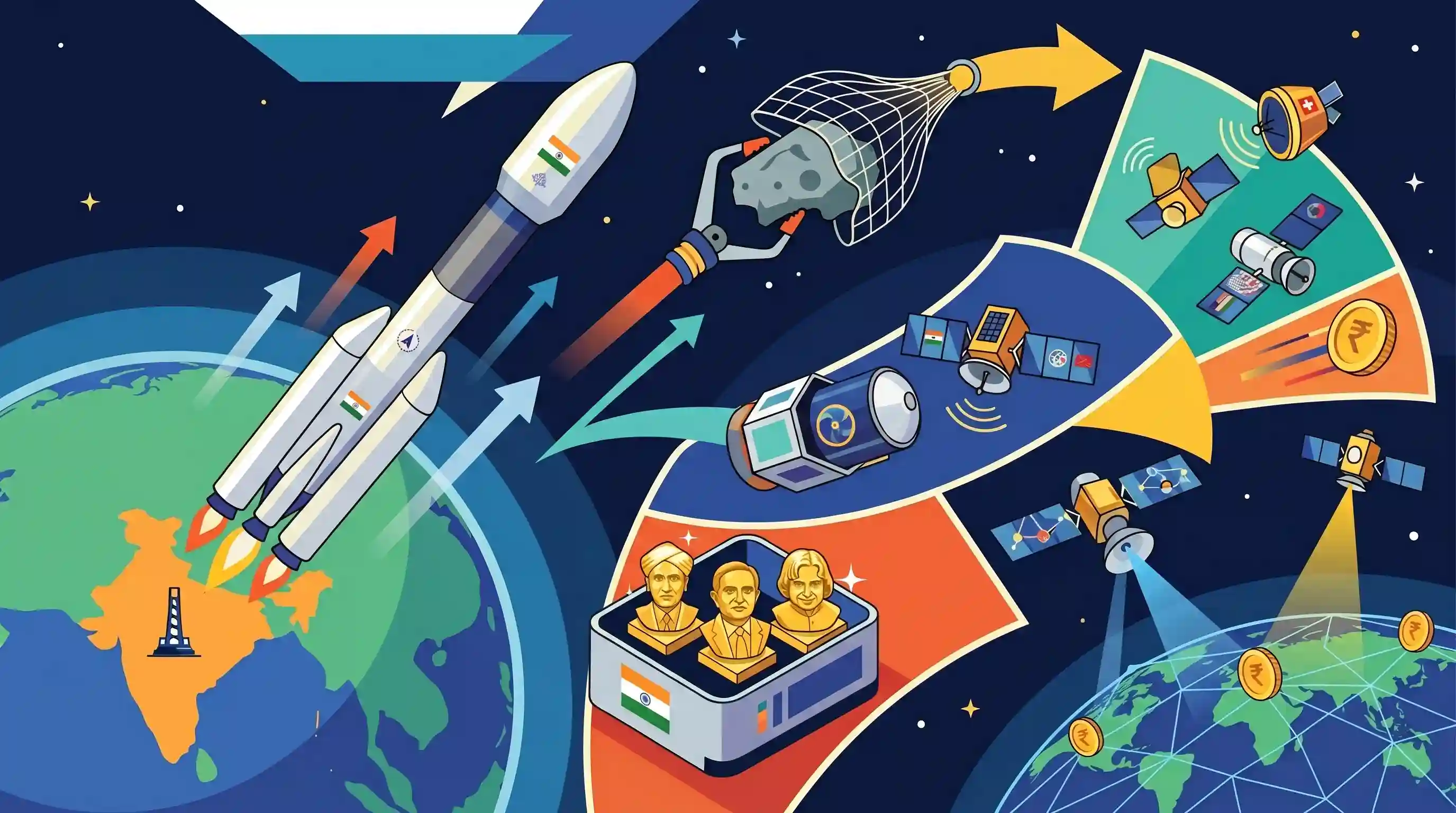
Skyroot Aerospace has announced the upcoming launch of Vikram-1, India's first privately developed orbital-class rocket, scheduled between July 12 and August 4, 2026. The rocket will carry six payloads, highlighting India's growing commercial space capability and technological diversity. These include the 'Embrace' payload by Cosmoserve Space to test soft-robotic capture technology for space debris removal, 'SOLARAS' by Graaha Space, and German payloads by Dcubed GmbH. Additionally, Vikram-1 will carry artistic payloads celebrating India's scientific heritage, including micro-sculptures of Sir C.V. Raman, Dr. Vikram Sarabhai, and Dr. A.P.J. Abdul Kalam made of 18K gold.
Key Points
- Launch of Vikram-1: Vikram-1, scheduled for launch between July 12 and August 4, 2026, is India's first privately developed orbital-class rocket manufactured by Skyroot Aerospace. This represents a major milestone in India's commercial space sector, advancing from Skyroot's previous suborbital launch (Vikram-S).
- Six Onboard Payloads: The orbital launch vehicle will carry six technology and artistic payloads from domestic and international entities.
- Space Debris & Sustainability: The 'Embrace' payload developed by Cosmoserve Space will test a soft-robotic capture technology designed for space debris removal and in-orbit servicing, marking a crucial step for orbital sustainability. This was developed rapidly under Skyroot's 'Mission Aagaman' testing platform.
- Scientific & Creative Tributes: In addition to technical systems, the rocket carries 'Cosmic Bloom' (a diamond jewellery creation by Cosmos Diamonds) and 'Microart' by Ajay Kumar Mattewada (18K gold rocket holding micro-sculptures of Sir C.V. Raman, Dr. Vikram Sarabhai, and Dr. A.P.J. Abdul Kalam, each smaller than a grain of rice).
- International and Private Commercial Collaboration: The payload includes German-made technology demonstration payloads (uD3PP and mD3RN by Dcubed GmbH) and 'SOLARAS' by Graaha Space, indicating growing confidence of international and domestic startups in Indian private launch vehicles.
Important Terms
Mission Aagaman

The maiden orbital test flight of the privately developed Vikram-1 rocket, scheduled for mid-2026, marking a significant milestone in India's private sector capabilities to launch satellites into Low Earth Orbit.
UPSC context
GS-3: Science and Technology. Tests awareness of privatization milestones, commercial satellite deployment, and indigenous space launch capabilities.
Skyroot Aerospace
A Hyderabad-based Indian private space tech startup that developed the Vikram rocket series, successfully launching India’s first private suborbital rocket (Vikram-S) and its first private orbital vehicle (Vikram-1).
UPSC context
GS-3: Space Technology and Privatization. Tests understanding of private sector roles in space reforms and the commercial launch industry.
Cosmoserve Space
An Indian space-tech startup demonstrating a soft-robotic capture system in orbit via 'Mission Embrace' on Vikram-1, proving critical technology for Active Debris Removal and long-term space sustainability.
UPSC context
GS-3: Space Debris and Sustainability. Tests knowledge of orbital debris mitigation, space situational awareness, and in-orbit servicing solutions.
Graaha Space
A Bengaluru-based space-tech startup whose "SOLARAS" nanosatellite platform, launched on Vikram-1, aims to validate next-generation communication modules, optical payloads, and near-real-time Earth observation systems.
UPSC context
GS-3: Space Technology. Tests knowledge of private nanosatellite constellations, geospatial data application, and Indian space sector liberalization.
Dcubed GmbH
A German NewSpace company specializing in release actuators and solar arrays. It is providing the international technology demonstration payload for the maiden orbital flight of India's Vikram-1.
UPSC context
GS-3: International Space Collaboration. Tests knowledge of foreign commercial payloads launching aboard newly developed private Indian launch vehicles.
Prelims Trap
India permits 100% automatic Foreign Direct Investment (FDI) across all segments of the space sector to encourage private launch vehicles.
FDI limits are tiered. While components allow 100% automatic FDI, launch vehicles are capped at 49% and satellites at 74% under the automatic route.
Static Concepts Connected
How do IN-SPACe and NSIL differ in India's space ecosystem?
- IN-SPACe: Acts as an autonomous, single-window regulatory and promotional agency for private sector space operations.
- NSIL: Functions as the commercial arm of ISRO, focused on technology transfer, commercial launches, and satellite service aggregation.
What are India's 2024 FDI limits for the space sector?
- Launch vehicles: Up to 49% automatic FDI is allowed for launch vehicles, launch pads, and associated systems.
- Satellites: Up to 74% automatic FDI is permitted for satellite manufacturing, operations, and data systems.
- Components: Up to 100% automatic FDI is allowed for manufacturing space subsystems, components, and ground terminals.
Cross-Topic Patterns
Space debris and international liability law
Commercial LEO expansion escalates collision risks, testing India's obligations under the 1972 Liability Convention and driving private active debris removal (ADR) technology development.
Additive manufacturing and strategic self-reliance
Vikram-1's 3D-printed engine components demonstrate how domestic advanced manufacturing bypasses global technology supply chain sanctions and bottlenecks.

Expect a multi-statement question on India's 2024 Space FDI policy ceilings and the distinction between IN-SPACe and NSIL mandates.
Linked PYQs · 2
Linked PYQs · 2
- 2026PrelimsGS1
Consider the following statements with regard to involvement of private entities in India's space programme : 1. The Indian National Space Promotion and Authorisation Centre (IN-SPACe) is an autonomous agency formed to facilitate participation of private entities. 2. Agnikul Cosmos launched the world's first flight using 3D-printed rocket engine. 3. Skyroot Aerospace has developed liquid fuel for GSLV. Which of the statements given above is/are correct ?
- 2016MainsGS3
Discuss India's achievements in the field of Space Science and Technology. How the application of this technology has helped India in its socio-economic development?
