Understanding Diabetes Remission and Lifestyle Interventions
Source:Indian Express ↗
Why It Matters
India faces a massive public health crisis due to the rising prevalence of Type 2 diabetes. Understanding medical concepts like insulin resistance and diabetes remission is important for Prelims General Science. For Mains (GS2), it relates directly to the management of non-communicable diseases, healthcare policies, and the shift towards lifestyle-based preventive healthcare to reduce the economic and infrastructural burden on the health system.
Summary
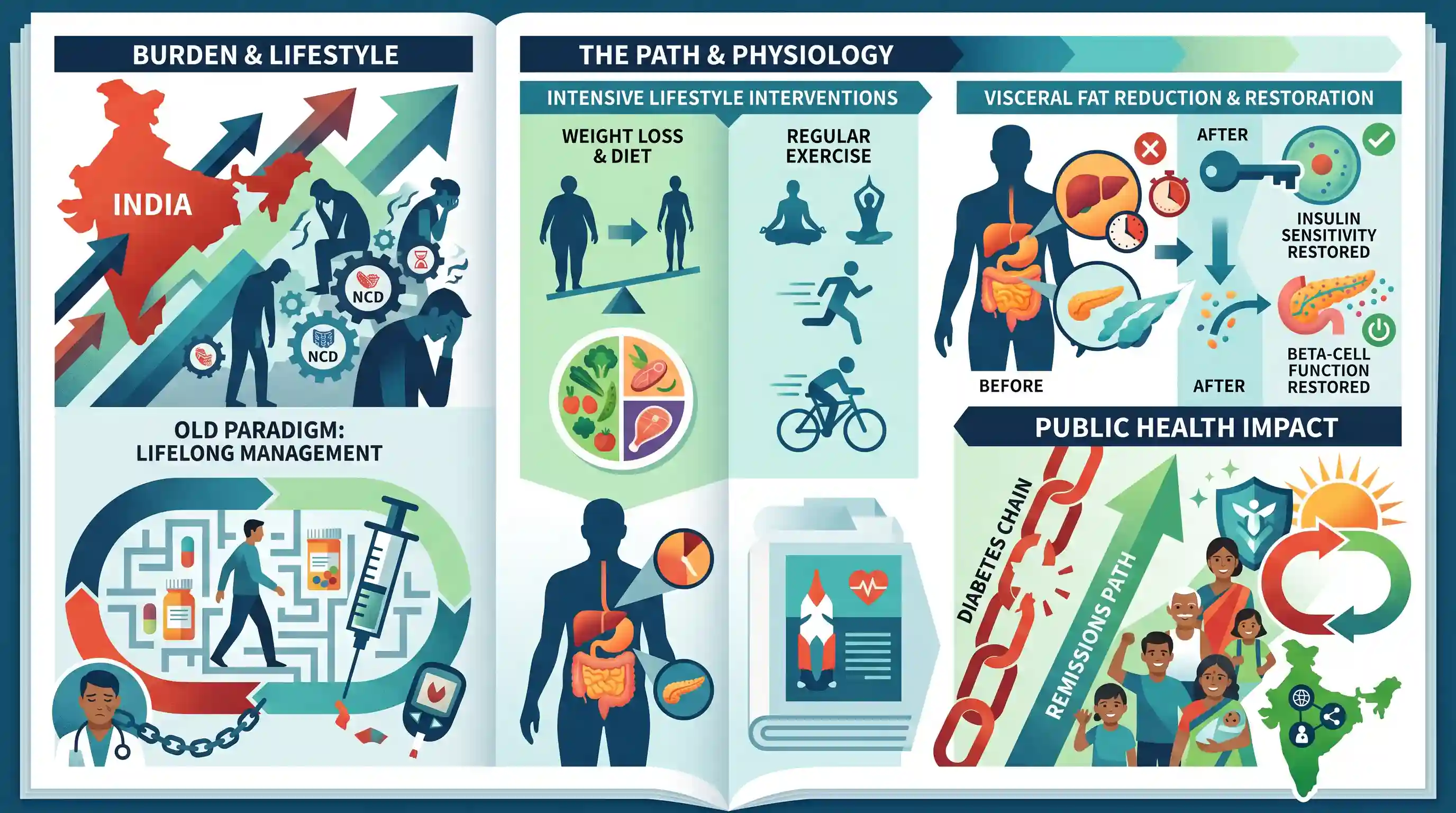
The article examines the concept of diabetes remission, particularly for Type 2 diabetes, where patients successfully maintain normal blood sugar levels without relying on insulin or glucose-lowering medications. Achieving remission involves intensive lifestyle interventions—including significant weight loss, low-calorie diets, and regular exercise—which help reduce fat around the liver and pancreas, thereby restoring insulin sensitivity and beta-cell function. From a public health perspective, emphasizing diabetes remission offers a proactive approach to combating India's rising burden of non-communicable diseases (NCDs), shifting the medical paradigm from lifelong pharmacological management to preventive healthcare and disease reversal.
Key Points
- Diabetes remission occurs when a patient's blood sugar levels return to healthy, non-diabetic ranges (HbA1c < 6.5%) without the need for glucose-lowering medications or insulin for at least three months.
- Remission is predominantly achievable for Type 2 diabetes patients through intensive lifestyle modifications, such as significant weight loss, carbohydrate restriction, and regular physical activity.
- The underlying mechanism involves reducing ectopic fat around the liver and pancreas, which helps restore beta-cell function and insulin sensitivity.
- Promoting diabetes remission marks a paradigm shift in healthcare from lifelong pharmacological management of the disease to potentially reversing it through preventive care and lifestyle intervention.
- Addressing the diabetes epidemic is crucial for India, given its status as the 'diabetes capital' and the resulting burden of non-communicable diseases (NCDs) on the public health system.
Important Terms
NP-NCD (formerly NPCDCS)

India's flagship health initiative (under NHM) for screening and managing chronic conditions. Renamed from NPCDCS in 2023 to include more diseases and emphasize preventive care.
UPSC context
GS Paper II (Health) & GS Paper III (Science). Tests knowledge of India's policy response to the NCD burden.
Diabetes Remission
A clinical state in Type 2 diabetes where blood glucose levels (HbA1c <6.5%) remain normal for at least three months without the use of glucose-lowering medications.
UPSC context
GS Paper II (Health/Social Issues). Evaluates understanding of preventive healthcare and shifting paradigms in chronic disease management.
Non-Communicable Diseases (NCDs)
Chronic, non-contagious medical conditions (e.g., heart disease, cancer, diabetes) caused by lifestyle, genetic, and environmental factors. They account for roughly 66% of all deaths in India.
UPSC context
GS Paper II (Health) & GS Paper III (Economy). Fundamental for discussions on India's epidemiological transition and healthcare costs.
ICMR (Indian Council of Medical Research)
The apex body in India for formulating, coordinating, and promoting biomedical research; functions as an autonomous organization under the Ministry of Health and Family Welfare.
UPSC context
GS Paper II (Governance/Institutions). Core institutional body often tested for its role in national health policy and research.
SDG Target 3.4
A global target to reduce premature mortality from non-communicable diseases by one-third by 2030 through prevention and treatment.
UPSC context
GS Paper II (International Relations/Health). Tests awareness of India's commitments under the 2030 Agenda for Sustainable Development.
Beta-cell Function
Cells in the pancreas that produce, store, and release insulin. Their restoration through weight loss is critical for achieving Type 2 diabetes remission.
UPSC context
GS Paper III (Science & Technology/Biology). Tests foundational understanding of human physiology and disease mechanisms in current affairs.
Prelims Trap
"Both Type 1 and Type 2 diabetes can be completely reversed or put into remission through intensive lifestyle modifications."
Remission via lifestyle changes (reducing ectopic fat) is specific to Type 2. Type 1 is an autoimmune disease destroying pancreatic beta cells, requiring lifelong insulin replacement.
Static Concepts Connected
What is the biological mechanism and utility of the HbA1c test?
- Glycation basis: It measures the percentage of hemoglobin in red blood cells (RBCs) that is coated with glucose (glycated).
- Timeframe (120 days): Because red blood cells have a lifespan of approximately 120 days, the test reflects average blood sugar over the past 2-3 months.
- No fasting required: Unlike traditional fasting blood sugar tests that capture a single moment in time, HbA1c does not require fasting and captures long-term metabolic control.
What is the fundamental difference between Type 1 and Type 2 Diabetes?
- Type 1 (Autoimmune): An autoimmune condition where the body's immune system destroys insulin-producing beta cells in the pancreas, resulting in little to no insulin production.
- Type 2 (Metabolic): A metabolic condition where the body becomes resistant to insulin, often driven by ectopic fat accumulation around the liver and pancreas due to lifestyle factors.
Cross-Topic Patterns
NCDs and Demographic Dividend
The rising burden of metabolic NCDs directly threatens the productivity of India's working-age population, potentially turning the demographic dividend into a massive healthcare and economic liability.
Epidemiological Transition & Dual Burden
India uniquely fights a high NCD mortality rate (65%) alongside persistent communicable diseases (TB, Malaria), straining primary healthcare infrastructure integrated under the NPCDCS scheme.

Expect a Prelims question contrasting HbA1c testing (based on RBC lifespan) with fasting glucose, or Type 1 vs Type 2 reversibility.
Linked PYQs · 3
Linked PYQs · 3
- 2020MainsGS2
In order to enhance the prospects of social development, sound and adequate health care policies are needed particularly in the fields of geriatric and maternal health care. Discuss.
- 2022PrelimsGS1
Which one of the following statements best describes the role of B cells and T cells in the human body?
- 2021MainsGS3
What are the research and developmental achievements in applied biotechnology? How will these achievements help to uplift the poorer sections of the society?
