Draft school mental health policy and holistic education
Source:The Hindu ↗
Why It Matters
Integrating mental health into the mainstream education system reflects a paradigm shift towards holistic education as envisioned in NEP 2020. This is crucial for UPSC aspirants as it covers the intersection of health, education (GS2), cultural values (GS1), and emotional intelligence (GS4).
Summary
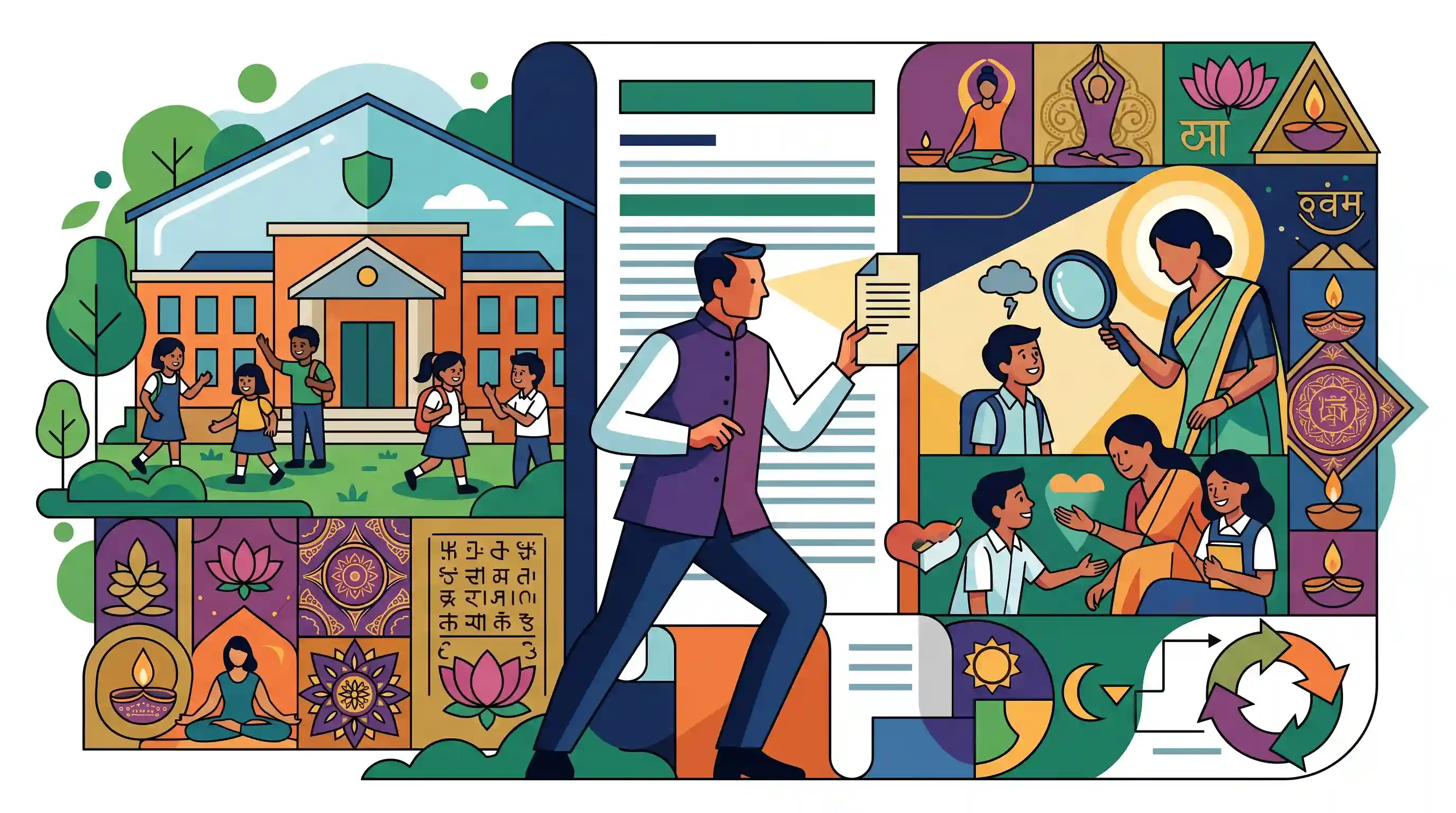
Union Education Minister Dharmendra Pradhan recently reviewed the draft National Mental Health and Well-Being Policy for Schools, highlighting that physical and mental well-being is fundamental to quality education. The proposed policy seeks to build safe, inclusive, and supportive learning environments through a holistic, preventive approach to mental health. It emphasizes building the capacity of teachers to act as primary mentors who can identify and address student stress early. Furthermore, the policy aims to incorporate elements of the Indian Knowledge Systems and traditional culture to ensure that mental health interventions are practical and culturally resonant.
Key Points
- Union Education Minister reviewed the draft National Mental Health and Well-Being Policy for Schools, emphasizing that student well-being is integral to quality education.
- The policy advocates a preventive and holistic approach to foster safe, inclusive, and supportive learning environments.
- Teachers are envisioned as the first level of mentors and counsellors; the policy proposes capacity-building initiatives for them to identify and address student stress early.
- The framework intends to leverage Indian Knowledge Systems and traditional cultural ethos to design practical, culturally relevant mental health solutions.
Important Terms
National Mental Health and Well-Being Policy for Schools

A proposed framework by the Ministry of Education to create inclusive, preventive mental health support systems in schools and train teachers as primary mentors for early stress detection.
UPSC context
GS Paper II (Social Justice/Education) and GS Paper IV (Ethics). Tests understanding of institutional mechanisms for student wellness and emotional intelligence.
National Education Policy (NEP) 2020
A comprehensive roadmap aimed at transforming India’s education system by 2040, emphasizing holistic development, flexibility, and integrating mental health as a core component of quality learning.
UPSC context
GS Paper II (Governance and Social Sector). A fundamental framework for all questions regarding educational reforms and human resource development.
Indian Knowledge Systems (IKS)
A division within the Ministry of Education (est. 2020) that promotes and integrates India's traditional knowledge and cultural heritage into modern academic curricula and research.
UPSC context
GS Paper I (Art & Culture) and GS Paper II (Education). Relevant for discussing the decolonization of education and cultural integration.
Manodarpan
An initiative under the Atmanirbhar Bharat Abhiyan providing psychosocial support, counseling, and mental health resources to students, teachers, and families through a national helpline and digital platform.
UPSC context
GS Paper II (Social Justice). Important for evaluating government welfare schemes for vulnerable sections, specifically students' mental health during and after COVID-19.
Ministry of Education (MoE)
The central nodal agency of the Government of India responsible for the formulation and implementation of national educational policies and human resource development.
UPSC context
GS Paper II (Governance). Fundamental for understanding the executive structure behind national-level educational initiatives and reforms.
Prelims Trap
The National Mental Health and Well-Being Policy for Schools is implemented by the Ministry of Health and Family Welfare.
Despite the core focus on clinical-sounding "mental health", this policy and related initiatives like MANODARPAN are driven strictly by the Ministry of Education, not MoHFW.
Static Concepts Connected
What is the MANODARPAN initiative?
- Nodal Ministry: Launched by the Ministry of Education as part of the Atmanirbhar Bharat Abhiyan.
- Purpose: Provides psychosocial support and counseling to students, teachers, and parents for mental health and emotional well-being.
- Infrastructure: Includes a national toll-free helpline, an interactive web directory of counselors, and online chat platforms.
How does NEP 2020 integrate Indian Knowledge Systems (IKS)?
- Curriculum Integration: Embeds traditional Indian wisdom, including yoga, ancient philosophy, and tribal knowledge, into standard educational curricula.
- Core Objective: Aims to foster cultural rootedness and pride in India's heritage while promoting modern multidisciplinary holistic development.
Cross-Topic Patterns
IKS integration in public policy
Incorporating Indian Knowledge Systems in student mental health parallels the integration of AYUSH in public healthcare, indicating a broader governance shift toward traditional, culturally rooted solutions.
Mental health as human capital
School-level mental health interventions are vital for human capital formation, ensuring that India's demographic dividend translates into a resilient and productive workforce rather than a stressed population.

Expect a multi-statement Prelims question linking MANODARPAN, Ministry of Education, and NEP 2020's focus on Indian Knowledge Systems.
Linked PYQs · 5
Linked PYQs · 5
- 2020MainsGS2
National Education Policy 2020 is in conformity with the Sustainable Development Goal-4 (2030). It intends to restructure and reorient education system in India. Critically examine the statement.
- 2020MainsGS2
In order to enhance the prospects of social development, sound and adequate health care policies are needed particularly in the fields of geriatric and maternal health care. Discuss.
- 2021MainsGS1
Examine the uniqueness of tribal knowledge system when compared with mainstream knowledge and cultural systems.
- 2020MainsGS4
What are the main components of emotional intelligence (EI)? Can they be learned? Discuss.
- 2022MainsGS4
Apart from intellectual competency and moral qualities, empathy and compassion are some of the other vital attributes that facilitate the civil servants to be more competent in tackling the crucial issues or taking critical decisions. Explain with suitable illustrations.
