Bhopal Review Focuses on NEP Sport Integration and APAAR System
Source:ddindia ↗
Why It Matters
Integrating physical education and sports into mainstream education through modern tracking systems (like APAAR) and credit-based pathways is a key reform under the NEP. It reflects a shift towards holistic student development and highlights the synergy between state-level sports infrastructure (such as Bhopal's Shooting Academy) and central educational policy.
Summary
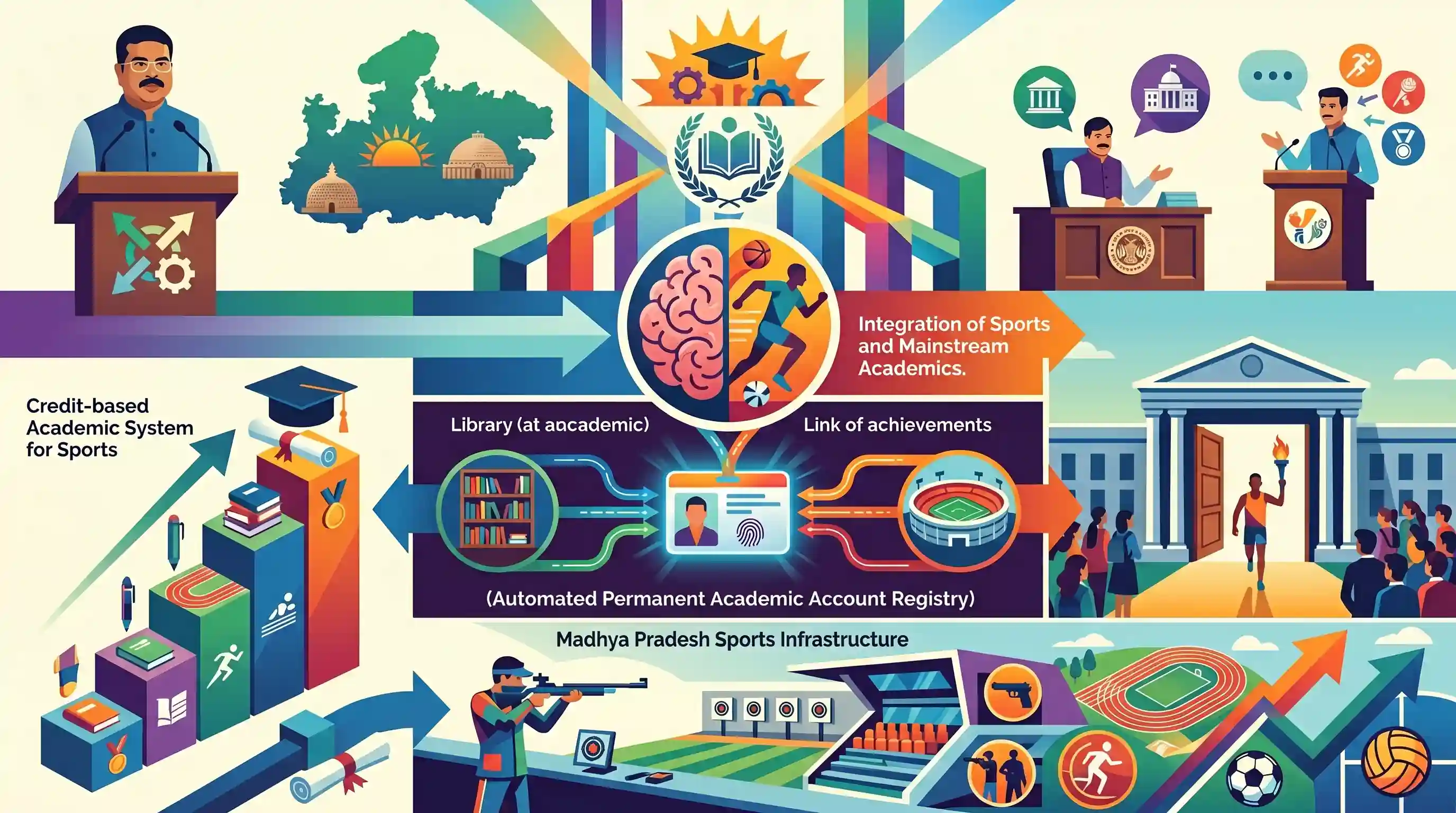
Union Education Minister Dharmendra Pradhan visited Bhopal, Madhya Pradesh, to review education and youth development initiatives. Key discussions with Chief Minister Mohan Yadav and State Sports Minister Vishvas Sarang centered around integrating sports with mainstream academics under the National Education Policy (NEP). This includes introducing a credit-based academic system for sports, utilizing the APAAR ID to link athletes' sporting and academic achievements, and implementing sports quotas in IITs. The visit also featured a trip to Bhopal's state-of-the-art Shooting Academy.
Key Points
- Union Education Minister Dharmendra Pradhan met MP Chief Minister Mohan Yadav in Bhopal to discuss education, sports, and youth development.
- The Union Minister, accompanied by MP Sports Minister Vishvas Sarang, visited the Shooting Academy in Bhopal and interacted with young athletes.
- He highlighted that the National Education Policy (NEP) aims to integrate sports and physical education with mainstream academics through a credit-based academic system.
- The government is working on linking athletes' academic records and sporting achievements using their APAAR ID (Automated Permanent Academic Account Registry).
- Premier institutions like the IITs have introduced sports quotas to encourage talented sportspersons to pursue higher education.
- National aspirations, such as hosting the 2036 Olympics and realizing the 'Viksit Bharat' vision by 2047, were reiterated during the visit.
Important Terms
National Education Policy (NEP) 2020

A comprehensive policy launched in 2020 to overhaul India's education system from school to higher education, replacing the 1986 policy and aiming to make India a "global knowledge superpower".
UPSC context
GS Paper II (Social Sector/Education), testing pedagogical structural reforms, center-state relations, and early childhood care.
APAAR ID (Automated Permanent Academic Account Registry)
A unique, lifelong 12-digit identification number assigned to students in India under the "One Nation, One Student ID" initiative to digitally store and track academic and co-curricular achievements.
UPSC context
GS Paper II (e-Governance), testing digital service delivery, educational database management, and data privacy issues.
National Credit Framework (NCrF)
A unified meta-framework developed under NEP 2020 that integrates and accumulates credits earned across school, higher, vocational, and skill education through a standardized, hour-based system.
UPSC context
GS Paper II (Education/Human Resources), testing mainstreaming of vocational education and credit mobility mechanisms.
Viksit Bharat 2047
The Government of India’s long-term vision to transform the nation into a fully developed, high-income country with a $30–40 trillion economy by its 100th year of independence.
UPSC context
GS Paper III (Economic Development/Planning), testing long-term targets, growth models, and structural demographic dividend reforms.
Ministry of Education (MoE)
The Union ministry responsible for formulating and implementing national policies on school, higher, and vocational education, renamed from Ministry of Human Resource Development under NEP 2020.
UPSC context
GS Paper II (Governance and Policies), testing central ministry frameworks and welfare scheme implementations.
Prelims Trap
APAAR is a mandatory 12-digit unique identity card that replaces the Aadhaar card for all school-going children.
APAAR is entirely voluntary, requires explicit parental consent for minors, and works in tandem with Aadhaar rather than replacing it.
Static Concepts Connected
What is the National Credit Framework (NCrF)?
- Unified framework: Integrates school, higher, vocational, and experiential learning (including sports) into a single, unified credit assignment mechanism.
- Credit metrics: Defines one credit as equivalent to 30 notional learning hours, aiming for an annual target of 40 credits.
- Portability: Enables seamless accumulation, storage, and transfer of credits through the Academic Bank of Credits (ABC).
What is the Academic Bank of Credits (ABC)?
- Digital repository: Established under UGC regulations to function as a digital storehouse of academic credits earned by students.
- No degree authority: Does not award degrees directly; it only stores and transfers validated credits to degree-awarding institutions.
- Verification system: Integrates with DigiLocker and the APAAR ID to ensure secure, verifiable digital trails of student progression.
Cross-Topic Patterns
Digital identity as social infrastructure
Linking APAAR ID with DigiLocker and India Stack demonstrates how Digital Public Infrastructure is leveraged to reduce educational administrative friction and support credit mobility.
Creditisation and human capital development
Formalizing non-academic domains like sports under NCrF aims to diversify skills, directly impacting India's structural employment goals and labor productivity.

UPSC 2026 may test the structural difference between Aadhaar and APAAR, focusing on consent, portability, and NCrF integration.
Linked PYQs · 4
Linked PYQs · 4
- 2021MPPSC_PRELIMSGS1
Player of Madhya Pradesh Chinki Yadav is associated with sports.
- 2021MPPSC_PRELIMSGS1
Player of Madhya Pradesh Vivek Sagar is associated with the sports of
- 2019MPPSC_PRELIMSGS1
Which of the following Sports Award is related to Madhya Pradesh State?
- 2020MPPSC_PRELIMSGS1
Which is the Highest Award given by Madhya Pradesh Government to sports coaches mentioned below?
