Tehri Garhwal model revives depleted Heval river through science
Source:indianmasterminds ↗
Why It Matters
Highly relevant for UKPSC Prelims and Mains as it highlights a successful, Uttarakhand-specific model for combating climate-induced water stress. It provides actionable case studies on institutional responses (SARRA), watershed management, and ecological conservation in the Himalayan region.
Summary
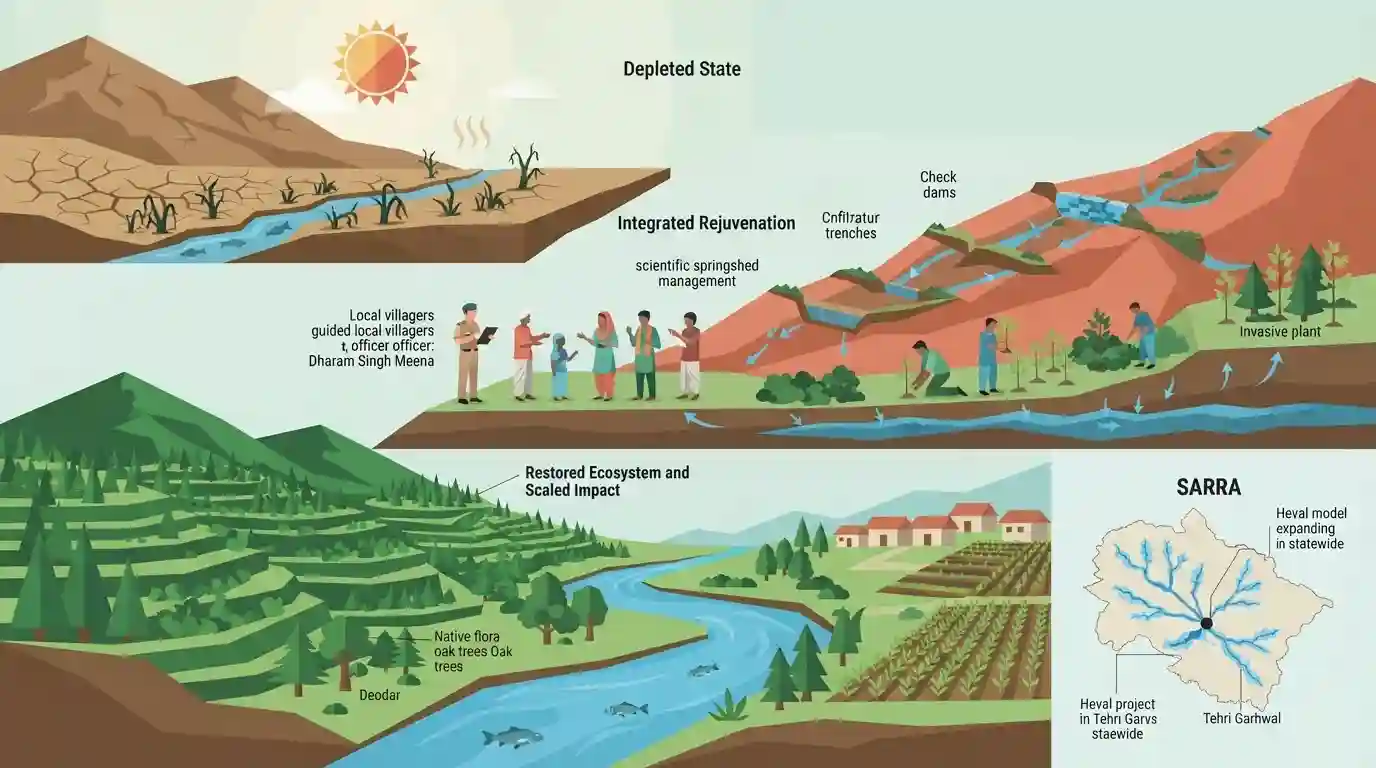
IFS officer Dharam Singh Meena successfully rejuvenated the critically depleted Heval River in Tehri Garhwal, Uttarakhand, through an integrated approach involving scientific springshed management, watershed restoration, and community participation. By mapping micro-watersheds, creating recharge zones, and replacing invasive species with native flora, the project restored base flows and mitigated water scarcity exacerbated by climate change. Recognizing this achievement, the Uttarakhand government created the Spring and River Rejuvenation Authority (SARRA) to scale the Heval model statewide.
Key Points
- The Heval River in Tehri Garhwal experienced severe depletion due to climate change, erratic rainfall, pine forest expansion, and soil degradation.
- IFS officer Dharam Singh Meena spearheaded a scientific rejuvenation project by mapping 66 micro-watersheds and over 300 springs, identifying critical recharge zones based on hydro-geology.
- Restoration techniques included constructing staggered trenches, check dams, and bio-fencing, coupled with eradicating invasive Lantana and planting native broad-leaved water-conserving species.
- The initiative successfully recharged groundwater, revived the river's base flow, and mitigated human-wildlife conflict by regenerating natural forest habitats.
- Inspired by the Heval model's success, the Uttarakhand government established the Spring and River Rejuvenation Authority (SARRA) to replicate scientific ecological restoration across the state.
Important Terms
Spring and River Rejuvenation Authority (SARRA)

A statutory body formed by the Uttarakhand government to oversee the integrated conservation and revival of the state's natural springs and rivers through scientific planning and watershed management.
UPSC context
Highly relevant for UKPSC GS papers on State Administration and Environment, highlighting institutional responses to regional water security and climate resilience.
Alakananda Bachao Andolan
A regional grassroots movement in Uttarakhand addressing severe water scarcity and ecological degradation in the Alaknanda river basin, advocating for the protection of water resources.
UPSC context
Crucial for UKPSC exams concerning Uttarakhand's social movements, environmental activism, and the community impact of Himalayan river depletion.
International Centre for Integrated Mountain Development (ICIMOD)
An intergovernmental knowledge centre that develops scientific methodologies for mountain ecosystems, whose research heavily informed the technical approach to springshed management in the Heval project.
UPSC context
Important for Geography and Environment sections, illustrating international frameworks for sustainable development in the Hindu Kush Himalayan region.
MGNREGA
The Mahatma Gandhi National Rural Employment Guarantee Act; utilized in the Heval River project to fund massive watershed restoration works, directly linking ecological interventions with local livelihood generation.
UPSC context
Key for rural development and governance topics, demonstrating inter-departmental convergence to achieve environmental conservation and employment simultaneously.
NITI Aayog
India's apex public policy think tank. It published critical reports on the drying springs in the Indian Himalayan Region, providing the policy impetus for localized rejuvenation efforts.
UPSC context
Essential for UKPSC Polity and Governance papers, showing the role of national think tanks in guiding state-level environmental strategies.
Prelims Trap
"SARRA was established by the Union Ministry of Jal Shakti to revive Himalayan rivers."
SARRA (Spring and River Rejuvenation Authority) is specifically a state-level nodal agency created by the Uttarakhand Government, not a Central Government body.
Static Concepts Connected
What is the difference between Watershed and Springshed management in Himalayan ecology?
- Watershed Management: Manages surface water runoff based on topographical boundaries (ridge to valley).
- Springshed Management: Focuses on underlying hydrogeology to trace underground aquifers and identify specific recharge zones for mountain springs.
Why are broad-leaved species preferred for forest restoration in Uttarakhand?
- Water Conservation: Broad-leaved native species (like Oak/Banj) retain soil moisture, reduce runoff, and promote groundwater recharge.
- Pine & Lantana Issues: Monocultures of Pine increase forest fire risks due to dry needles, while invasive Lantana depletes groundwater and stifles native undergrowth.
Cross-Topic Patterns
Springshed mapping + Naula conservation
Scientific mapping of hydrogeological recharge zones complements the preservation of traditional Himalayan water harvesting systems like Naulas and Dharas, frequently tested in UKPSC culture and geography sections.
Lantana eradication + Wildlife corridors
Replacing Lantana with native broad-leaved flora not only aids water retention but also restores natural grazing grounds for herbivores, indirectly reducing human-wildlife conflict in the hills.

Expect a multi-statement question on Heval River's geography (Ganga tributary in Tehri) and SARRA's status as a state-level body.
Linked PYQs · 2
Linked PYQs · 2
- 2025UKPSC_PRELIMSGS1
Consider the following statements and select the correct answer from the options given below : Statement 1 : Uttarakhand is highly vulnerable to climate change. Statement 2 : Climate change is causing water stress and depleting biodiversity in Uttarakhand.
- 2025UKPSC_PRELIMSGS1
Consider the following statements and select the correct answer from the options given below : Statement 1 : The State Council for Climate Change (SCCC) of Uttarakhand was established in the year 2011. Statement 2 : The responsibility of preparing Uttarakhand Action Plan on Climate Change (UAPCC) was given to the State Revenue Department.
