Emergency Era Judicial Verdicts and Constitutional Morality Debate
Source:The Hindu ↗
Why It Matters
The ADM Jabalpur case and Emergency provisions are core polity topics for Prelims and Mains. The Vice-President's critique of the judiciary's role during the Emergency revives critical debates around judicial independence, the protection of fundamental rights, and constitutional morality.
Summary
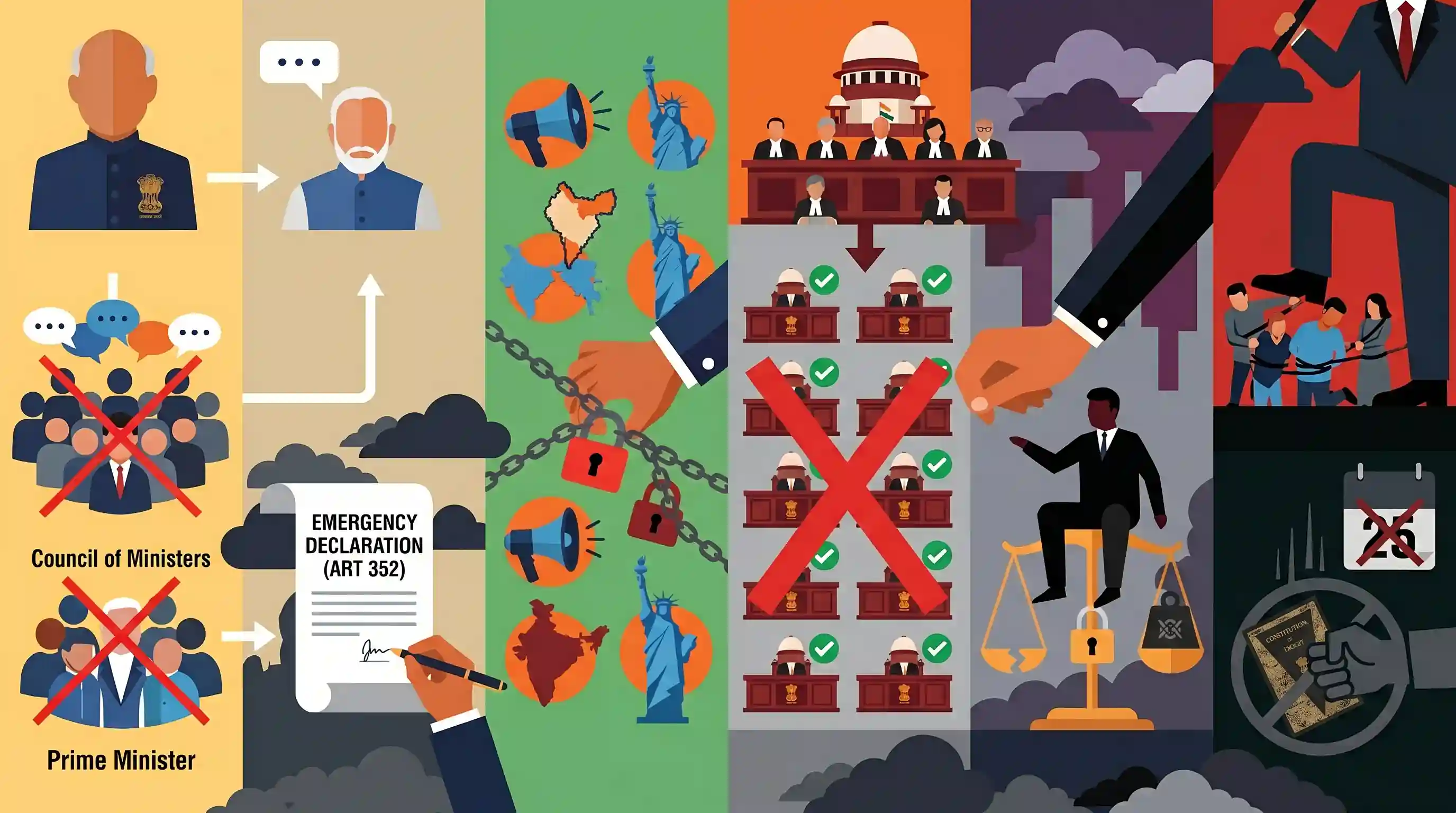
Vice-President Jagdeep Dhankhar criticized the Supreme Court's Emergency-era judgment (ADM Jabalpur case), describing it as the "darkest in judicial history" for overruling nine High Courts and allowing the suspension of fundamental rights, thus legitimizing dictatorship. He emphasized that the 1975 National Emergency was declared by then-President Fakhruddin Ali Ahmed on the sole advice of then-PM Indira Gandhi, bypassing the Council of Ministers' consultation. Dhankhar's remarks align with the government's recent decision to observe June 25, the day the Emergency was imposed, annually as 'Samvidhan Hatya Diwas' (Constitution Murder Day).
Key Points
- Vice-President Dhankhar condemned the Supreme Court's Emergency-era ruling (ADM Jabalpur case) that permitted the suspension of fundamental rights, terming it a capitulation to authoritarianism.
- He highlighted that the apex court had overruled nine High Courts that had valiantly upheld citizens' rights and access to justice during the 1975 Emergency.
- The Vice-President pointed out constitutional impropriety in the 1975 Emergency proclamation, noting it was signed by President Fakhruddin Ali Ahmed based solely on the PM's advice, without consulting the Council of Ministers.
- The remarks contextualize the government's initiative to mark June 25 every year as 'Samvidhan Hatya Diwas' to remember the constitutional excesses of the Emergency.
Important Terms
ADM Jabalpur Case

Landmark 1976 judgment where the Supreme Court (4-1) ruled that Fundamental Rights, including the right to life (Article 21), remain suspended during a National Emergency.
UPSC context
GS Paper II (Polity); essential for understanding judicial history, fundamental rights, and the 'Habeas Corpus' case's eventual reversal.
Article 359
Constitutional provision authorizing the President to suspend the right to move any court for the enforcement of Fundamental Rights during a National Emergency.
UPSC context
GS Paper II (Polity); tests knowledge of Emergency's impact on rights and the 44th Amendment's safeguards.
Council of Ministers
A body of high-ranking government officials that advises the President; post-1978, the President can only declare Emergency upon their written recommendation.
UPSC context
GS Paper II (Executive); critical for understanding Article 74 and checks against the unilateral exercise of executive power.
Samvidhan Hatya Diwas
Observed annually on June 25 to commemorate the 1975 Emergency, paying tribute to those who fought against the suspension of democratic rights.
UPSC context
GS Paper II (Current Affairs/Polity); reflects the contemporary political and constitutional discourse regarding the 1975 Emergency's legacy.
Article 352 (National Emergency)
Constitutional provision for declaring an Emergency on grounds of war, external aggression, or armed rebellion, shifting India's federal structure to a unitary one.
UPSC context
GS Paper II (Polity); core topic for understanding extraordinary powers and the 44th Amendment’s procedural changes.
Article 358
A constitutional mandate that automatically suspends the six fundamental rights under Article 19 only during an Emergency declared due to war or external aggression.
UPSC context
GS Paper II (Polity); tests the distinction between automatic (358) versus presidential (359) suspension of rights.
Prelims Trap
"During any National Emergency, the six fundamental rights under Article 19 are automatically suspended."
Post-44th Amendment, Article 19 is suspended (via Article 358) ONLY during emergencies declared on grounds of war or external aggression. It is NOT suspended for emergencies based on armed rebellion.
Static Concepts Connected
How did the 44th Amendment Act (1978) alter National Emergency provisions?
- Written Cabinet Advice: Mandated that the President can declare a National Emergency only after receiving a written recommendation from the Union Cabinet (Article 352).
- Grounds Amended: Replaced the vague ground of 'internal disturbance' with the specific 'armed rebellion' to prevent discretionary executive misuse.
- Articles 20 & 21: Prohibited the President from suspending the right to move courts for the enforcement of Articles 20 and 21, even during an active National Emergency.
What are the key differences between Article 358 and Article 359?
- Scope of Rights: Article 358 affects only Article 19 rights, whereas Article 359 affects all Fundamental Rights (except Arts 20 & 21) specified in the subsequent Presidential order.
- Trigger Mechanism: Article 358 automatically suspends Article 19 upon an emergency declaration, while Article 359 requires a specific Presidential Order to suspend the enforcement of rights.
- Internal Emergency: Post-44th Amendment, Article 358 does not apply to emergencies declared on grounds of armed rebellion; Article 359 applies to both internal and external emergencies.
Cross-Topic Patterns
ADM Jabalpur vs. Basic Structure Doctrine
The ADM Jabalpur ruling highlighted the vulnerability of constitutional rights, heavily influencing the Supreme Court's later entrenchment of the Basic Structure (Minerva Mills) to permanently shield judicial review from executive overreach.
The 9th Schedule and Judicial Review
The Emergency era saw rampant misuse of the 9th Schedule to shield executive actions, a theme UPSC frequently tests alongside the evolution of judicial review and the I.R. Coelho judgment.

Expect a multi-statement Polity question contrasting automatic Art 19 suspension (Art 358) vs Presidential orders (Art 359) post-44th CAA.
Linked PYQs · 3
Linked PYQs · 3
- 2024PrelimsGS1
Which of the following statements are correct about the Constitution of India? 1. Powers of the Municipalities are given in Part IX A of the Constitution. 2. Emergency provisions are given in Part XVIII of the Constitution. 3. Provisions related to the amendment of the Constitution are given in Part XX of the Constitution. Select the answer using the code given below :
- 2025MainsGS2
"Constitutional morality is the fulcrum which acts as an essential check upon the high functionaries and citizens alike...." In view of the above observation of the Supreme Court, explain the concept of constitutional morality and its application to ensure balance between judicial independence and judicial accountability in India.
- 2024MainsGS2
Right to privacy is intrinsic to life and personal liberty and is inherently protected under Article 21 of the constitution. Explain. In this reference discuss the law relating to D.N.A. testing of child in the womb to establish its paternity.
