Dhan Dhaanya Krishi Yojana: Cabinet Approval for 100 Agri Districts
Source:Indian Express ↗
Why It Matters
Understanding such targeted agricultural schemes is essential for the UPSC examination, particularly for GS Paper III. It highlights the government's transition towards decentralized, district-level agricultural planning aimed at doubling farmers' income, improving supply chain infrastructure, and mitigating local agro-climatic challenges.
Summary
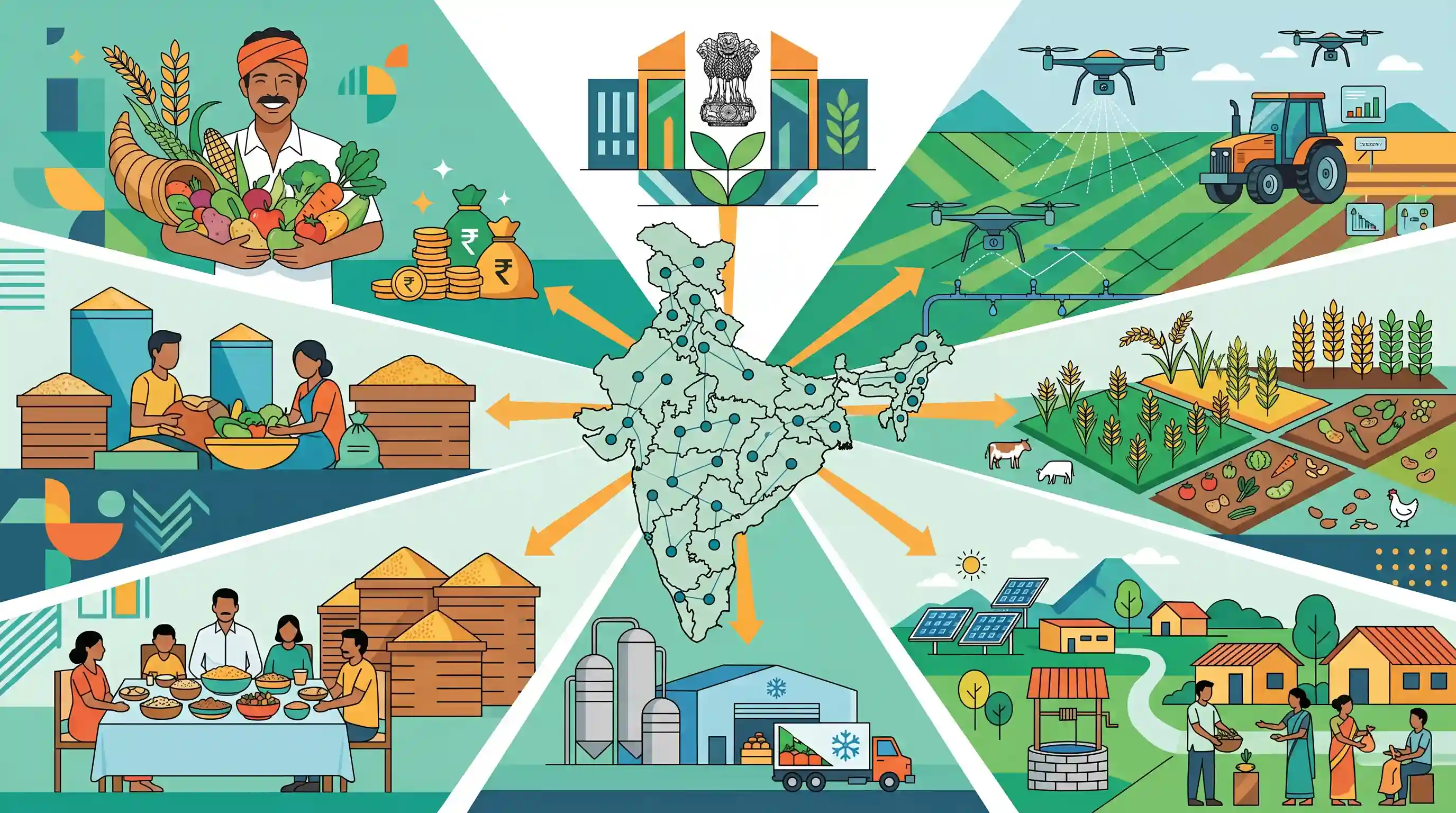
The Union Cabinet has granted approval to the 'Dhan Dhaanya Krishi Yojana', a strategic scheme aimed at developing 100 agricultural districts across India. This initiative is designed to bolster agricultural productivity and increase farmers' incomes by promoting modern farming techniques, crop diversification, and resilient post-harvest infrastructure. By adopting a targeted district-level approach, the scheme seeks to address specific local agro-climatic challenges, thereby ensuring comprehensive rural economic development and long-term food security.
Key Points
- The Union Cabinet has approved the Dhan Dhaanya Krishi Yojana, a major agricultural initiative.
- The scheme will focus on the intensive development of 100 select agricultural districts across the country.
- It aims to modernize farming practices, encourage crop diversification, and build robust post-harvest infrastructure.
- The overarching goal is to augment agricultural productivity, ensure food security, and substantially boost farmers' incomes.
- The initiative reflects a targeted, district-level approach to resolving region-specific agro-climatic challenges.
Important Terms
Prime Minister Dhan-Dhaanya Krishi Yojana (PMDDKY)

A mission-mode scheme (2025-26) targeting 100 underperforming districts to boost farm yields, irrigation, and credit. It converges 36 existing schemes across 11 ministries through decentralized district-level planning.
UPSC context
GS Paper III: Agriculture. Relevant for government policies, agricultural productivity, and the shift toward district-centric developmental models.
Cropping Intensity
The ratio of total cropped area to net sown area, measuring how many crops are raised on a field annually. It is a key selection criterion for PMDDKY districts.
UPSC context
GS Paper I & III: Geography/Agriculture. Tests understanding of land-use efficiency and irrigation's role in intensive farming practices.
Aspirational Districts Programme (ADP)
A NITI Aayog initiative launched in 2018 to transform underdeveloped districts via convergence and competition. It serves as the structural inspiration for the implementation of PMDDKY.
UPSC context
GS Paper II: Governance. Important for cooperative federalism, outcome-based monitoring, and strategies for inclusive regional growth.
Crop Diversification
The strategic shift from monoculture (like wheat-rice) to multiple or high-value crops to enhance soil health, manage climate risks, and increase farmer income.
UPSC context
GS Paper III: Sustainable Agriculture. Crucial for discussions on food security, climate resilience, and doubling farmers' income.
Post-harvest Infrastructure
Facilities like cold chains, silos, and processing units used after harvesting to prevent spoilage and improve price realization. PMDDKY prioritizes these at panchayat and block levels.
UPSC context
GS Paper III: Food Processing & Supply Chain. Key to reducing agricultural waste and improving the primary sector's economic viability.
District Dhan-Dhaanya Samiti
A district-level body, usually headed by the Collector, tasked with drafting and executing localized agriculture plans and ensuring the convergence of various welfare schemes.
UPSC context
GS Paper II: Decentralized Planning. Demonstrates the role of local administration in implementing central flagship schemes at the grassroots.
Prelims Trap
It is a standalone fund promoting paddy (Dhan) cultivation across all districts in India.
PMDDKY targets exactly 100 low-performing districts and actively promotes crop diversification AWAY from water-intensive crops like paddy, operating via convergence of existing schemes.
Static Concepts Connected
What are the core principles of the Aspirational Districts Programme (ADP) model?
- Convergence: Synergizing existing Central and State schemes to achieve saturation of services without necessarily allocating new standalone funds.
- Collaboration: Establishing a coordinated approach between Central, State, and District-level administration (Prabhari officers).
- Competition: Real-time monitoring and ranking of districts based on specific socio-economic indicators to spur competitive development.
What defines Cropping Intensity and what are its primary constraints in India?
- Formula: It is the ratio of Gross Cropped Area (GCA) to Net Sown Area (NSA), multiplied by 100. It indicates how many times a field is planted annually.
- Primary Constraints: Lack of assured year-round irrigation (micro-irrigation), inadequate short-term credit for inputs, and delayed harvesting cycles.
Cross-Topic Patterns
Aspirational Districts model in Agriculture
PMDDKY replicates NITI Aayog’s Aspirational Districts template of 'saturation-based convergence', shifting governance focus from outlays (new funding) to outcomes (yield and income) in targeted geographies.
Climate resilience via crop diversification
Pushing away from water-guzzling crops connects directly to the geography of groundwater depletion, linking India's water security challenges directly to agrarian economic viability.

Expect a multi-statement Prelims question comparing PMDDKY's convergence mechanism with NITI Aayog's Aspirational Districts Programme.
Linked PYQs · 4
Linked PYQs · 4
- 2021MainsGS3
What are the present challenges before crop diversification? How do emerging technologies provide an opportunity for crop diversification?
- 2020MainsGS3
Suggest measures to improve water storage and irrigation system to make its judicious use under depleting scenario.
- 2020MainsGS3
What are the challenges and opportunities of food processing sector in the country? How can income of the farmers be substantially increased by encouraging food processing?
- 2020PrelimsGS1
In India, which of the following can be considered as public investment in agriculture? 1. Fixing Minimum Support Price for agricultural produce of all crops 2. Computerization of Primary Agricultural Credit Societies 3. Social Capital development 4. Free electricity supply to farmers 5. Waiver of agricultural loans by the banking system 6. Setting up of cold storage facilities by the governments Select the correct answer using the code given below:
