Uttarakhand Replaces Madrasa Board for Modern Education Access
Source:the-statesman ↗
Why It Matters
The abolition of the state Madrasa board and the implementation of the Uniform Civil Code (UCC) in Uttarakhand represent significant shifts in state policy concerning minority education and civil laws. These developments intersect closely with constitutional provisions like Article 30 (rights of minorities to establish educational institutions) and Article 44 (Directive Principles on UCC), making them highly relevant for exams covering Indian Polity and Governance.
Summary
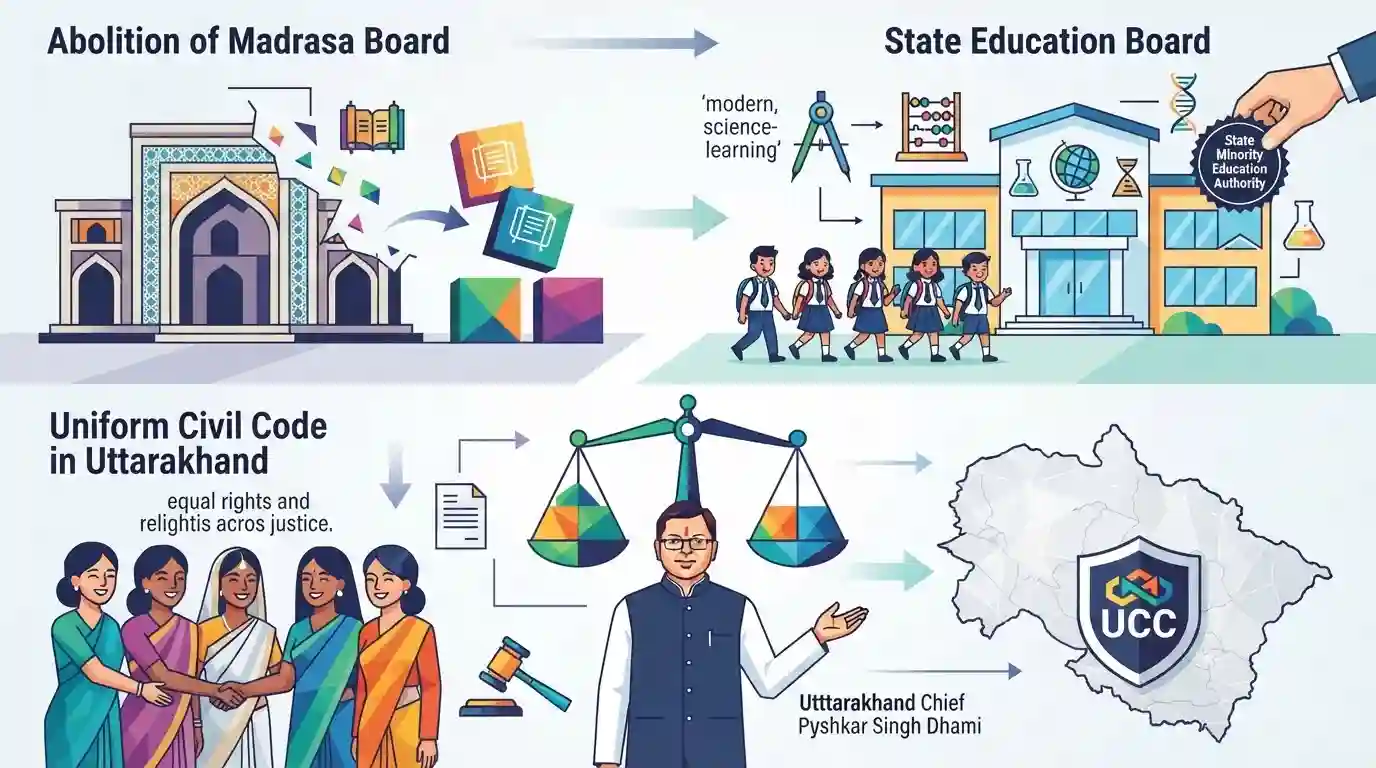
Uttarakhand Chief Minister Pushkar Singh Dhami justified the state's decision to abolish the Madrasa Board, asserting that the new system under the State Education Board and State Minority Education Authority will offer minority students better, modern, and science-based learning opportunities. He also highlighted Uttarakhand's historic implementation of the Uniform Civil Code (UCC) as a crucial step towards ensuring equal rights and justice, particularly for women, across all religions.
Key Points
- The Uttarakhand government abolished the State Madrasa Board, mandating minority educational institutions to affiliate with the State Education Board and the newly formed State Minority Education Authority.
- This reform is designed to provide minority students with modern, science-based, and employment-oriented education alongside their religious studies.
- Uttarakhand became the first state in India to implement the Uniform Civil Code (UCC), aiming to unify personal laws related to marriage, divorce, and inheritance across all religious communities.
- CM Dhami emphasized that the UCC ensures equal rights, respect, security, and justice for women across all faiths, thereby strengthening social harmony.
Important Terms
Uniform Civil Code (UCC)

A unified legal framework envisioned under Article 44, replacing religion-based personal laws regarding marriage, divorce, and succession with a single common law for all citizens.
UPSC context
GS Paper 2 (Polity); tests Directive Principles of State Policy, secularism, and state-level legislative competence.
State Madrasa Board
A statutory body historically responsible for regulating Islamic seminaries. Uttarakhand abolished it to integrate minority institutions into the mainstream secular education framework.
UPSC context
GS Paper 2 (Social Justice); relevant to Article 30 (minority educational rights) and mainstreaming education.
State Minority Education Authority
A newly established unified regulatory body in Uttarakhand overseeing educational institutions for all six notified minority communities, ensuring alignment with the National Education Policy.
UPSC context
GS Paper 2 (Governance); tests minority welfare policies, structural reforms, and inclusive educational governance.
State Education Board
The state's mainstream academic regulatory body. Under Uttarakhand's new framework, minority institutions must secure affiliation with it to ensure standardized, science-based curriculums.
UPSC context
GS Paper 2 (Education); highlights the Right to Education and state efforts to standardize academic quality across all communities.
Prelims Trap
Article 30 grants minorities an absolute right to administer educational institutions, barring any state intervention in their curriculum.
Article 30 is not absolute. The State can impose reasonable regulations to ensure academic excellence, mandate modern subjects like science, and prevent maladministration without violating minority rights.
Static Concepts Connected
To what extent can the State regulate Minority Educational Institutions?
- Not Absolute: The right to administer under Article 30 is not an absolute right to maladminister. The state can intervene to ensure proper functioning.
- Academic Standards: The state can prescribe a modern syllabus, teacher qualifications, and academic standards to ensure educational excellence and student welfare.
- RTE Exemption: Despite broad state regulatory powers for academic excellence, minority institutions are completely exempt from the 25% reservation mandate of the RTE Act.
What is the constitutional framework for enacting the Uniform Civil Code?
- Article 44 (DPSP): Enshrined in Part IV (Article 44), it directs the State to endeavor to secure a UCC, though it remains non-justiciable.
- Concurrent List: Personal laws like marriage, divorce, and succession fall under the Concurrent List (Entry 5), empowering individual states like Uttarakhand to enact their own civil codes.
Cross-Topic Patterns
State as unit for minority status
The T.M.A. Pai judgment established the state, not the national population, as the unit for determining minority status, deeply intertwining cultural/educational rights with federalism and state-level demographics.
State UCCs vs. National Integration
Uttarakhand's UCC invokes debates on whether piecemeal state-level personal laws fragment the national civil code envisioned by the Constitution, linking DPSP objectives to Concurrent List powers.

A multi-statement Prelims question testing the absolute nature of Article 30 versus state regulatory powers and RTE exemptions is highly likely.
Linked PYQs · 3
Linked PYQs · 3
- 2024UKPSC_PRELIMSGS1
Regarding the Directive Principles of State Policy, which one of the following statements is not correct ?
- 2025UKPSC_PRELIMSGS1
Consider the following statements about 'Right to Education' and choose the correct answer : 1. It try to achieve the aim of 'Education for All'. 2. Earlier a provision of free and compulsory education was provided in Part IV of the Constitution. 3. It became Fundamental Right after 91ˢᵗ Constitutional Amendment.
- 2012UKPSC_PRELIMSGS1
Under which article of the Constitution reservations in admission to educational institutions, including private and unaided, to OBCs/ST/SC is made?
