Uttarakhand Government Launches Seva Pakhwada Public Campaign
Source:garhwalpost ↗
Why It Matters
Information regarding political milestones (such as CM tenures), key historical figures in state administration, and good-governance campaigns like 'Jan Jan Ki Sarkar-Jan Jan Ke Dwar' are frequently tested areas in the UKPSC PCS Prelims.
Summary
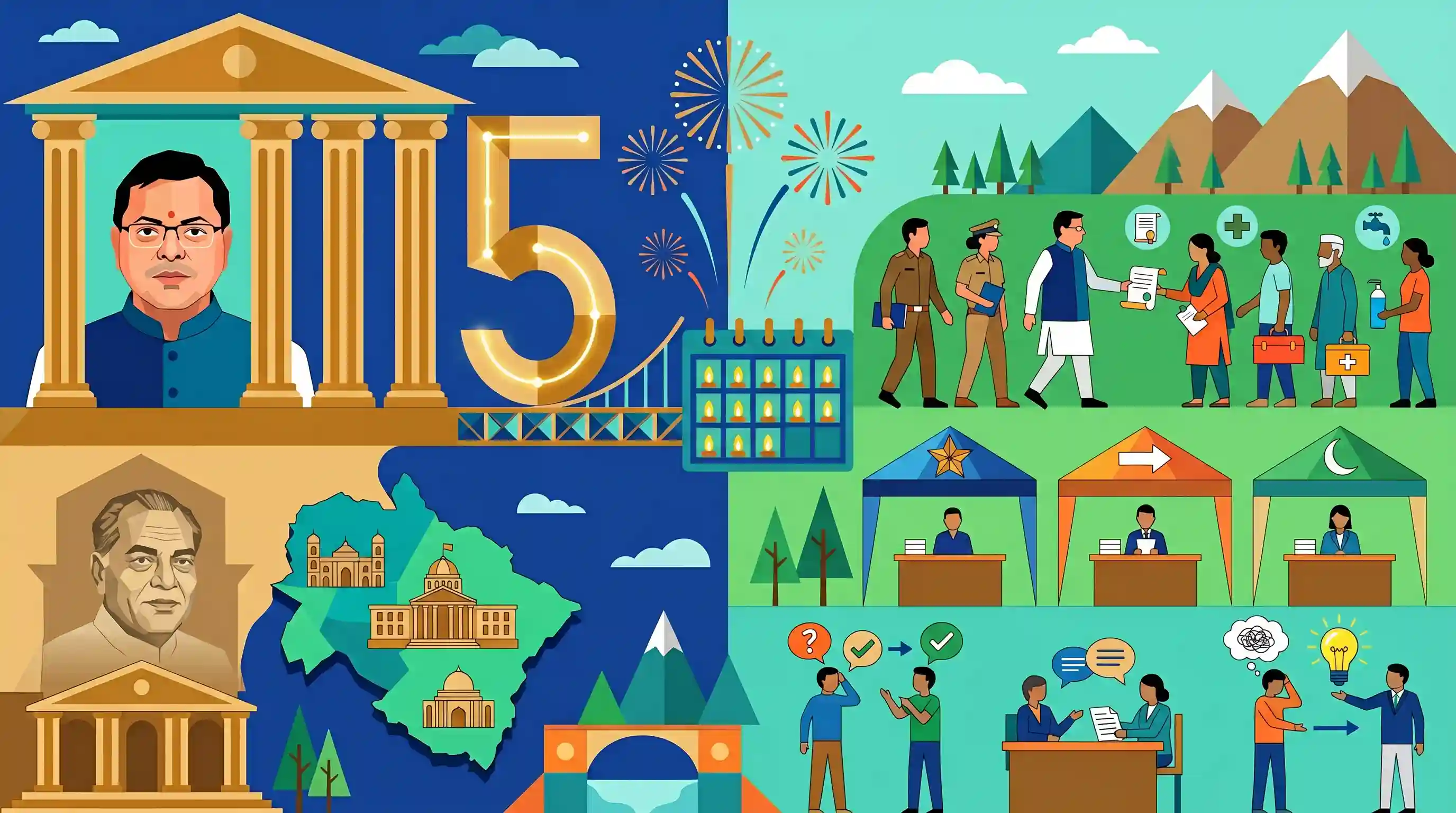
On July 4, 2026, Chief Minister Pushkar Singh Dhami completes 5 years in office, making him only the second Chief Minister in Uttarakhand's history after N.D. Tiwari to reach this milestone. To celebrate, the government is launching a 15-day 'Seva Pakhwada' under the second phase of the 'Jan Jan Ki Sarkar-Jan Jan Ke Dwar' campaign, which will feature public grievance redressal and citizen service camps at district, block, and tehsil levels.
Key Points
- Pushkar Singh Dhami is set to complete 5 years as the Chief Minister of Uttarakhand on July 4, 2026.
- He is only the second CM in Uttarakhand's history after Narayan Dutt Tiwari (2002-2007) to achieve the milestone of completing 5 years in office.
- To mark this occasion, the Uttarakhand government is launching a 15-day 'Seva Pakhwada' (Service Fortnight) under the second phase of the 'Jan Jan Ki Sarkar-Jan Jan Ke Dwar' campaign.
- Special public grievance redressal and scheme benefit camps will be organized during this period at the district, block, and tehsil levels across the state.
- The first phase of 'Jan Jan Ki Sarkar-Jan Jan Ke Dwar', launched in December 2025 as a 45-day drive, successfully organized 681 camps, benefited over 5.33 lakh citizens, and resolved around 33,000 complaints.
Important Terms
Jan Jan Ki Sarkar-Jan Jan Ke Dwar campaign

A public outreach and good governance initiative by the Uttarakhand government to bring administrative services directly to citizens' doorsteps, resolve public grievances on-the-spot, and ensure seamless delivery of welfare schemes in remote areas.
UPSC context
GS Paper II: Good Governance, citizen-centric administration, and public service delivery.
Seva Pakhwada
A dedicated fortnight of public service organized across India to run extensive welfare camps, healthcare drives, cleanliness campaigns, and citizen grievance redressal programs at the grassroots level.
UPSC context
GS Paper II: Welfare schemes, social sector initiatives, and grassroots governance.
State Executive
The constitutional executive arm of an Indian state comprising the Governor, Chief Minister, Council of Ministers, and Advocate General, governed by Articles 153 to 167 of Part VI.
UPSC context
GS Paper II: Indian Constitution, state-level governance, and executive powers.
Public Grievance Redressal Mechanism
Institutional channels, platforms, and processes set up at central, state, and local levels to systematically register, monitor, and resolve citizen complaints, improving governance accountability.
UPSC context
GS Paper II: Transparency, accountability, and citizen-centric administrative reforms.
Prelims Trap
Gram Panchayats are legally mandated to maintain a local 'Health Register' under state Panchayati Raj Acts.
While Gram Panchayats legally maintain key administrative registers like the Family Register and Birth-Death Register, the Health Register is maintained by the State Health Department, not the local government.
Static Concepts Connected
Constitutional provisions governing State Chief Minister's tenure
- Appointment under 164: Under Article 164, the Chief Minister is appointed by the Governor, and other ministers are appointed on the advice of the Chief Minister.
- Doctrine of pleasure: Ministers hold office during the pleasure of the Governor, which is bound by the council's majority support in the Legislative Assembly.
- Collective responsibility: The State Council of Ministers is collectively responsible to the Legislative Assembly of the State.
Scheduled Tribes of Uttarakhand
- Five main groups: The five primary indigenous tribal communities are the Jaunsari, Tharu, Bhotia, Buksa, and Raji.
- 1967 Notification: These five communities were officially declared as Scheduled Tribes (STs) in the state in 1967.
- PVTG classification: The Raji and Buksa communities are further categorized under Particularly Vulnerable Tribal Groups (PVTGs) due to extreme vulnerability.
Cross-Topic Patterns
Physical outreach vs. Digital governance
Physical doorstep grievance camps complement digital governance initiatives, addressing the persistent digital divide in remote mountain terrains where e-governance platforms alone cannot achieve universal last-mile delivery.
Executive stability and policy continuity
Analyzing how executive stability, through unbroken five-year CM tenures, directly correlates with long-term policy continuity and fiscal planning in ecologically vulnerable Himalayan states.

State Executive power limits under Article 164 coupled with local governance registers may be tested as a multi-statement polity question.
Linked PYQs · 3
Linked PYQs · 3
- 2024UKPSC_PRELIMSGS1
Who among the following was the first Chief Minister of Uttarakhand ?
- 2025UKPSC_PRELIMSGS1
Consider the following statements with reference to Uttarakhand and choose the correct answer: 1. The executive of Uttarakhand includes Governor as the head of the state. 2. It also includes the Chief Minister and his/her council of ministers.
- 2025UKPSC_PRELIMSGS1
Which among the following pairs is correctly matched? 1. Chairman of First Finance Commission - Nityanand Swami 2. First Advocate General of Uttarakhand - Nanda Ballabh Tiwari 3. First Chief Minister of Uttarakhand - Indu Kumar Pandey 4. First Woman Governor of Uttarakhand - Margaret Alva
