India-Bangladesh Border Security and Repatriation of Illegal Migrants
Source:Indian Express ↗
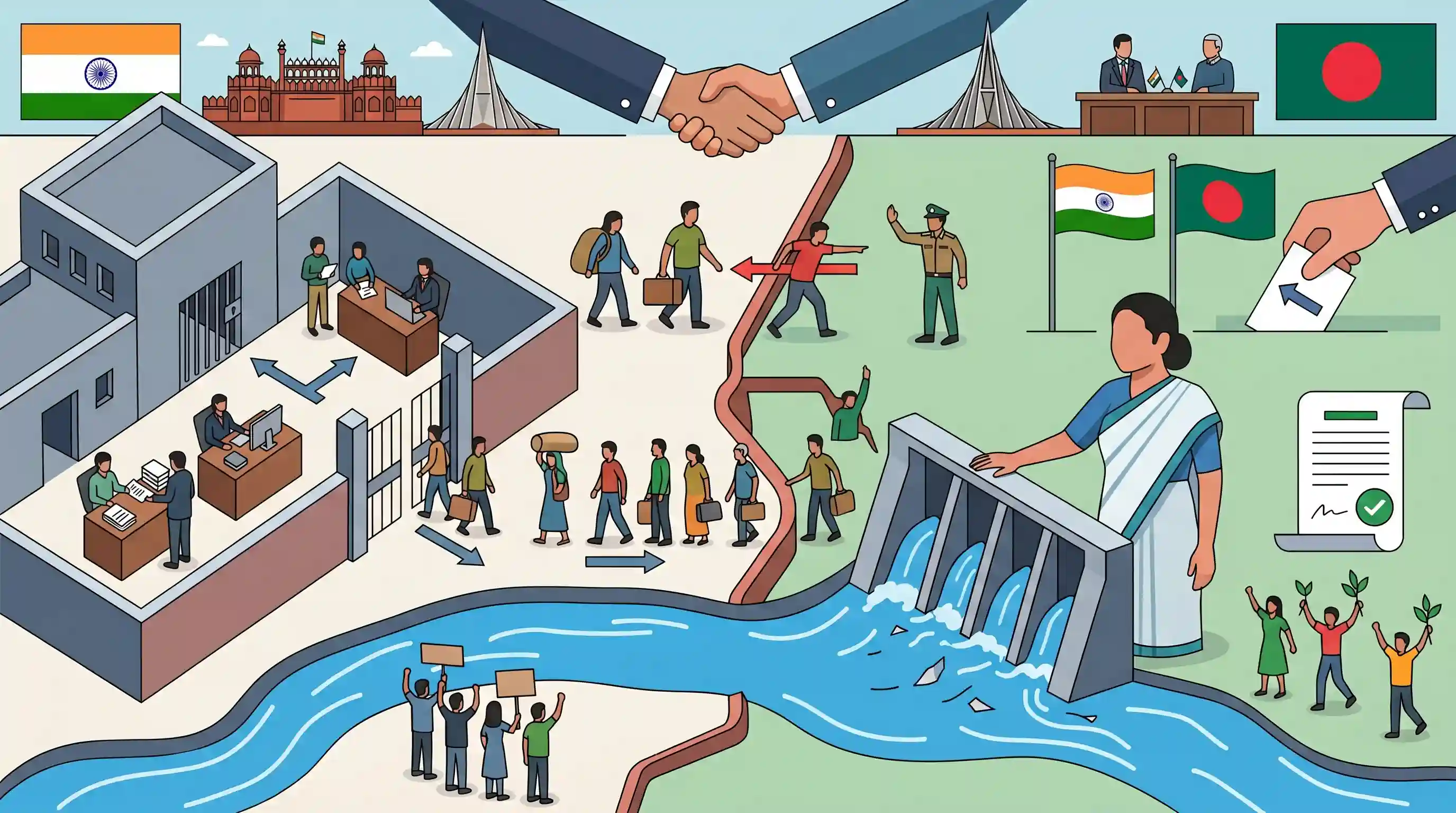
Why It Matters
The article highlights two critical aspects of India-Bangladesh relations: the security and diplomatic challenge of illegal cross-border migration, and the influence of regional politics (federalism) on international river water sharing agreements. It is highly relevant for GS2 (India and its neighborhood) and GS3 (Border Security).
Summary
India and Bangladesh are engaging in diplomatic discussions concerning illegal immigration and border management. Dhaka has raised the issue of unverified individuals being 'pushed-in' across the border, while New Delhi is pushing for faster nationality verification and repatriation of illegal Bangladeshi immigrants housed in Indian prisons. Additionally, the recent electoral defeat of Mamata Banerjee in West Bengal has removed a major political hurdle for the long-delayed Teesta river water sharing pact, presenting an opportunity for the two nations to finalize the agreement despite potential residual protests.
Key Points
- Bangladesh has raised concerns about the "push-in" of unverified illegal immigrants across the border, while India has pressed for the faster repatriation of Bangladeshi nationals illegally residing in India or currently in prisons.
- The repatriation process is hampered by the slow pace of nationality verification and consular access provided by Bangladeshi authorities.
- The recent political shift in West Bengal—where the BJP achieved a landslide victory and unseated Mamata Banerjee—could pave the way for the signing of the long-pending Teesta river water sharing pact.
- Mamata Banerjee had been the primary obstacle to the Teesta agreement, citing concerns over water availability for northern West Bengal.
Important Terms
Teesta River Water Sharing Agreement

A proposed bilateral treaty to share the waters of the Teesta River during the dry season. It is a major flashpoint in India-Bangladesh relations, stalled since 2011 due to domestic political opposition.
UPSC context
GS Paper II: International Relations (Neighborhood); GS Paper III: Water Management. Tests understanding of transboundary water diplomacy and federalism.
Repatriation
The formal, legal process of returning a foreign national to their country of origin after verified nationality. India seeks faster verification from Dhaka to repatriate illegal immigrants in Indian prisons.
UPSC context
GS Paper II/III: International Relations and Internal Security. Tests knowledge of diplomatic protocols and the legal framework for handling illegal immigration.
Push-in/Push-back Policy
Informal, extra-legal practices of returning suspected illegal immigrants across the border without formal legal proceedings. Dhaka uses 'push-in' to protest Indian actions it views as violations of border protocols.
UPSC context
GS Paper III: Internal Security (Border Management). Tests understanding of human rights, border security challenges, and bilateral tensions.
Coordinated Border Management Plan (CBMP)
A 2011 agreement between India's Border Security Force (BSF) and Border Guard Bangladesh (BGB) to synergize efforts against cross-border crimes, smuggling, and human trafficking while maintaining border peace.
UPSC context
GS Paper III: Internal Security. Focuses on institutional mechanisms for managing porous borders and reducing border violence.
Transboundary Rivers
Rivers that cross international boundaries, such as the 54 shared by India and Bangladesh. Their management involves "hydro-diplomacy," balancing upstream usage with downstream requirements and ecological health.
UPSC context
GS Paper I: Geography; GS Paper II: International Relations. Essential for understanding South Asian regional cooperation and resource-sharing disputes.
Cooperative Federalism
The constitutional concept where the Centre and States collaborate on shared interests. In foreign policy, it reflects the need for state concurrence (like West Bengal for Teesta) on international treaties.
UPSC context
GS Paper II: Polity/Governance. Tests the intersection of Article 253 (International Agreements) and state-list subjects like water and irrigation.
Prelims Trap
State government consent is constitutionally mandatory for the Union to sign international river water treaties.
Under Article 253, Parliament can legislate on State subjects to implement treaties. West Bengal's consent for Teesta is a political necessity, not a strict constitutional mandate.
Static Concepts Connected
What is the geographical course and significance of the Teesta River?
- Origin: Rises in the Pauhunri Mountain/Tso Lhamo lake region in the Sikkim Himalayas.
- Major Tributary: The Rangit River is its most significant tributary, joining the Teesta at Triveni in West Bengal.
- Confluence: Flows into Bangladesh and joins the Brahmaputra (known locally as the Jamuna) in Rangpur district.
How does the Constitution balance international treaties with State subjects?
- Article 253: Empowers Parliament to make any law for the whole or part of India to implement any international treaty, agreement, or convention.
- State List Entry 17: Places 'Water' (supplies, irrigation, canals) under state control, making state cooperation vital for grassroots implementation of water pacts.
- Union List Dominance: Allows the Union to regulate inter-state rivers, while international transboundary relations and treaties fall under Union List Entry 14.
Cross-Topic Patterns
Paradiplomacy and Act East Policy
State-level politics directly shaping foreign policy is a recurring GS2 theme. The West Bengal-Teesta dynamic mirrors how Tamil Nadu has historically influenced India's stance on Sri Lankan Tamil issues.
Internal Security & Border Demography
The 'push-in' and repatriation challenges directly link GS2 bilateral relations with GS3 border management, echoing demographic anxieties and NRC debates in border states like Assam.

Teesta’s breakthrough makes it a prime candidate for a 2026 GS2 Mains question on paradiplomacy and Article 253 vs State List Entry 17.
Linked PYQs · 2
Linked PYQs · 2
- 2014MainsGS3
How does illegal transborder migration pose a threat to India's security? Discuss the strategies to curb this, bringing out the factors which give impetus to such migration.
- 2016MainsGS3
Border management is a complex task due to difficult terrain and hostile relations with some countries. Elucidate the challenges and strategies for effective border management.
