DGCA Implements Mandatory Timeframes for Airline Ticket Refunds
Source:Indian Express ↗
Why It Matters
Understanding the DGCA's updated consumer-centric regulations provides a practical example of how regulatory bodies intervene in service sectors to curb unfair trade practices, enforce accountability on service providers (airlines and travel portals), and strengthen consumer grievance redressal frameworks.
Summary
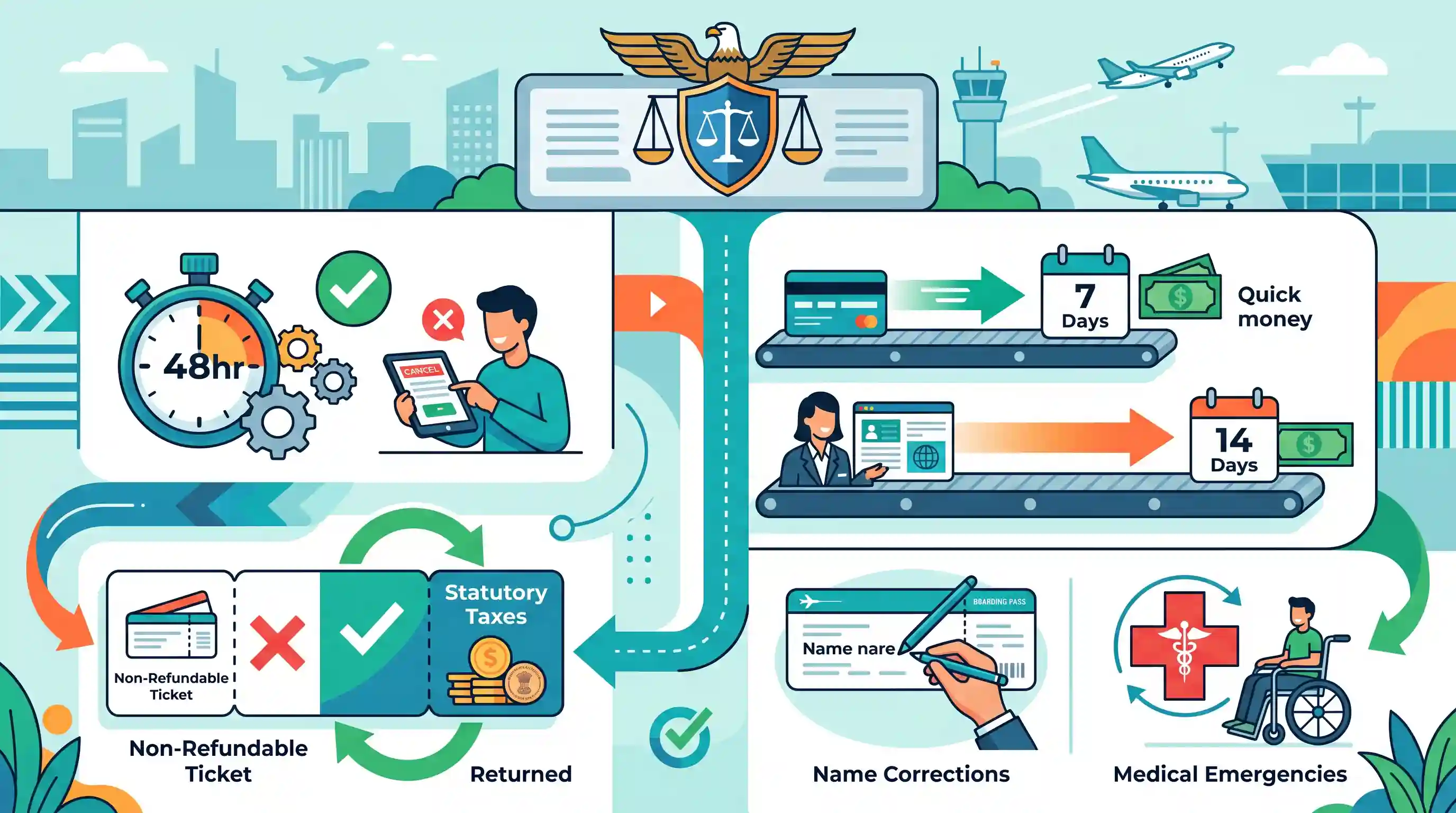
The Directorate General of Civil Aviation (DGCA) has implemented revised air ticket refund rules under its Civil Aviation Requirements (CAR) to strengthen passenger rights. The modifications introduce a 48-hour free cancellation window for direct bookings and mandate stricter refund timelines—14 days for travel agent bookings and seven days for credit card transactions. Additionally, it makes the refund of statutory taxes mandatory even for non-refundable tickets and brings in provisions for name corrections and medical emergencies. The changes underscore the government's push for timely grievance redressal and consumer protection against arbitrary airline and e-commerce travel portal practices.
Key Points
- The DGCA has updated the Civil Aviation Requirements (CAR) regarding air ticket refunds and cancellations, aiming to enhance consumer protection.
- Passengers now get a 48-hour "look-in" period to cancel or amend tickets without extra charges, provided the booking is made directly on the airline's website.
- For tickets booked via travel agents or portals, the onus of refund rests entirely on the airline, with a strict 14-day completion deadline.
- Statutory taxes such as User Development Fee (UDF), Aviation Security Fee (ASF), and Passenger Service Fee (PSF) must be fully refunded, even on non-refundable base fares.
- Airlines may, at their discretion, offer refunds or credit shells for cancellations arising out of medical emergencies (hospitalization of a passenger or immediate family).
Important Terms
Directorate General of Civil Aviation (DGCA)

The principal regulatory body in India for civil aviation, functioning as an attached office under the Ministry of Civil Aviation to oversee safety, licensing, and airworthiness.
UPSC context
GS Paper II: Statutory and Regulatory Bodies. Tests knowledge of sectoral regulators and their role in ensuring public safety and service standards.
Civil Aviation Requirements (CAR)
A set of mandatory regulatory standards issued by the DGCA under the Aircraft Rules to govern airline operations, safety protocols, and passenger rights.
UPSC context
GS Paper II: Government Policies and Interventions. Important for understanding how executive-made rules regulate critical infrastructure and consumer protection.
Statutory Taxes (Aviation)
Mandatory levies included in airfare, such as GST and airport fees, which regulators mandate must be refunded to passengers even if the base fare is non-refundable.
UPSC context
GS Paper III: Indian Economy and Infrastructure. Relates to taxation policy and fiscal transparency in the service sector.
User Development Fee (UDF)
A revenue-collection charge levied by airport operators on passengers to fund the development and maintenance of airport infrastructure.
UPSC context
GS Paper III: Infrastructure. Relevant to the Public-Private Partnership (PPP) model and airport financing in India.
Credit Shell
A digital credit note issued by an airline for a cancelled ticket's value, allowing the passenger to book a future flight instead of receiving a cash refund.
UPSC context
GS Paper II: Governance and Consumer Protection. Tests knowledge of grievance redressal mechanisms and fair business practices.
Passenger Service Fee (PSF)
A fee charged to passengers to cover security costs and provide amenities at airports, collected by airlines and remitted to airport authorities.
UPSC context
GS Paper III: Aviation and Internal Security. Relates to airport security funding and passenger facility management.
Prelims Trap
The 48-hour free cancellation window applies to all air ticket bookings regardless of the booking platform.
The 48-hour free cancellation 'look-in' period is strictly limited to tickets booked directly on the airline's own website, excluding online travel aggregators.
Static Concepts Connected
What is the statutory backing and mandate of the DGCA?
- Statutory status: Originally an executive body, it was granted statutory status under the Aircraft (Amendment) Act, 2020.
- Core Mandate: Primarily oversees aviation safety, issues pilot and aircraft licenses, and frames Civil Aviation Requirements (CAR).
- Jurisdiction: Functions under the Ministry of Civil Aviation and enforces regulations on both airlines and aerodromes.
What are the key statutory airport charges levied on air passengers?
- User Development Fee (UDF): Levied to fund airport development and modernization; tariffs are regulated by AERA for major airports.
- Aviation Security Fee (ASF): Collected to fund security deployments, primarily the CISF, across all major commercial airports in India.
- Refundability Rule: Statutory taxes must be entirely refunded to the consumer, even if the base ticket fare is strictly non-refundable.
Cross-Topic Patterns
Aviation CARs & Consumer Protection
Holding airlines directly accountable for online travel aggregator (OTA) refund delays mirrors the CCPA's broader regulatory push to prevent primary service providers from deflecting liability to intermediaries.
Statutory Levies & PPP Airport Viability
Statutory levies like UDF and PSF are critical for the financial closure of PPP airport projects, linking consumer ticket policies directly to infrastructure financing models.

Expect a Prelims question differentiating the regulatory jurisdictions of DGCA, AERA, and BCAS over passenger amenities and statutory fees.
Linked PYQs · 3
Linked PYQs · 3
- 2025PrelimsGS1
With reference to the Government of India, consider the following information: Organization Some of its functions It works under I. Directorate of Enforcement Enforcement of the Fugitive Economic Offenders Act, 2018 Internal Security Division-I, Ministry of Home Affairs II. Directorate of Revenue Intelligence Enforces the Provisions of the Customs Act, 1962 Department of Revenue, Ministry of Finance III. Directorate General of Systems and Data Management Carrying out big data analytics to assist tax officers for better policy and nabbing tax evaders Department of Revenue, Ministry of Finance In how many of the above rows is the information correctly matched?
- 2023MainsGS2
Discuss the role of the Competition Commission of India in containing the abuse of dominant position by the Multi-National Corporations in India. Refer to the recent decisions.
- 2019MainsGS2
“The Central Administrative Tribunal which was established for redressal of grievances and complaints by or against central government employees, nowadays is exercising its powers as an independent judicial authority.” Explain.
